
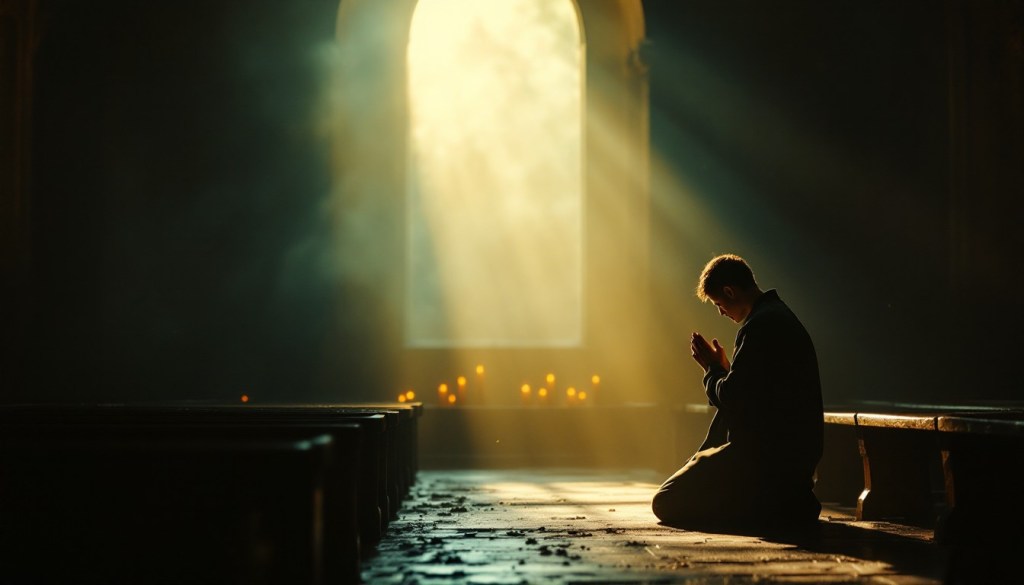
There are moments, especially in a group setting, when prayer begins with a hesitation that is difficult to explain. Someone is asked to pray, or perhaps volunteers to do so, and in that instant, something shifts. What was meant to be a simple turning toward God becomes layered with awareness. Words must be chosen. Tone must be found. There is a sense of being heard, not only by God, but by others, and this awareness subtly changes the act itself.
This uneasiness is not necessarily a sign of insincerity. It reveals that prayer is more complex than it first appears. The act of speaking to God introduces a second dimension, the awareness of oneself as the one who is speaking. Even in solitude, this awareness does not fully disappear. We hear our own words, notice their shape, and sense whether they feel adequate or lacking. The teaching of Jesus Christ in the Gospel of Matthew urges prayer in secret rather than for public display, yet experience suggests that removing the external audience does not fully resolve the tension.
This reveals the deeper nature of the dilemma. Prayer is not only about who is listening, but also about who is speaking, and how that speaker relates to himself in the act of speaking. The inner observer remains present, and it is within this space that the complexity of prayer begins to unfold.
The Emergence of Performance
It does not take much for prayer to become something we observe ourselves doing. A slight adjustment in phrasing, a pause before choosing a word, or an awareness of how the prayer might sound can gradually shape the experience. These are small movements, almost imperceptible, yet they introduce a layer of self-consciousness that shifts the nature of prayer from direct relationship to something more reflective.
In communal settings, this becomes more pronounced. In traditions where spontaneous prayer is common, such as many Protestant gatherings, individuals are invited to speak aloud. This openness affirms that prayer belongs to everyone and allows for immediacy and personal expression. At the same time, it introduces responsibility for the form of the prayer. Without a shared structure, individuals must navigate their own language, and this can invite comparison, even if no one explicitly intends it.
What begins as sincerity can gradually take on the shape of performance. This is not a deliberate act, but a natural human response to being aware of oneself in the presence of others. Prayer, which was meant to be relational, risks becoming presentational, and the line between the two can be difficult to discern.
The Question of Authorship
From here, a deeper question emerges. If prayer is something we speak, in what sense do we author it? The language we use suggests ownership. We speak of “my prayer” or “his prayer,” as though each act of prayer were a kind of composition. This introduces a subtle but significant shift, where prayer becomes something we produce and something that can be evaluated or compared.
The Christian tradition offers a different perspective. Many enduring prayers are attributed to figures such as St. Augustine or St. Francis of Assisi, yet these prayers are not preserved as expressions of individual creativity. They are received, repeated, and inhabited by generations of believers. In this process, authorship is not erased but transformed. The prayer no longer belongs to the original speaker in a possessive sense. It becomes part of a shared language that anyone can enter fully.
This suggests that the tension lies not in authorship itself, but in how we hold it. When authorship becomes something we cling to, it introduces distance between ourselves and the act of prayer. When it is released, it allows us to participate in something larger than our individual expression.
Structure as Surrender, Not Constraint
Seen in this light, structured prayer takes on a different meaning. Repetition and templated forms may appear restrictive at first, but they can function as a way of stepping out of self-authorship. To pray words that are not originally our own is to enter a stream that was already flowing before we arrived. This reduces the pressure to create and allows us to focus on presence rather than production.
There is, of course, a risk that repetition becomes mechanical. Words can lose their meaning if they are no longer inhabited. Yet this does not negate the value of structure itself. Instead, it highlights the importance of how we engage with it. Structure provides a space in which the impulse to perform can soften, making room for a more grounded form of sincerity to emerge.
In this sense, structure does not oppose personal prayer. It prepares for it. By stepping out of the role of author, even temporarily, we create the conditions in which personal expression can arise without the burden of needing to be impressive or complete.
Gethsemane and the Exposure of the Self
The prayer of Jesus in Gethsemane, as recorded in the Gospel of Matthew, offers a powerful contrast. Here, there is no concern for eloquence or form. The words are simple and repeated, yet they carry a profound weight. “Let this cup pass from me… yet not as I will, but as you will.” This is not a carefully composed prayer, but one that reveals the full tension between human desire and divine surrender.
What stands out is not originality, but honesty. The prayer does not resolve the conflict it contains. Instead, it holds both aspects together, allowing them to be fully present. In this moment, prayer is not about crafting the right expression, but about allowing oneself to be seen without defense.
Even here, words remain central. Yet their function has shifted. They are no longer a means of presenting oneself, but a way of offering oneself. The focus is not on how the prayer sounds, but on what it reveals.
The Cross and the Paradox of Borrowed Words
At the culmination of the narrative, another moment of prayer emerges that deepens this paradox. On the cross, Jesus Christ cries out, “Eloi, Eloi, lama sabachthani?” (My God, my God, why have you forsaken me?) as recorded in the Gospel of Mark. The words express a sense of abandonment and suffering that is deeply personal.
At the same time, these words are drawn from Psalm 22. This means that the most intimate expression of suffering is articulated through language that has already been given. The paradox here is striking. The prayer is entirely personal, yet it is not newly created. It is both received and embodied.
This reveals that authenticity in prayer does not depend on originality. Instead, it depends on alignment. When the words we speak fully correspond to the reality we are experiencing, they become true, regardless of whether they are newly formed or inherited. In this moment, the distinction between personal and traditional disappears, and what remains is a unity between experience and expression.
When Words Begin to Fall Away
If words can carry prayer to this depth, there remains the question of what happens when they begin to feel insufficient. There are moments when speaking no longer feels necessary, not because there is nothing to say, but because saying itself cannot fully contain what is being encountered. This is where contemplative or silent prayer becomes meaningful.
Practices such as Lectio Divina begin with attentive reading, allowing each word of Scripture to unfold gradually. The process moves from reading to reflection, and eventually to a form of resting. At this point, words recede, and what remains is a sustained attentiveness. Prayer becomes less about expression and more about presence, less about forming language and more about receiving.
In this state, the question of authorship fades naturally. There is nothing to construct or refine. The self is no longer centered as the one who produces meaning. Instead, there is a sense of being addressed, even if no new words are heard. Silence becomes a space in which the relationship continues without the need for articulation.
Beyond Authorship: Prayer as Relationship
Bringing these reflections together, prayer can be understood not as a problem to be solved, but as a movement to be lived. It moves between words and silence, between expression and surrender, between authorship and participation. Each dimension has its place, and none fully replaces the others.
There are times when words are necessary, giving shape to thought and emotion. There are times when words become complicated, entangled with self-awareness and comparison. And there are moments when words fall away, leaving only presence. Through all of this, the central question shifts. It is no longer about whether the prayer is well-formed or authentic in appearance, but about the direction of the heart.
Instead of asking whether a prayer belongs to us, it may be more meaningful to ask whether we are holding onto it or offering it. This shift, though subtle, changes the nature of prayer. It becomes less about ownership and more about participation, less about expression and more about relationship.
Prayer is not something we perfect. It is something we enter, again and again, with all the complexity that comes with being human. Words may begin the movement, and silence may deepen it, but neither stands alone. What remains is the ongoing act of turning toward God, until even our words no longer feel like something we possess, but something that gently comes to rest.
Image: StockCake
 Tom’s Blog