

The image of a young activist standing before cameras has become familiar. Their voice is steady, their eyes unflinching, and their words are directed not only at politicians but at entire generations. In their confidence there is both courage and a sharp edge, as if moral clarity has left no room for hesitation. Some find this inspiring. Others find it unbearable.
The same mixture appears in public responses to tragedy. When a controversial figure dies, waves of grief mingle with waves of mockery. People post condolences and prayers, while others joke or celebrate. These moments feel brutal. They reveal how quickly compassion can harden into cruelty, even among those who claim to value empathy.
Such scenes expose the deeper reality of our time. People are not divided along a single line of left or right. They are situated within a matrix of generations, cultures, economies, and faiths. They are also layered beings, carrying ancient tribal impulses alongside modern rational ideals. To make sense of the cruelty and the hope, we need to see both the topology of difference and the depth of development.
Why Single Axes Fail Us
It is tempting to think in one dimension. Left against right. Liberal against conservative. Democrat against Republican. These labels simplify a complex field, but they mislead. People rarely fit so neatly.
Economics is one important axis. On one side lies redistribution and shared welfare. On the other side lies faith in markets and private initiative. Yet this spectrum cannot explain why a person might support social welfare while holding strict views on family or religion.
Culture is another axis. On one side are libertarian values, individual freedom, and globalist attitudes. On the other side are authoritarian values, traditional morality, and national pride. This line explains conflicts over immigration, gender, and identity more clearly than economic debates.
Generation is a third axis. Younger people often prize moral clarity and fearless expression. Older people often prefer moderation and pragmatism. This is not absolute, but the pattern repeats through history. Youths shout for change, elders urge caution.
Religion adds further depth. In some societies it falls under the cultural axis. In others it is its own dimension, deciding elections and shaping wars. Religious versus secular divides cannot be captured by economics alone.
When we imagine these axes together, the map looks less like a line and more like a cube. Young progressives occupy one corner, nationalist youths another, older centrists somewhere in the middle. This map does not solve conflict, but it helps us see why aggression appears on both sides. What looks like polar opposites on the surface are simply different coordinates in the same shared space.
The Ladder Inside and the Ladder Between
If the matrix shows where people stand, Spiral Dynamics shows how values grow. It describes stages, or memes, that guide how humans and societies make meaning.
The first tier begins with Beige, the survival instinct, followed by Purple, the tribal bond, then Red, the energy of power. Blue brings order and discipline, Orange brings rational achievement, and Green brings pluralist empathy. Each meme arises to address the limits of the one before it. Each claims its truth as ultimate.
The second tier begins with Yellow and then Turquoise. These stages differ not by a new content of belief but by a new attitude. They see earlier memes not as enemies to defeat but as necessary layers in the whole. Yellow seeks integration. Turquoise seeks wholeness.
Crucially, development does not erase earlier memes. Red remains inside Blue. Orange still carries Purple. Green still has Red impulses. We do not discard our past. We stack it. This is why the most progressive person can act with primitive cruelty under stress, and why the most traditional person can surprise with creativity or empathy.
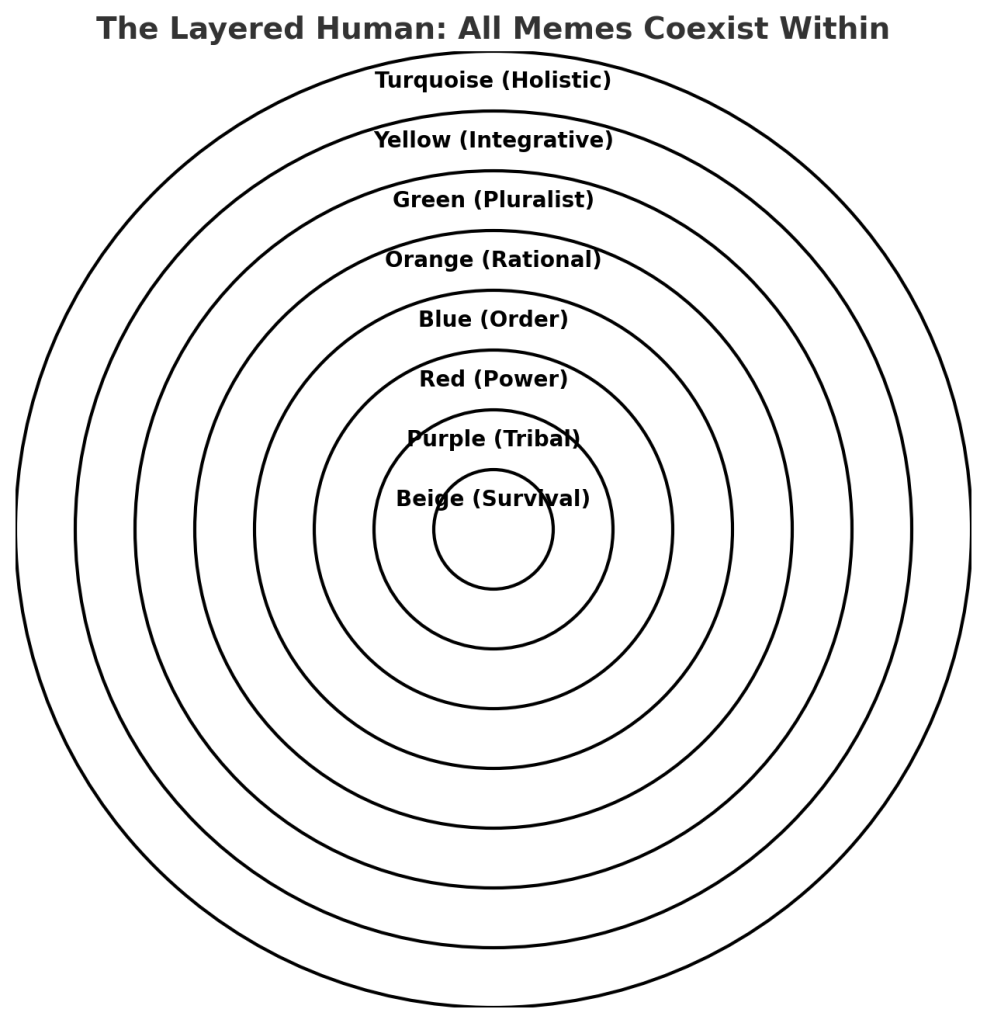
How Every Self Contains Many Worlds
The human self is not one thing. It is layered like concentric rings. At the core lie survival and tribal loyalty. Around them are rings of power, order, reason, empathy, and beyond them the wider rings of integration.
In daily life, different rings are activated by different contexts. A neighbor who is generous at home may become ruthless in business. A scholar who prizes empathy may lash out on social media. A soldier who writes tender letters to his children may commit violence in battle. The rings coexist. Which one shines depends on circumstance.
This explains why societies that appear mature can still commit atrocities. Beneath modern institutions lie older layers that resurface under fear or scarcity. The twentieth century, with its genocides and wars, showed that even nations at the height of rational progress can regress to tribal cruelty.
To acknowledge these layers is not to excuse them. It is to understand that humanity is always more than one meme. We carry within us the potential for generosity and brutality alike. Without awareness, the lower layers erupt unchecked. With awareness, they can be honored and transformed.
Energy Without Restraint, Courage Without Temper
Youth movements reveal this most clearly. Young people often speak with a certainty that both inspires and unsettles. Their voices carry moral urgency and little patience for compromise.
History shows the pattern. Early Christian martyrs were often young, fearless against imperial power. French revolutionaries demanded liberty with uncompromising zeal. Students in the 1960s defied authority and reshaped culture. In each case, youthful conviction brought renewal and danger.
The same pattern can turn dark. The Red Guards in China or the child soldiers of brutal movements remind us how youth can be manipulated into cruelty. When energy is severed from wisdom, courage becomes recklessness.
Today, social media magnifies these tendencies. Platforms reward sharpness and anger. A young person’s zeal becomes a spectacle, celebrated by allies and mocked by opponents. This cycle amplifies both courage and cruelty. The pattern is ancient, but the tools are new.
Green’s Shadow, Orange’s Blind Spot, Blue’s Tyranny
Every meme has a shadow. Its virtue, when absolutized, becomes a vice.
Blue gives order, but in rigidity it becomes tyranny. Laws protect, but they can also suffocate. Authority stabilizes, but it can also silence.
Orange gives progress, but in arrogance it becomes exploitation. Science liberates, but it can dehumanize. Achievement creates wealth, but it can neglect compassion.
Green gives empathy, but in moral certainty it becomes punitive. The desire to include can exclude dissenters. Compassion can curdle into cruelty toward those deemed heartless. This is why even those who proclaim love and justice may celebrate a death online. The Green ideal collapses into Red anger when threatened.
The symmetry matters. Cruelty is not the property of one side. Each meme, when hardened, turns against its own intention. Recognizing this symmetry is the first step to breaking the cycle.
What Grace Looks Like in Civic Life
Grace interrupts the spiral of absolutism. It is not abstract. It is a posture, a way of seeing identity and suffering differently.
Grace loosens the grip of identity. Without grace, each meme defines the self absolutely. With grace, identity becomes clothing, not a cage. A tribal bond no longer requires exclusion. Power no longer requires cruelty. Order no longer requires rigidity. Empathy no longer requires condemnation.
Grace reframes suffering. Without grace, suffering isolates. With grace, suffering becomes shared. Exclusion becomes a lesson in compassion. Humiliation becomes understanding of anger. Failure becomes humility. Injustice becomes awareness of human limits.
In public life, grace looks like humility in debate, patience in dialogue, and institutions that reward listening as much as speaking. It does not mean weakness. It means refusing to annihilate the other. Grace turns identity from prison to garment, suffering from punishment to teacher.
Institutions and Habits That Carry Integration
Grace is not only a private attitude. It can be built into public structures. Institutions can either inflame conflict or channel it toward integration.
Deliberative assemblies that bring citizens from different axes together can temper certainty. When people hear not caricatures but real voices, the sharpness softens.
Education that teaches history as layered development rather than binary battle can prepare young people to recognize both the strengths and limits of each meme. Lessons in cognitive empathy and epistemic humility can make future debates less destructive.
Media and platforms can be designed to slow speech, to add context, and to reward accountability. These are difficult choices, but design matters. The speed and sharpness of current platforms amplify cruelty. Slower and more reflective spaces could amplify grace.
Local rituals, shared meals, apprenticeships across generations — these small practices matter. They teach people to see others not only as ideological opponents but as layered beings with shared vulnerabilities.
Not Compromise as Cowardice but Integrative Courage
Some fear that speaking of coexistence is weakness. They hear the call for grace as an invitation to relativism. This is not the case. Grace is not softness when faced with genuine harm. It is a refusal to dehumanize while resisting.
A society still needs boundaries. Violence must be restrained. Exploitation must be checked. Injustice must be named. Grace does not cancel moral clarity. It reframes it. To resist is not to annihilate the humanity of the one resisted.
Integration is not compromise at any cost. It is courage of a deeper kind. It says, we will act against harm, but we will not become what we oppose. We will protect order without tyranny, create progress without arrogance, extend empathy without cruelty. That balance is rare, but it is possible.
The Work Ahead Is Spiritual and Civic
Return to the opening image of a child scolding the world. Without the map of memes, we hear only accusation. With the map, we see the ring of Green speaking fiercely, while the ring of Red pulses beneath it. Without grace, we respond with defensiveness or cruelty. With grace, we hear both the pain and the courage.
The work ahead is both spiritual and civic. Spiritual, because it requires an interior shift in how we hold identity and suffering. Civic, because it requires institutions that channel zeal into creative renewal instead of destructive conflict.
Every person can begin this work. Listen across axes. Name the layers in yourself. Reframe suffering as participation rather than punishment. Practice the art of grace in small conversations. From such seeds, broader integration can grow.
Coexistence is not easy. It asks more than agreement. It asks that we remember the layered nature of every self and every society. Only then can differences stop being prisons of antagonism and become coordinates in a shared human whole.
Image by mijung Park
 Tom’s Blog