
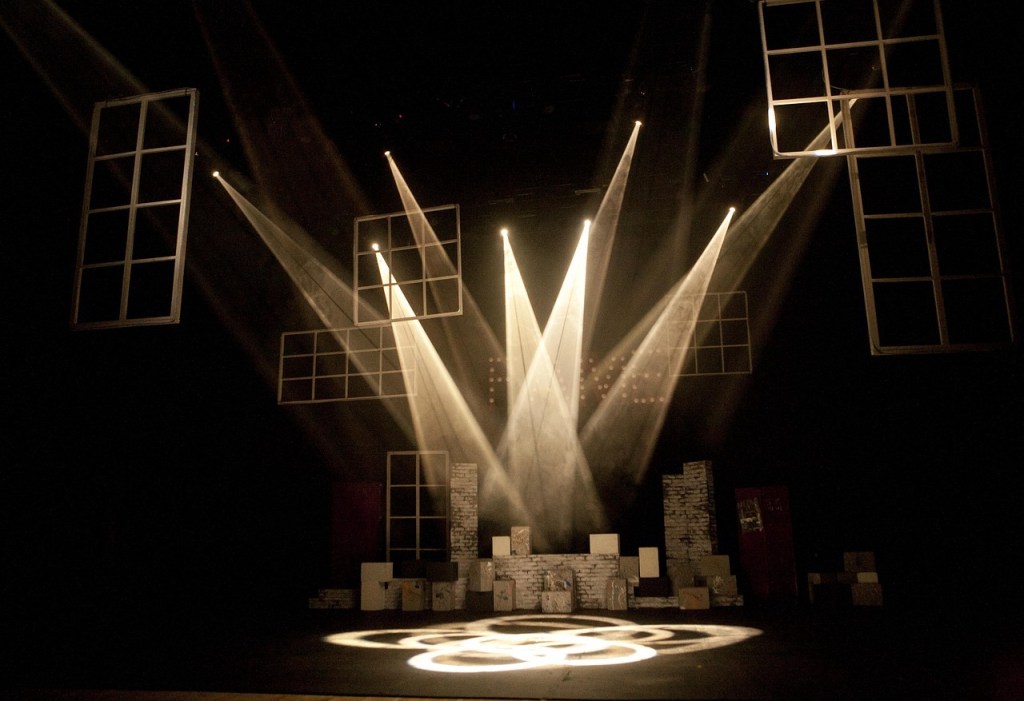
When I picture the universe, I sometimes imagine that I am facing it. I feel as if I am standing apart, looking toward a vast backdrop that stretches into infinity. It is as though I have stepped outside the world and can take it in as a whole.
But there is no such position. I cannot stand outside the universe. There is no platform, no balcony, no neutral ground from which to view it. I am always inside. Every thought, every perception, every point of reference is already within the whole.
This same illusion appears when I look at other people. I imagine that they, too, are standing somewhere else in relation to the universe, on their own separate ground, facing their own backdrop. In my mind, there are three spaces: the stage I stand on, the stage where others stand, and the vast scene behind us. And perhaps, far above, I imagine God watching from a hidden place beyond the ceiling.
It feels natural to see life this way, but it distorts the truth.
The Illusion of Separate Stages
This mental theater is familiar. It has a clear structure. I have my lines, my movements, my part of the spotlight. Others have theirs. Behind us lies the scenery, stars, oceans, cities, and above it all, a presence that may or may not intervene.
The structure is convenient. It helps me organize my experience. It makes interactions seem clear. It even helps me imagine morality, justice, and purpose, because in the theater there are actors and an audience, rules and stories.
But the theater is a model, not reality. In truth, there is no gap between my stage and yours, between the boards we walk on and the painted backdrop. Everything we see, including ourselves, belongs to the same reality. To divide it into stages is to impose lines that do not exist.
The Deeper Reality: One Seer, One Seen
There is another way to see.
In this view, there is no separation between the observer and the observed. When I look at myself, the universe is looking at itself. When I look at you, the same is true. When I turn my thoughts toward God, it is still the same reality meeting itself through a different form.
Life does not simply happen to me. Life is living itself through me. My thoughts, feelings, and actions are not detached from the whole, but are expressions of it. Even my sense of being a separate “I” is part of the flow of the universe experiencing itself.
From here, the boundaries of life and death begin to lose their finality. What I call my birth and my death are just points within a movement that extends beyond the narrow limits of my individual story.
Why We Still Need the Theater
And yet, I cannot live every moment in this boundless awareness.
Human life seems to require the structure of the theater. My mind works in terms of roles, relationships, and narratives. I need to know where I stand and who is in front of me. I need the sense that there is a stage where my part matters.
This is not just a flaw. It is a functional necessity. Without the framework of the play, I could not make decisions or form commitments. The separation of stages may be an illusion, but it is an illusion that gives shape to daily life.
We cannot simply walk off the set. The drama is still unfolding, and we are part of it.
Detached Awareness: Seeing the Play as a Play
But even as I act, I can remember that the play is not the whole.
Some part of my consciousness can stand at the edge of the stage, aware that the lights, the scenery, and the applause are all part of the production. The story will end, the set will be taken down, and what remains will be what was always there.
This awareness does not make the play meaningless. In fact, it changes how I perform. I can act with full commitment without being trapped by my role. I can respond to others with more patience, knowing that their role is not their entire being. I can feel the weight of choices without being crushed by them.
The play is still real in its moment, but its reality is not final.
Consolation and Seriousness
There is comfort in knowing that beyond the play, we are one. The conflicts that seem absolute on stage dissolve when the curtain falls. The separations that define our roles vanish in the light that fills the empty theater.
But this is not just a comfort for hard times. It is also a serious responsibility. If I am not truly separate from others, then how I treat them is, in a deep sense, how I treat myself. If God sees Himself through every person, every creature, and every star, then every encounter is sacred.
To know this is to walk more gently. It is to recognize that the drama is not just entertainment, but a way the whole expresses itself.
Living With Two Truths
The challenge is to live with both truths at once.
One truth is that life on stage matters. Our words, choices, and relationships shape the unfolding of the play. The other truth is that the stage is not the final reality. Behind the performance is a unity that holds everything together.
To hold both truths is to live fully without clinging. It is to take the script seriously without believing it is the only story. It is to act with care, knowing that the curtain will fall, and that what remains is what was always there; one life, one reality, one God, seeing Himself.
Image: Pixabay
 Tom’s Blog