
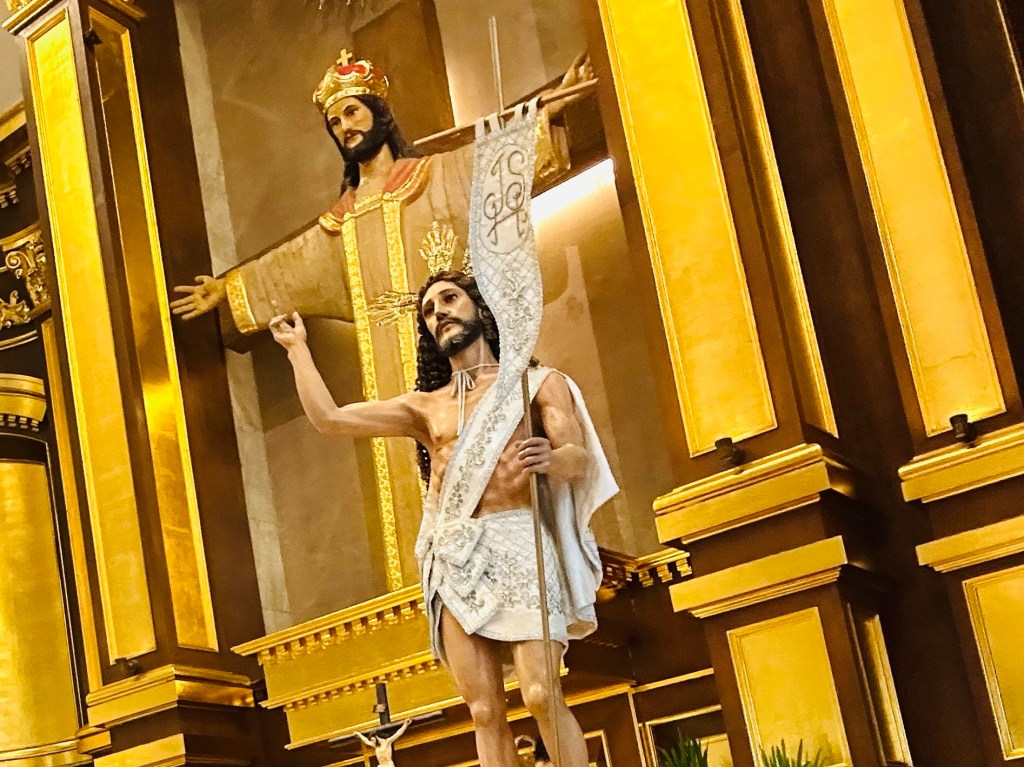
It was a radiant Easter morning. My wife and I arrived early at Christ the King Parish, the sanctuary already filled with people preparing for the celebration of the Resurrection. The golden altar gleamed, and the figure of the risen Christ stood tall above us, triumphant and serene.
We took a photo to mark the occasion, but something deeper lingered beneath the surface, a question that had long been present in my heart. What exactly does it mean to say, “He is risen”?
At one level, the Resurrection is the triumph of life over death, the assurance that the crucifixion was not the end. But sitting through the Mass, hearing again the Gospel account of the empty tomb, I found myself listening in a different way. My thoughts turned not just to the miracle of the Resurrection, but to what it says about us, our lives, our deaths, and what lies beyond the ego.
The False Self and the Fear of Death
For most of us, the fear of death is not just about physical decay or suffering. It’s the fear of disappearance, the loss of control, the vanishing of the person we think we are. That is the ego, the constructed identity built from memory, ambition, attachment, and pride. It’s what we defend when we feel offended, and what we mourn when we feel forgotten. This “self” is often mistaken for our soul, but it is more fragile and reactive than we admit.
In many spiritual traditions, this constructed self is seen as the main obstacle to liberation. In Christian language, it is the self that must be crucified. “Whoever wants to be my disciple must deny themselves and take up their cross daily and follow me,” Jesus said. And in Paul’s words, “I die daily.” These are not just poetic expressions of suffering; they speak of a real inner death, letting go of the self that clings, compares, and competes.
The Resurrection, then, is not merely a historical event. It is an invitation to abandon the illusion that this ego-self is all there is. If death terrifies us, it is because we fear the death of what we think we are. But if Christ lives in us, as Paul proclaims, then death loses its final word. Not because we escape it, but because something deeper has already passed through it and come out the other side.
Christ Lives in Me
Paul’s declaration in Galatians is one of the most radical in all of scripture: “I have been crucified with Christ. It is no longer I who live, but Christ lives in me.” This is not mere metaphor. Paul is describing a transformed state of being, one in which the old self has truly died and what remains is a life carried by Christ Himself.
This idea has puzzled many. Is Paul suggesting a loss of individuality? Is the Christian life meant to erase our personality? Not quite. It’s not a destruction of the self, but a reconstitution. It’s the difference between living for oneself and living from a deeper source. When Paul speaks of being “in Christ,” he speaks of an identity no longer grounded in personal merit, past failures, or future anxieties. Instead, it is rooted in grace, something received, not achieved.
This shift in identity is at the heart of Easter. Resurrection is not just something we wait for after death. It is something we begin to participate in here and now, when we allow the old self to die and make space for the life of Christ to dwell in us. This is what it means to be a new creation. It is not perfection, but participation.
Why Jesus Said “Do Not Cling to Me”
One of the most mysterious lines in the Easter narrative comes from the Gospel of John. When Mary Magdalene, overcome with emotion, finds Jesus outside the empty tomb, she reaches out to Him. But Jesus tells her, “Do not hold on to me, for I have not yet ascended to the Father.”
Why would He say this? Isn’t it natural for Mary to want to touch Him, to embrace Him after such sorrow?
Theologians have offered many explanations, but what struck me this year was the symbolic meaning behind this exchange. Mary represents the longing heart, the soul attached to its own image of God. She reaches out to the Jesus she knew, the Jesus who walked with her, taught her, healed her. But now, He is not simply the Jesus of the past. He is the Risen One, the Christ who is moving beyond time, beyond form.
To cling to the familiar, even to a holy familiarity, can be a way of holding on to the ego’s need for certainty. But Resurrection requires detachment from what we thought we knew, even from the forms of love that comforted us. Jesus is saying: Let go of what was. Something greater is unfolding. The true relationship with Me will no longer be through touch, but through union, through Spirit.
It is only after the Ascension, after letting-go is complete, that the Spirit is poured out. The fullness of Resurrection can only be received when we stop trying to possess it.
Ascension and the Spiritual Journey
The Ascension is often treated as a footnote in Christian celebrations, an epilogue to the Resurrection. But it is crucial. It marks the final transition from the visible to the invisible, from presence to indwelling. Christ no longer walks beside us; He lives within us.
This movement mirrors the spiritual life itself. In the beginning, faith often feels external; God is a helper, a savior, a teacher. But as we grow, we are invited to discover God not just in church or in scripture, but within our own being. The Ascension is the promise that God is not only above or around us but can be found in the quiet center of our hearts. That center, however, is often buried beneath layers of identity, fear, and noise.
To ascend with Christ is to let go of the need to grasp Him outwardly and instead receive Him inwardly. The spiritual path is not a climb toward heaven as a distant goal, but a return to the place where Christ already abides. It is to stop searching and start receiving. Resurrection leads to Ascension not as departure but as transformation.
Resurrection as Inner Revolution
There’s a temptation to see Easter as a kind of joyful ending, the dramatic resolution after the pain of Good Friday. But in truth, Easter is the beginning of something far more mysterious. It is not just a return to life, but a transformation of what life even means.
The early Church did not preach Resurrection as a doctrine to be debated, but as a reality to be lived. Baptism was understood as a symbolic death and rebirth, a passing through the tomb with Christ. The Christian life was about becoming Resurrection people: those who live without fear, who love without clinging, who serve without pride.
This kind of life is not simply moral. It’s metaphysical. It is a reordering of one’s entire center of gravity. No longer driven by the anxieties of the ego, the Christian becomes free to live from a deeper trust. To forgive when it makes no sense. To hope when all seems lost. To rejoice even in suffering, because life is no longer measured by success or control, but by union with the Risen One.
This is not an easy life. It is a life that demands surrender. But it is also a life full of peace.
Dying Before We Die
One of the most repeated phrases among mystics and saints is this: Die before you die. What they mean is that the ego must die if we are ever to know true life. This death is not physical, but spiritual. It is the death of the false self, the one that tries to save itself through accomplishment, avoidance, or control.
Jesus’ life, death, and resurrection offer a pattern that every soul is called to follow. First comes the recognition of the false self, then the surrender of it, then the rising of a new self formed not in pride but in grace. This is why Jesus calls us to lose our life in order to find it. Not in some future heaven, but now.
To “die before we die” is not to reject life, but to live it more deeply. It is to be free from the fear that drives so much of human behavior. It is to become a witness, not just to the resurrection of Christ, but to the resurrection happening within.
Seeing With New Eyes
When the disciples encountered the Risen Christ, they often failed to recognize Him. Mary mistook Him for a gardener. The two on the road to Emmaus did not see Him until the breaking of bread. This is not just a narrative detail. It reveals something profound.
The Risen Christ does not appear as a memory. He appears as something new, and we must learn to see again. Resurrection changes not only the one who rises but those who witness it. Our perception must shift from the surface of things to their hidden center. We are called to live with new eyes, eyes that see grace where there was only failure, light where there was darkness, God where there was absence.
This is the Easter vision. Not a triumph in the worldly sense, but a quiet revolution in the heart.
Living the Resurrection
Easter is more than a holiday. It is a revelation. It tells us that death is not the end, but only for those who no longer live for themselves. For those still ruled by ego, death remains a terrifying horizon. But for those in whom Christ lives, death has already lost its sting. Because what is true has already begun.

To celebrate the Resurrection is to live as though it is true, not just once a year, but every day. It is to meet life with the openness of Mary Magdalene, but also the detachment Christ asks of her. It is to allow ourselves to be seen, broken, forgiven, and renewed, not by clinging to the past, but by walking forward into the light of something entirely new.
This is the rhythm of Easter. He is risen. And so may we be, again and again.
Image: A photo captured by the author.
 Tom’s Blog