
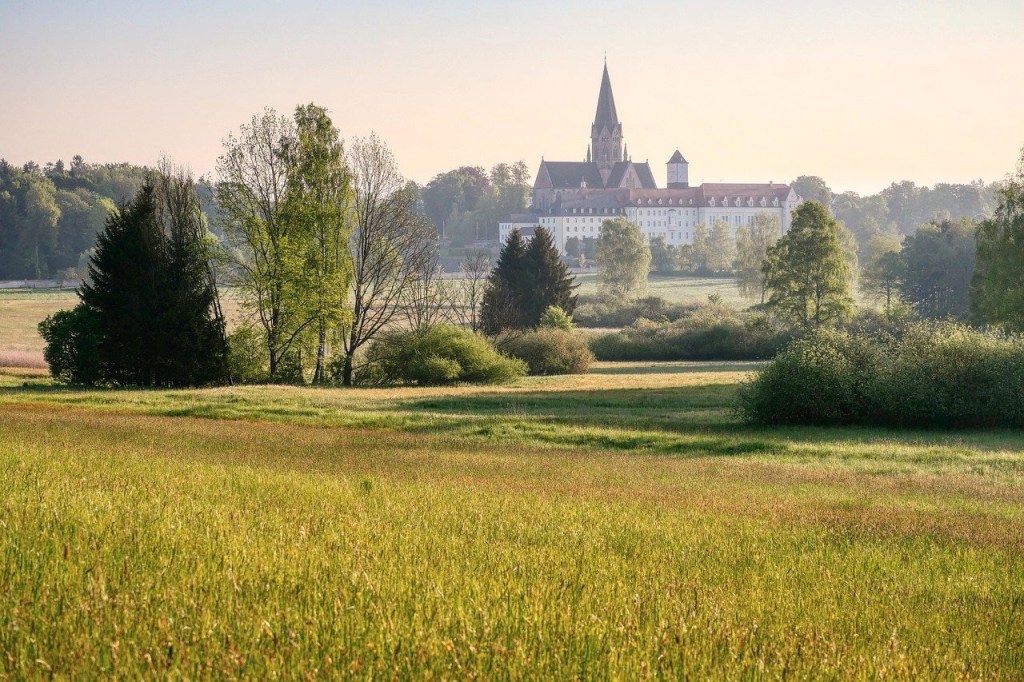
The motto of the Benedictine Order is well known: “pray and work.” In Latin, ora et labora. Monks in this religious tradition devote their lives to these activities, with a variety of tasks falling under these two categories.
In prayer, they follow rigorous rituals scheduled throughout the days, weeks, months, and years. Each day, inspired by the following Psalm verse, they traditionally pray eight times:
Seven times a day do I praise thee because of thy righteous judgments. – Psalm 119:164
These prayer sessions are even conducted at midnight, as another verse from Psalms says:
At midnight I will rise to give thanks unto thee because of thy righteous judgments. – Psalm 119:62
In one sense, they are “busy” with their prayer activities. Yet this “busyness” is far different from the hectic rush of our everyday lives. Ironically, time in their prayer sessions moves slowly, silently, and mindfully.
Work: Engaging with the World
But this doesn’t mean they are removed from worldly activities. If someone wishes to “escape” from worldly affairs and seeks a “peaceful life” in a monastery, they would be disappointed. As the other part of the motto reminds us, work is also essential. Monks actively engage in various activities in the world, though these pursuits are neither materialistically profit-driven nor naively impractical.
In societies where Catholic traditions are common, we often see monks as teachers, community workers, professors, or writers. Figures like Thomas Merton readily come to mind. Simultaneously, many monks work in factories, kitchens, or shops, crafting items such as baking cookies, bread, and even brewing beer. Some may even be found on construction sites operating heavy equipments.
In these roles, there is no “discrimination” between types of work. They do not heavily identify themselves by the kind of work they do or excel in. Their talents, they believe, are from God, and their bodies, considered temples of the Holy Spirit, reflect that. All contributions are seen as equally reflecting God’s grace.
What? Know ye not that your body is the temple of the Holy Ghost which is in you, which ye have of God, and ye are not your own? – 1 Corinthians 6:19
This perspective is crucial. Often, we misunderstand the “highest” layer of Maslow’s model, self-actualization. This does not mean pursuing “success” selfishly to satisfy ego-driven goals. Instead, maximizing one’s God-given talents should signify true actualization. In later years, Maslow himself revised his model to place self-transcendence above self-actualization.
The Myth of the Perfect Place
Thus, a monastery is not for those who cannot live in this world anymore; it is not a place to hide or escape. Those seeking peace through external conditions will inevitably face disappointment. No place in this world offers perpetual peace or happiness as long as we live as ego-bound beings.
This is a common fallacy we fall into: believing that external conditions or places will “save” us from the challenges we face. Wherever we go, whatever we do, and however we do it, unless we free ourselves from our ego, we will continue to encounter disappointment. If you have trouble with people in your workplace, the same will happen in the church you thought was ideal, or even in the monastery you dreamed of as a haven of peace.
Indeed, the kingdom of heaven is not found externally but within you. Once you discover the kingdom of heaven within, peace can be found “here and now,” regardless of place or circumstance.
And when he was demanded of the Pharisees, when the kingdom of God should come, he answered them and said, The kingdom of God cometh not with observation: Neither shall they say, Lo here! or, lo there! for, behold, the kingdom of God is within you. – Luke 17:20-21
Who is My Neighbor?
Jesus Christ commands us to love our neighbors as ourselves. Yet we may wonder: Who are our neighbors?
And thou shalt love the Lord thy God with all thy heart, and with all thy soul, and with all thy mind, and with all thy strength: this is the first commandment. And the second is like, namely this, Thou shalt love thy neighbour as thyself. There is none other commandment greater than these. – Mark 12:30-31
This question reflects another critical fallacy. There is no need to ask who our neighbors are. By “neighbor,” Christ means anyone we encounter—potentially a manifestation of God’s grace. From an ego-driven perspective, some may appear as enemies. Yet Jesus never described specific qualifications for “neighbors.” Instead, He shared the parable of the Good Samaritan and boldly commanded us to love our enemies.
But I say unto you, Love your enemies, bless them that curse you, do good to them that hate you, and pray for them which despitefully use you, and persecute you; – Matthew 5:44
The Impossibility of Love Without God
Of course, we cannot do this on our own. It is impossible to love our enemies if we view them solely through the lens of our ego. Similarly, we cannot find the perfect, peaceful place in this world if we rely on external conditions.
This is why the first commandment—to love God with all your heart and mind—must come before the second.
And thou shalt love the Lord thy God with all thy heart, and with all thy soul, and with all thy mind, and with all thy strength: this is the first commandment. And the second is like, namely this, Thou shalt love thy neighbour as thyself. There is none other commandment greater than these. – Mark 12:30-31
Only by loving God wholeheartedly and accepting our inability to do so perfectly can we truly understand who our neighbor is. Our neighbor is anyone, including God Himself, our perceived enemies, and even ourselves.
Finding the Monastery Within
In this understanding, we can find the true monastery within us, where we practice ora et labora. Whether in a traditional monastery or in the world, the point is to cultivate this inner sanctuary. The kingdom of heaven is within, and in our internal monastery, we can devote ourselves to prayer and work wholeheartedly.
Then, we may come to understand Meister Eckhart’s words:
Whoever possesses God in their being, has him in a divine manner, and he shines out to them in all things; for them all things taste of God and in all things it is God’s image that they see. God is always radiant in them; they are inwardly detached from the world and are in-formed by the loving presence of their God.
Image by Albrecht Fietz
 Tom’s Blog