

We often view time, growth, and the universe’s movements through straightforward, linear perspectives: days following each other, years passing in succession, and orbits cycling around a static center. Yet, this vision overlooks a deeper, more intricate reality: a spiral structure that permeates everything from the cosmos to the patterns of human development.
This spiraling movement isn’t just an abstract idea; it is woven into the fabric of the universe itself, emerging in cosmic motion, biological patterns, and theories of human growth. By exploring the helical path of celestial bodies, the spiral shape of DNA, and the dynamic growth suggested by developmental models like Spiral Dynamics, we uncover a unifying principle.
The spiral, in its many manifestations, offers a profound insight into our own lives, inviting us to see our experiences as part of an interconnected, ever-evolving continuum.
The Dynamic Spiral of Cosmic Motion
At first glance, the Solar System appears to be organized like a clock, with planets revolving around a stationary Sun. This conception, though practical for everyday understanding, conceals a far more dynamic truth: the Sun itself is in constant motion, hurtling through space at incredible speeds as it orbits the center of the Milky Way galaxy. As the Sun moves, it drags the planets along with it, creating a spiral path rather than a closed loop. Imagine each planet not merely revolving around the Sun but chasing it through space, forming a helical shape as the entire Solar System moves forward.
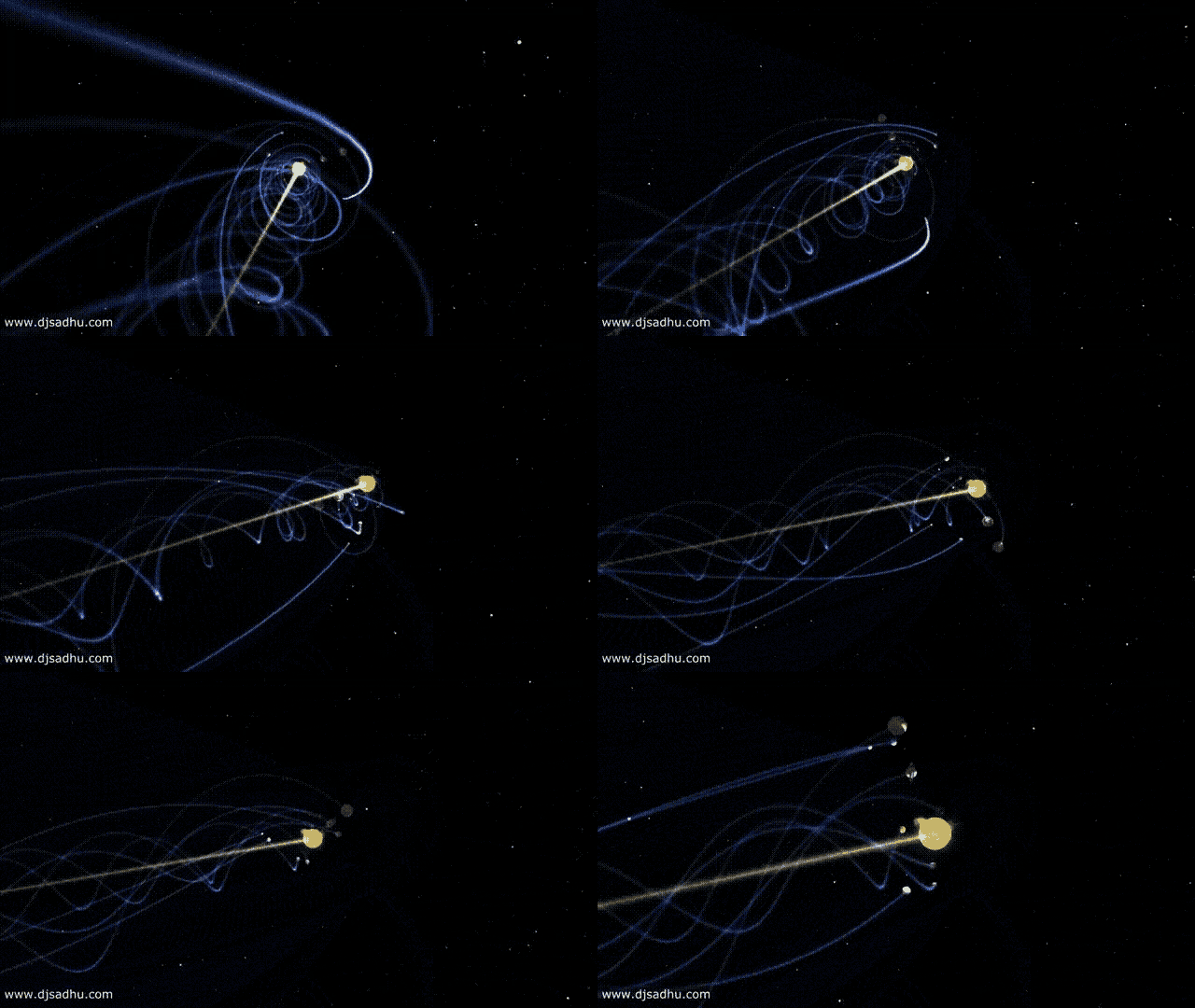
This spiral movement shatters the illusion of a static universe and redefines our understanding of planetary motion. Each year, each orbit, is unique, taking place in a new location in space, with the entire Solar System moving through the galaxy at a rate of around 828,000 kilometers per hour. This trajectory isn’t circular or cyclical but a forward-spiraling path through the cosmos. Consequently, each “new year” or “return” of the planets isn’t a return at all but a step forward in an ongoing, intricate journey.
Expanding this view to the galaxy itself, we find yet another layer of spiraling motion. The Milky Way, too, is moving, influenced by gravitational forces from neighboring galaxies, such as Andromeda. Our cosmic neighborhood, the Local Group, drifts toward even larger structures. This cascade of motion—the spiral path of the Solar System within a spiraling galaxy that itself moves within the universe—suggests that spirals are not merely common but fundamental. They represent an underlying pattern, one that connects our Solar System to the largest scales of existence, hinting at a harmony in motion that echoes throughout the cosmos.
DNA and the Biological Spiral of Life
This spiral motion in the universe finds a remarkable parallel in the structure of life itself. DNA, the molecular blueprint of all living organisms, is structured as a double helix, another spiral formation. The structure of DNA is not only elegant but highly functional, allowing for compact storage of genetic information and efficient replication. This helical design enables DNA to carry the code of life, storing the history and potential of an organism in a shape that can coil, uncoil, and replicate as needed.
The presence of a double helix in the smallest unit of life echoes the spirals we see in space. Just as the planets spiral around a moving Sun, carrying the potential for life within them, DNA spirals within every cell, carrying the blueprint of life forward. This similarity hints at a shared principle or pattern that emerges across vastly different scales. It suggests that spirals may be nature’s way of encoding stability and complexity in a compact, energy-efficient form, allowing both the cosmos and life to evolve in harmonious yet dynamic ways.
DNA’s spiral structure also emphasizes that life, like the universe, is in constant motion. Cells divide, replicate, and mutate, creating the diversity of life that we see. This helical process of growth and replication allows for continuity and adaptation across generations, forming a lineage that spirals forward. In this way, the double helix is not just a structure but a symbol of life’s continuity and evolution—a biological spiral that mirrors the cosmic dance of stars and planets.
Time and the Spiral of Personal Experience
Our experience of time similarly follows a spiral path rather than a linear or cyclical one. We measure days, months, and years, often feeling that time moves in predictable cycles, but each moment is distinct. Each “day” we experience occurs at a new point in space, influenced by the Earth’s and the Solar System’s ongoing journey through the galaxy. This progression creates a sense that time, like planetary orbits, spirals forward, never returning to the same exact point.
This dynamic view of time has profound implications for how we perceive our lives and our memories. Certain days or seasons may feel familiar, evoking a sense of “return,” yet each day is singular, shaped by our current perspective and the unique circumstances of our lives. We might revisit old ideas, relationships, or challenges, but we approach them differently each time, influenced by our evolving experiences and knowledge. Just as no two points on a spiral are identical, no two days or years are truly the same.
This spiral movement of time can also be seen as a journey of personal growth. Life presents us with recurring themes—patterns of joy, loss, love, and learning—yet each recurrence offers a chance for deeper understanding. Our personal timelines are not closed loops but helical paths, where the past informs the present, and the present shapes our future. In this way, our experience of time is both linear and cyclical, forward-moving yet revisiting themes in an evolving, expanding spiral.
Spiral Dynamics and the Growth of Human Consciousness
The spiral framework is not limited to the cosmos or biology; it also appears in human developmental theories like Spiral Dynamics. This model suggests that individuals and societies evolve through distinct stages of consciousness, each characterized by more complex and integrated worldviews. Rather than moving in a straight line, growth in Spiral Dynamics is envisioned as a spiral, with each stage building upon the last while moving forward into new perspectives.
In Spiral Dynamics, each level of consciousness incorporates insights from previous stages but reimagines them in broader, more nuanced ways. Just as a spiral revisits familiar coordinates at a different angle, human growth revisits core ideas—such as community, survival, and self-expression—through increasingly complex and inclusive frameworks. This spiral pattern of development reflects the nature of learning and adaptation, where new insights integrate past knowledge without negating it, allowing for a richer, more layered understanding of the world.
This model of growth mirrors the helical patterns we observe in nature, suggesting that human consciousness and culture might follow similar principles of development as physical structures. In the same way that DNA preserves genetic information while adapting to environmental pressures, human societies evolve, carrying forward past knowledge while adapting to new challenges. Spiral Dynamics offers a vision of human development that, like the cosmos and life itself, is dynamic, recursive, and integrative, embodying the same spiraling journey toward greater complexity and awareness.
Embracing the Spiral Journey of Life
The spiral nature of time, growth, and existence invites us to rethink how we view our place in the universe. Rather than seeing life as a linear path toward a single goal or a repetitive cycle, the spiral offers a model of continuous, evolving growth. It suggests that each moment, each experience, is part of a broader, interconnected journey. Our lives are not isolated trajectories but parts of a larger cosmic spiral, influenced by the stars, shaped by our DNA, and enriched by the stages of human consciousness.
Recognizing this spiral pattern can deepen our appreciation for both the familiar and the new. Each stage of life revisits core themes—such as love, purpose, and belonging—but with greater depth and insight. We are not simply moving forward or around in circles; we are evolving, carrying the essence of each experience while expanding into new realms of understanding. This spiral perspective invites us to embrace change, knowing that growth is not a rejection of the past but a building upon it.
The spiral reminds us that we are part of a universe that is itself a living, evolving entity. Our lives, our societies, and even our cells reflect the same dynamic order that shapes the stars and galaxies. By seeing ourselves as part of this interconnected spiral, we can find meaning in both our personal journeys and the vast, cosmic dance in which we play a small but significant part. This spiral of existence, at once biological, cosmic, and developmental, offers a profound vision of unity—a reminder that growth, in all its forms, is a journey of becoming, a movement forward that remains connected to where we have been.
The Spiral as a Unifying Pattern
The spiral reveals itself as a universal pattern, one that bridges the vast distances between the stars and the intricate details of our lives. From the double helix of DNA to the spiral orbits of celestial bodies, from the unfolding of personal time to the stages of human consciousness, the spiral emerges as a shape that represents growth, connection, and continuity. It reminds us that life, the cosmos, and even human development are not static but are engaged in an ongoing journey of transformation.
This vision of the spiral encourages us to view our lives as part of an interconnected continuum, where each experience builds upon the last, yet moves forward into new realms of possibility. We are both grounded in the past and moving toward the future, part of a cosmic journey that connects us to the stars and to each other. The spiral serves as a symbol of resilience and adaptability, a reminder that growth is an evolving, expansive process. Embracing this spiral view of life can inspire us to approach each day as a unique moment within a larger journey, knowing that we are part of something far greater than ourselves—an endless, spiraling dance that defines existence itself.
Images: WikiImages and Solar Model Animation GIF
 Tom’s Blog