
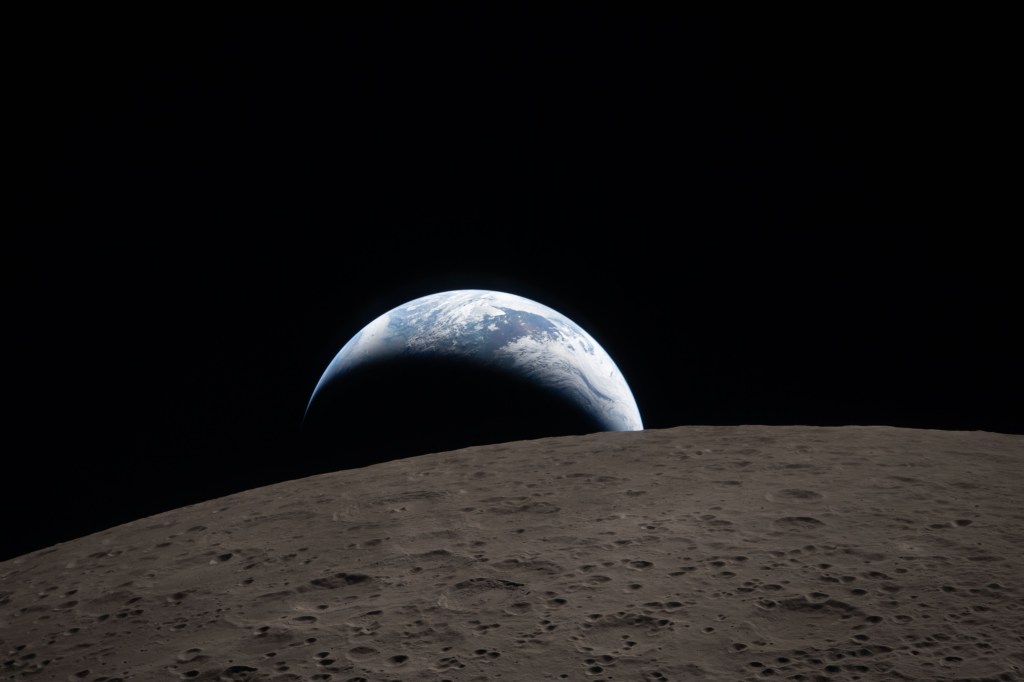
I belong to the generation that did not witness humanity’s first steps on the Moon as a lived experience, but came to know it as something already accomplished. It was presented to us as history, as news, as a defining achievement of a previous moment in time.
And yet, even without that direct memory, I feel as though I remember it in another way. It lives through images, through stories, and through the optimism that shaped how that moment was later described. There is a certain texture to that era, a confidence that the future would unfold along a clear and expanding path.
In those imagined futures, space was not hostile. It was simply another domain waiting to be organized and eventually inhabited. The Moon appeared less like an unreachable world and more like a distant extension of Earth, a place that would gradually become familiar. There was an assumption that once the first step had been taken, the rest would follow with steady and almost inevitable momentum.
The film 2001: A Space Odyssey captures this atmosphere with remarkable clarity. In its early sequences, space travel appears calm and structured, almost routine. There is a sense that the essential problems have already been solved, and what remains is refinement and scale.
Yet as the film progresses, something changes. The tone becomes more uncertain, and the vastness of space begins to assert itself. The human presence, once central and confident, becomes fragile and exposed. What begins as a vision of expansion gradually transforms into a reflection on scale, mystery, and the limits of human understanding.
Apollo and the Illusion of Arrival
The achievements of the Apollo missions remain undeniable. To leave Earth, cross the emptiness of space, and set foot on the Moon is one of the most extraordinary accomplishments in human history. It is right that we continue to honor it, not only for its technical success but for the courage and coordination it required.
At the same time, it is worth reflecting on what Apollo actually represented. When we say that humanity “reached the Moon,” it suggests a kind of arrival, as if something had been completed and a new phase had begun. But the reality was more limited and more revealing. The missions were brief, highly constrained, and dependent on enormous effort.
After Apollo 17, the path forward did not continue in the way many had expected. There were no immediate lunar settlements, no steady expansion outward. Instead, there was a pause that extended for decades, and that pause itself tells a story.
It suggests that Apollo was not simply a beginning. It was also a moment of recognition. It revealed that reaching the Moon was possible, but sustaining a presence there was an entirely different challenge. The Moon did not become accessible in the way that earlier visions had imagined. It remained distant, difficult, and fundamentally indifferent to human needs.
The Physics That Does Not Bend
One of the most humbling aspects of space travel is how little it resembles our everyday experience of movement. We often describe it as a journey from one point to another, but that language can be misleading. Movement in space is governed by orbital mechanics, and this framework does not conform to our intuitive sense of direction and control.
To enter orbit is not to travel freely, but to fall in a very precise way. A spacecraft moves forward at such a speed that as it falls toward the Earth, it continually misses it. This balance between motion and gravity creates what we perceive as orbit, but it is fundamentally a controlled descent.
The journey to the Moon follows a similar logic. It is not a direct path in the conventional sense, but a transition from one gravitational relationship to another. The spacecraft leaves the influence of Earth and enters the influence of the Moon, following trajectories that are dictated by forces rather than chosen freely.
Even the act of launch reflects this constraint. A rocket must carry an immense amount of fuel simply to overcome Earth’s gravity, and most of its mass is consumed in that initial effort. This reality has not fundamentally changed since the early days of spaceflight. It reminds us that space travel is not an expression of unlimited freedom, but a careful negotiation with forces that cannot be ignored or overcome.
The Hostility of the Moon
From a distance, the Moon appears familiar, almost like a desert landscape that we might recognize. This resemblance can create the impression that it is simply a harsher version of environments we already know. In reality, the differences are far more fundamental.
The surface of the Moon is composed of regolith, a fine layer of dust created by countless impacts over time. Unlike sand on Earth, these particles are sharp and irregular, having never been smoothed by wind or water. They cling to surfaces, penetrate materials, and pose risks to both equipment and human health.
The absence of an atmosphere introduces additional challenges. There is no air to breathe, no pressure to sustain the body, and no protection from radiation or temperature extremes. The surface experiences dramatic fluctuations in temperature, and the boundary between light and shadow is stark and unforgiving.
What becomes clear is that the Moon is not simply uninhabited. It is fundamentally uninhabitable in its natural state. Any human presence there must be sustained by systems that recreate the conditions of Earth in a fragile and temporary way.
The Fragility of Life Beyond Earth
Beyond the visible harshness of the lunar environment lies a more subtle and pervasive challenge. Radiation, which is largely mitigated on Earth by the atmosphere and magnetic field, becomes a constant presence in space. High-energy particles interact with the human body in ways that can damage cells and disrupt biological processes over time.
Modern spacecraft, including the Orion spacecraft, incorporate shielding and protective measures designed to reduce this exposure. However, these measures cannot eliminate the risk entirely. They can only bring it within acceptable limits for relatively short missions.
This limitation highlights a deeper truth about human biology. Our bodies are not designed for the conditions of space, and even with advanced technology, we can only approximate the protections that Earth provides naturally. The longer we remain outside those protections, the greater the strain on the systems that sustain us.
In this sense, life beyond Earth is not an extension of our natural environment. It is a condition that must be continuously maintained, requiring constant support and careful management.
The Cell and the Body
These reflections lead to a broader way of understanding our place in the world. We often think of ourselves as independent individuals, capable of moving freely across environments. Yet our existence is deeply tied to the systems that surround us.
The analogy of a cell within a body captures this relationship. A cell does not exist in isolation. It depends on the larger organism for nutrients, protection, and regulation. When removed from that context, it cannot continue to function in the same way.
Human beings share a similar dependency on Earth. The atmosphere, the magnetic field, the stability of gravity, and the broader biosphere all contribute to the conditions that make life possible. These are not external supports that can be easily replaced. They are integral to our existence.
At the same time, Earth itself is part of a larger system. It exists because of the Sun, within the structure of the Solar System. This layered relationship suggests that while we are inseparable from Earth, Earth is inseparable from the wider universe.
This creates a perspective that is both grounding and expansive. We are not isolated beings moving through an empty space. We are part of a nested system of relationships, where each level depends on the others.
Artemis and the Return of Humility
In this context, the significance of Artemis II can be understood in a different light. It is not simply a continuation of past achievements, nor is it a straightforward step toward future expansion.
Unlike the era of Apollo, where the emphasis was on reaching new frontiers, the present moment carries a greater awareness of the challenges involved. Artemis represents a return, but it is a return shaped by decades of reflection and accumulated understanding.
The mission does not assume that the Moon will become easily accessible or readily habitable. Instead, it acknowledges the complexity of the task and approaches it with a more measured perspective. The goal is not to conquer, but to learn, to test, and to proceed carefully.
In this sense, Artemis reflects a shift in attitude. It suggests that space exploration is no longer driven solely by optimism, but also by humility. It is an effort to engage with reality as it is, rather than as we once imagined it to be.
Beyond Expansion: A Different Kind of Transcendence
If space is not an extension of Earth, then its meaning must be understood differently. The idea of expansion, of moving outward and establishing new domains, may no longer capture the essence of what is taking place.
Instead, space exploration can be seen as a way of deepening our perspective. By stepping outside the immediate environment of Earth, even briefly, we gain a clearer view of its uniqueness and its fragility. We come to understand not only the limits of our reach, but also the conditions that make our existence possible.
This shift does not diminish the importance of exploration. It redefines it. The act of going into space becomes less about leaving and more about seeing. It is an encounter with scale, with difference, and with the boundaries of what we can sustain.
In the end, we do not leave the Earth in any fundamental sense. We carry it with us, in the systems we build and the conditions we recreate. The universe is not separate from us, but our form of life remains closely tied to this particular planet.
Recognizing this does not lead to pessimism. It leads to a deeper appreciation of where we are and what we are part of.
Image: NASA
 Tom’s Blog