
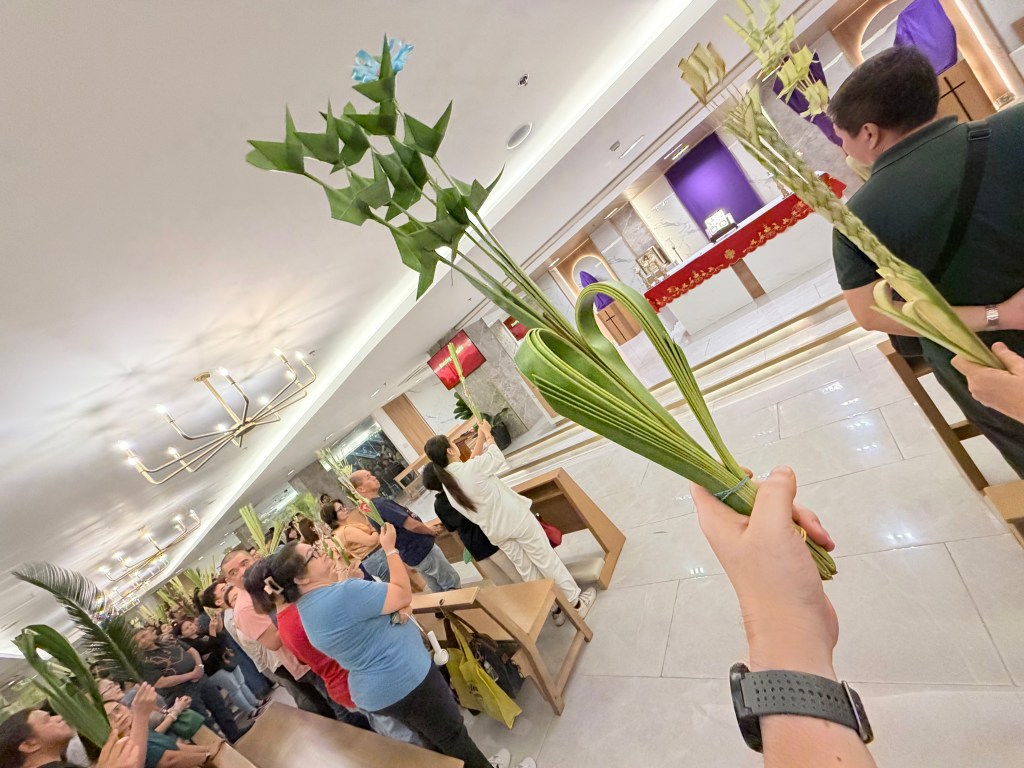
My wife and I stood among the faithful, palms in our hands, attending the Mass of Palm Sunday. There is a particular beauty in this moment. The gestures are simple, the movement is shared, and the words are familiar. It draws us in without resistance, allowing us to participate almost naturally in something sacred.
At first, the atmosphere feels light. Even without walking in the procession, we are drawn into its meaning. Holding the palms and listening to the account of Christ’s entry into Jerusalem creates a sense of alignment. We stand with those who welcomed Him, those who recognized Him, those who raised their voices in praise. It feels like a place where we belong.
Yet the liturgy does not remain there. It shifts with intention. The tone moves from celebration to confrontation, from welcome to rejection. The same gathering that proclaims “Hosanna” is led into the words of the Passion. The transition is not softened. It is direct, almost abrupt, and it unsettles the position we had just begun to settle into.
In that movement, a question begins to surface. Where are we actually standing in this story? The palms remain in our hands, but their meaning becomes less certain. They no longer confirm our place. They begin to challenge it.
The Comfortable Illusion of Suffering with Christ
There is a familiar way of entering Holy Week. We reflect on the suffering of Christ and seek to draw closer to it. Through prayer, fasting, and contemplation, we try to accompany Him, to understand His endurance, and to respond with devotion. This movement carries sincerity and a genuine desire for connection.
Within this approach, there is also an assumption that often goes unnoticed. In placing ourselves alongside Christ, we assume we are aligned with Him. We imagine that we would have remained faithful, that we would not have turned away, that we would not have joined in rejection. Our identification with His suffering becomes an affirmation of our own moral position.
This is where the structure of the Passion begins to interrupt us. The narrative does not focus on how a few remained faithful. It reveals how ordinary people responded. It shows hesitation, confusion, pressure, and eventual rejection. It does not idealize human response. It presents it plainly.
To remain only beside Christ is to miss this dimension. The story is not only about His suffering. It is also about how we respond when confronted with truth, especially when that truth unsettles us. And that response is often less stable than we assume.
The Crowd We Refuse to Recognize
The crowd in the Passion narrative is easy to distance ourselves from. We tend to imagine them as a different kind of people, shaped by a different time, more susceptible to manipulation or driven by stronger emotions. This distance allows us to preserve our sense of difference.
Yet the Gospel does not present them as uniquely extreme. They are ordinary. Some believed they were defending what was right. Some trusted authority. Some were carried by the energy of the moment. Others simply did not resist what was unfolding. Their actions emerge from recognizable human patterns rather than extraordinary malice.
The liturgy makes this even more direct. When the Passion is proclaimed, the congregation often takes the role of the crowd. We do not only hear the words. We speak them. “Crucify him” is not assigned to a distant group. It is placed in our own voices.
This moment removes the distance we prefer to maintain. It brings the narrative into the present. We are not observing the crowd. We are asked to recognize ourselves within it. And this recognition is where the discomfort begins.
Even in Guilt, We Remain the Victim
There is another layer that emerges once we begin to acknowledge our place within the crowd. Even then, we often reinterpret what that recognition means. We explain our position. We soften its implications. We say we were misled, influenced, or unaware. These explanations carry elements of truth, but they also serve a protective function.
They allow us to retain a sense of innocence. Even in admitting fault, we reposition ourselves as those who were affected, shaped, or carried by circumstances. Responsibility becomes diluted. The edge of recognition becomes less sharp.
This pattern is not limited to the Passion narrative. It is visible in contemporary life. Individuals and groups claim harm while directing strong judgment toward others. Moral certainty is often grounded in the belief that one has been wronged. This creates a framework where accusation and self-protection reinforce each other.
The crowd in the Gospel likely did not see themselves as perpetrators. They believed they were acting within reason. This is what makes the narrative enduring. It reflects a tendency that remains active. We can act with conviction and still participate in harm. We can feel justified and still be mistaken.
The Cross as the End of Self-Justification
At the center of Holy Week stands the Cross. It is often approached as the place where Christ suffers for humanity, where love is revealed in its most complete form. This remains essential, but the Cross also reveals something about us.
It exposes the limits of our self-understanding. We tend to assume that sincerity aligns us with what is right. We believe that our intentions protect us from deeper error. The Cross challenges this assumption. It shows that conviction and correctness are not always the same.
This is not a message of condemnation. It is a movement toward clarity. The Cross brings together two realities that are difficult to hold at once. We are responsible, and we are loved. We are implicated, and we are forgiven. These are not separate ideas. They exist together.
When self-justification begins to loosen, something shifts. We no longer need to explain everything in our favor. We can begin to see more clearly, not only what has been done, but who we are within it. This clarity is not destructive. It creates the possibility of transformation.
Repentance Beyond Performance
Repentance is often expressed through visible actions. We attend services, observe traditions, and engage in practices that shape our spiritual life. These actions are meaningful, but they can remain external if they are not grounded in deeper recognition.
If we continue to see ourselves primarily as those who are right or those who have been wronged, repentance becomes limited. It turns into something we perform rather than something that reshapes how we understand ourselves. The underlying structure remains unchanged.
A deeper form of repentance begins when we no longer need to secure our position. When we can acknowledge our participation in what is wrong without immediately explaining it away, something opens. We are no longer defending an image. We are facing reality.
This does not lead to despair. It creates space for change. Without the need to protect ourselves, we become more attentive, more responsive, and more willing to move differently. Repentance becomes less about correction and more about transformation.
Walking Through Holy Week Differently
As Holy Week unfolds, the events of the Passion are presented in sequence. Each moment carries weight and meaning. Yet the significance of these events depends on how we place ourselves within them.
If we approach them only as observers or as those who stand beside Christ, we miss something essential. The narrative invites a more difficult positioning. It asks us to recognize our place within the movement that leads to the Cross.
This recognition does not diminish the meaning of what Christ has done. It deepens it. Forgiveness becomes more than a concept. It becomes something that meets us within reality rather than above it.
The palms we carry home remain as signs, but their meaning has shifted. They no longer confirm our place. They remind us of the movement within us, from praise to rejection, from certainty to recognition. They become part of a longer process that continues beyond the liturgy.
A Different Way of Standing
Holy Week does not resolve tension. It does not offer a simplified conclusion. It holds together what is difficult to reconcile and allows us to remain within it.
To see ourselves not only as those who follow but also as those who turn away is not an easy recognition. It challenges the way we understand ourselves. It removes the comfort of clear alignment.
Yet within this, something more stable begins to emerge. Without the need to claim innocence or defend our position, we are able to stand differently. Not as victims, and not as judges, but as those who are capable of both error and change.
And in that position, the meaning of the Cross becomes clearer. Not as something distant, but as something that meets us where we actually are.
Image: A photo captured by the author
 Tom’s Blog