
I recently found myself attending a high school reunion, though not in the way such gatherings are usually experienced. The reunion took place in Nara, Japan, my hometown, while my life has since taken me overseas. In that sense, I was absent. Under ordinary circumstances, that absence would have meant a complete disconnection from the event, a simple acknowledgment that something meaningful had happened elsewhere.
Yet the conditions of our time have changed what it means to attend. Through shared videos, photos, and a group chat, fragments of the reunion reached me. I was not actively participating in every exchange, but I remained present enough to feel included. At one point, the organizing members encouraged more interaction, and the conversation briefly became more active. That small shift was enough to draw me in. I began to feel as though I was not entirely outside the gathering, even if I was not physically there.
This experience existed somewhere between presence and absence. It was not a substitute for being there in person, but it was also not negligible. It allowed something to emerge that would not have been possible in the past, a form of participation shaped by distance yet sustained by connection. Within that space, I found myself reflecting not only on the reunion itself, but on the passage of time that made such a reunion meaningful in the first place.
The Persistence of Who We Were
What struck me first was how easily we returned to our earlier selves. Even through short messages and brief videos, the tone of our conversations felt familiar. We spoke in ways that resembled our high school days, moving freely between trivial topics and more thoughtful reflections without any need for structure or purpose. There was a natural rhythm that required no reconstruction.
It seemed that those years had not disappeared but had simply remained beneath everything that followed. With the right conditions, they resurfaced immediately. The distance of decades did not erase that part of us. Instead, it revealed that something essential had been preserved, quietly waiting.
At the same time, the contrast with the present was unmistakable. We looked older, which was expected, but the change was not limited to appearance. Each person carried a presence shaped by the years they had lived. The way we spoke, the pauses we took, and the themes we returned to all reflected our individual paths. Some carried the weight of family responsibilities, others seemed defined by their professional journeys, and still others revealed a more complex mixture of both.
These differences were not easily categorized, but they were clearly felt. What became evident is that two realities coexist without conflict. We remain who we were, capable of returning to that earlier version of ourselves, and at the same time, we are shaped by everything that has happened since. These are not opposing truths, but layers that have accumulated within the same life.
A Life Revealed in Conversation
As I followed the exchanges, I began to notice how our lives had gradually revealed themselves through the way we spoke. Over time, the direction of one’s life becomes visible not through formal explanation, but through tone, emphasis, and the kinds of questions one returns to. It appears subtly, but unmistakably.
In our case, many of us had come from a class with a strong orientation toward science. Our chemistry teacher had shaped the environment in which we studied, and it was interesting to see how many had continued into scientific fields. More than that, the way of thinking associated with that background seemed to persist, appearing in how people approached problems and expressed their ideas.
Our teacher himself, now advanced in age, remains active and engaged in his own pursuits. There was something reassuring in that continuity. It suggested that certain inclinations, once formed, do not simply disappear. They evolve, but they remain recognizable.
At the same time, these reflections were not limited to my high school connections. Almost coincidentally, I found myself reconnecting with someone from a very different part of my past, a member of the church community I had been part of when I was younger. The context was different, and the reconnection was not planned. It simply emerged, as many such encounters seem to do, through the possibilities created by modern communication.
As a young person, I had been part of a church group where we discussed Christianity with a mixture of curiosity and skepticism. We approached faith in a rational way, often questioning its claims while remaining open to what it might offer. There was a tension in those conversations. We were drawn to belief, yet not fully able to settle into it. In many ways, we stood at a distance, trying to understand something that had not yet become part of our lived reality.
At that stage, faith existed largely as a concept. It belonged to a future that had not yet arrived. It was something we discussed, something we examined, but not something that had been tested by experience. Now, after several decades, the nature of that conversation has changed. When we speak about faith today, it is no longer theoretical. It is grounded in experience, shaped by success and failure, illness and recovery, doubt and endurance. What was once abstract has become something that has accompanied us through time.
Experiences like this have led me to realize that it is not only school reunions that carry this kind of depth. Any form of reconnection, whether through education, faith, work, or other shared contexts, can reveal how time has transformed both the relationship and the individuals within it. What was once a beginning returns as something more complete, shaped by years that could not have been imagined at the time.
The Things We Leave Behind
Amid these reflections, one moment stood out in a way I did not anticipate. A classmate brought with him an old pamphlet from one of our high school trips. It was from our second year, just before we entered the period of preparing for university entrance exams. That year, we had gone on a skiing trip to Nagano, an experience that at the time felt both ordinary and memorable.
The pamphlet had been created entirely by hand. This was before the internet and before word processors became common. Every page was written and illustrated manually, reflecting a kind of effort that was inseparable from the process of creation. The physical presence of the pamphlet, with its faded paper and softened ink, carried the weight of time in a way that digital files rarely do.
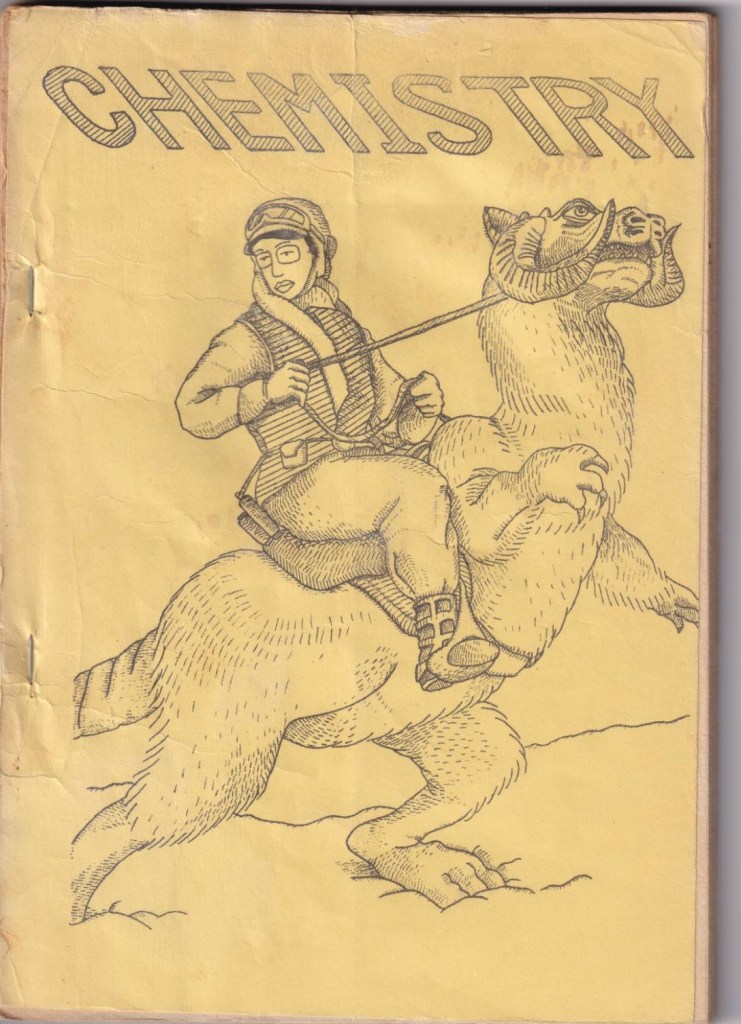
On the cover, there was a drawing I had made. It depicted our chemistry teacher in a science fiction setting, something inspired by the imagery of Star Wars. At the time, I regarded it as a small contribution. I was simply helping with the pamphlet, without any sense that it would carry significance beyond that moment.
What moved me was learning that this drawing had remained with someone all these years. My classmate shared that the pamphlet, and especially that drawing, had stayed in his memory. It was something he remembered clearly, something that had taken on meaning over time. This realization was unexpected. It revealed that what we consider minor or incidental can become important to others in ways we do not anticipate.
It made me reflect on how the things we say and do are often carried forward beyond our awareness. A brief conversation, a shared moment, or a simple act of creation can remain with someone for years, shaping how they remember a particular time or relationship. In this sense, we leave traces in each other, not through intention, but through participation.
Memory, Technology, and Continuity
The pamphlet itself was more than a nostalgic object. It functioned as a tangible record of a shared past, something that could be held and revisited. Its material nature mattered. The texture of the paper, the imperfections in the handwriting, and the gradual fading all contributed to its presence as an artifact of time.
At the same time, we now live in a context where such artifacts can be transformed in new ways. Out of curiosity, I took that old drawing and enhanced it using AI. What had originally been a rough sketch became more detailed and visually refined. The process did not erase the original, but extended it, allowing it to exist in a different form.

This brought together two distinct moments in time. The original drawing belonged to a world defined by limitation, where creation required patience and effort. The enhanced version belongs to a world where tools can amplify and reinterpret what has already been made. Despite this difference, the underlying intention remained consistent.
In this sense, technology does not replace what we once created. It allows us to revisit it, to see it again from another perspective, and to extend it beyond its original form. The connection between past and present is not broken, but deepened.
Returning to Ourselves
As I reflect on these experiences, I find that reunions carry a meaning that extends beyond simple reconnection. They reveal how our lives have unfolded in relation to one another, and how those connections have persisted, often quietly, across time.
It is easy to focus on visible markers such as career or status, but these are not what remain most strongly. What endures are the smaller elements, the conversations, the shared experiences, and the moments that seemed unremarkable at the time but continue to live within others.
This is why I find myself thinking about future reunions, particularly those that may take place later in life. There is a sense that such gatherings will allow us to return to a state similar to our earlier years, where we are no longer defined primarily by roles or expectations. At that stage, we may meet again simply as individuals shaped by experience.
In that return, there is both humility and confidence. We are no longer driven by uncertainty, yet we are also less bound by external definitions. What remains is a clearer sense of who we are, formed through time but not confined by it.
In this sense, a reunion is not merely a return to the past. It is an encounter with continuity, where what once seemed small reveals its lasting presence, and where even the simplest act can find its way into the future, carried by someone else, waiting to be remembered.
Image: StockCake and photos captured by the author.
 Tom’s Blog