
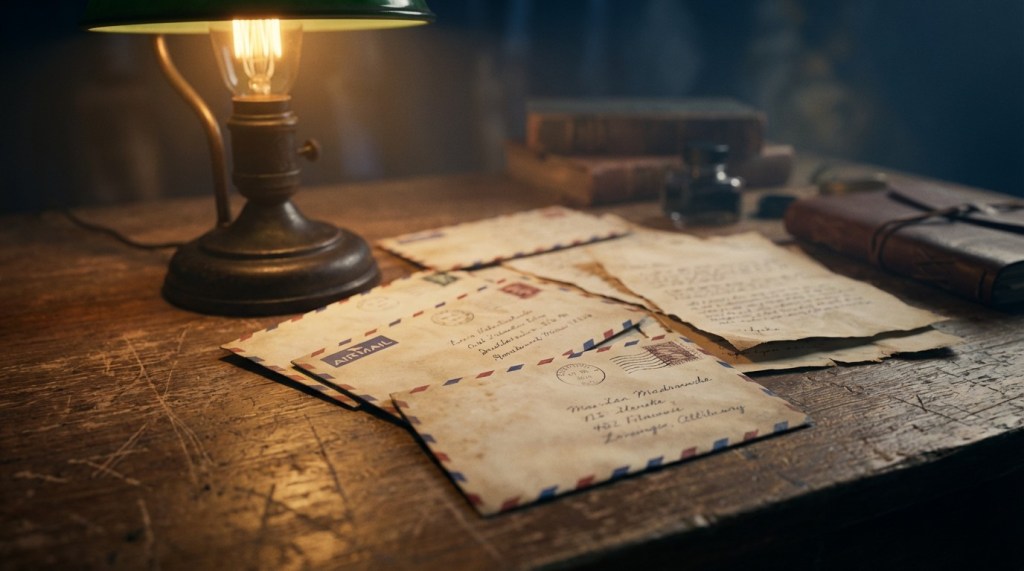
There was a time when international communication carried a physical weight. Before email, before messaging apps, and before the expectation that a reply should arrive within minutes, words traveled slowly across oceans. They moved through the world as objects. Paper crossed borders, and ink survived long journeys. A letter could take weeks to reach its destination.
One of the most recognizable forms of such communication was the aerogramme. It was a thin sheet of paper designed to serve both as letter and envelope. After writing the message inside, the sender folded the paper along marked lines and sealed it, with the address and postage printed on the outside. The paper itself was extremely light, which made it economical for international airmail. At the time, this was not considered slow communication. Quite the opposite. The airplane had transformed global correspondence. Letters that once took months by ship could now reach another continent in a matter of weeks. Airmail represented technological progress and modern efficiency.
Yet when I recall those days now, the memory that returns is not speed but slowness. The letter itself had a presence that modern communication rarely carries. The thin blue paper felt delicate in the hand, almost translucent under light. When folded carefully into its final form, it became both message and vessel, carrying words across the sky. What seemed efficient then now feels almost ceremonial, because the journey of a letter was part of the meaning of the message itself.
The Craft of Writing a Letter
Writing an airmail letter was never a casual act. I usually began by drafting the content in a notebook or on a small notepad, sometimes with a pencil and sometimes with a ballpoint pen. The draft allowed me to shape my thoughts before committing them to the thin aerogramme paper. The final version required more care.
With a fountain pen in hand, I copied the letter slowly and neatly onto the aerogramme. The space was limited, and the paper did not forgive mistakes easily. One had to think about each sentence before writing it down, because corrections were difficult. Later, when I obtained my first manual typewriter, the process changed slightly but remained equally deliberate. Typing on such thin paper demanded precision, and a typing error could easily ruin the entire sheet. Even when the letter was typed, I still signed my name with a fountain pen at the end.
Looking back, the entire process resembled a small craft. A letter was not simply information. It was something shaped with attention. Words were chosen carefully, sentences were arranged thoughtfully, and the physical act of writing slowed the mind in a way that modern keyboards rarely do. Time was invested in each message, and that investment itself carried meaning.
Pen Pals and the Education of Language
For many young people of my generation, international pen pals were more than a hobby. They were also an education. Correspondence encouraged us to express our thoughts clearly in another language, and each letter became an opportunity to experiment with vocabulary and sentence structures. Over time, one naturally tried to write better.
The desire to write better gradually shaped how one read. Whenever I encountered a beautiful phrase in a book or article, I sometimes wrote it down in a notebook, hoping that one day I might use that expression in a letter. Before the internet, such expressions did not appear instantly through search engines. They had to be discovered through reading and remembered through note taking. Books, dictionaries, and handwritten notes became companions in this process.
Language grew slowly through this practice. Each new letter reflected a small step forward. Correspondence formed a bridge between reading and writing, because the more carefully one read, the more thoughtfully one wrote. Today, when artificial intelligence can instantly produce examples of elegant phrasing, that earlier process may appear inefficient. Yet there was something deeply formative about learning language through patient accumulation, where each expression carried a memory of where it had been found.
The Gift from Another World
Perhaps the most powerful element of airmail correspondence was the waiting. Even with airplanes carrying the letters, international mail rarely moved quickly. A message often required one or two weeks to arrive, and the reply might take just as long. Sometimes nearly a month passed between sending a letter and receiving the answer.
During that time life simply continued with its ordinary routines. Yet somewhere far away a letter was traveling through the world. Then one day it appeared. Opening the mailbox and discovering an overseas envelope created an excitement that is difficult to describe. The letter had crossed oceans, and the paper had been touched by someone far away.
It felt almost like receiving a gift from another world. The handwriting carried personality, and the choice of paper revealed small preferences. Sometimes a faint scent remained from the place where it had been written. These details gave the letter a presence that digital messages rarely possess, because the journey of the paper became part of the message itself.
Encounters Across Distance
The people who wrote those letters came from many different parts of life. Some were pen pals introduced through correspondence clubs or magazines. We had never met in person, yet the letters gradually created a sense of familiarity. Others were people encountered during travel or exchange programs, where addresses were exchanged with the hope that the connection might continue across distance.
There were also host families, teachers, advisors, and friends whose paths crossed mine during different stages of life. And sometimes there was someone special. In youth, relationships often emerge quickly and fade just as quietly. Time changes circumstances, addresses change, and letters become less frequent until the correspondence eventually stops.
Yet the memory of those exchanges remains vivid. Each letter once carried a small world inside it. A description of daily life, a reflection on recent events, and a glimpse into another person’s thoughts traveled across oceans through that thin sheet of paper. Through these letters, distant places became slightly more real.
What Speed Changed
Today communication travels at extraordinary speed. Messages cross the planet in seconds, video calls connect people across continents instantly, and language barriers can be bridged within moments by translation tools. From a technological perspective, humanity has achieved something remarkable, because distance has largely lost its power to separate people.
Yet something subtle has also changed. When communication becomes instantaneous, the rhythm of interaction transforms. Messages are often brief, replies are expected quickly, and conversations unfold in real time rather than through reflection. The physical dimension of correspondence disappears as well. Digital messages do not carry the texture of paper or the marks of travel. They arrive without the evidence of distance.
In this sense modern communication has gained speed but lost a certain sense of journey. A letter once moved through the world before reaching its reader, and that movement created anticipation. It allowed time for thoughts to settle. Slowness shaped the experience of communication itself.
Memories That Remain
Looking back now, the practices of that era may appear tedious. Drafting letters by hand, copying them carefully onto thin paper, consulting dictionaries for expressions, and waiting weeks for a reply would feel inefficient by today’s standards. Few people would willingly return to such a system.
Yet I feel fortunate to have experienced it. Those evenings spent writing letters remain vivid in my memory. I can still imagine the quiet desk, the notebook drafts, and the careful strokes of a fountain pen on thin blue paper. I can still recall the excitement of discovering an overseas envelope in the mailbox.
Many of the people who wrote those letters are no longer part of my daily life. Time carried us in different directions, and the correspondence gradually faded as many relationships do. But memories have their own persistence. When I close my eyes, the scenes return easily. The folded aerogramme, the careful handwriting, and the long journey across oceans remain part of my younger days.
What was once considered the most advanced form of communication now feels almost timeless. A technology created to accelerate communication has quietly become a symbol of patience, care, and human connection. In those memories of thin blue paper traveling across the sky, I sometimes rediscover a feeling that modern communication rarely provides: the sense that words, written carefully and sent far away, could carry a small piece of one’s life across the world.
Image: StockCake
 Tom’s Blog