
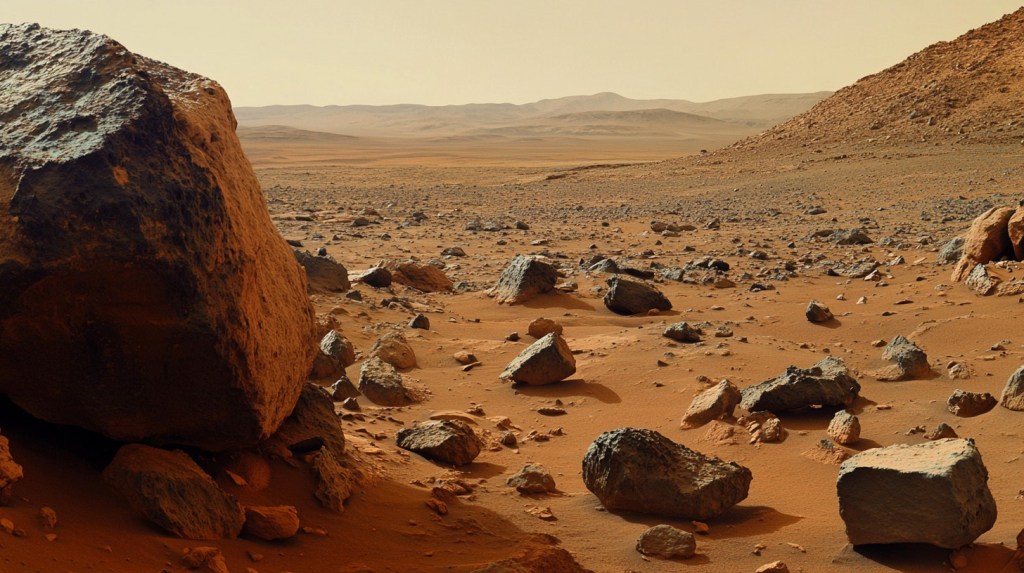
Images from Mars often evoke a strange familiarity. The red plains, scattered rocks, and distant horizons resemble deserts on Earth. At first glance the scene appears almost ordinary, as though it might be a remote valley somewhere on our own planet. Yet the resemblance dissolves when we consider the most important difference.
On Earth, even the harshest landscapes are alive. The Sahara Desert hosts resilient microbes and insects. Beneath Antarctic ice, bacteria persist in extreme cold. Deep under the ocean near volcanic vents, entire ecosystems flourish where sunlight never reaches. Even the thin soils of high mountain slopes contain microscopic life.
Life on Earth does not merely occupy favorable places. It spreads almost everywhere it can. Wherever liquid water, minerals, and energy exist, some form of life tends to appear.
Mars presents the opposite condition. The surface appears still and empty. The rocks carry no visible signs of biological activity. There are no plants, no animals, no microbial mats clinging to damp surfaces. Even the possibility of microscopic life remains uncertain despite decades of exploration.
The contrast creates a striking asymmetry. One small planet overflows with living systems, while nearby worlds remain silent. When we look at Earth from space, this difference becomes even clearer. The blue oceans, white clouds, and green landmasses reveal a planet whose chemistry has been transformed by living processes.
Oxygen fills the atmosphere because of photosynthesis. Soil exists because organisms slowly break down rock. Even the carbon cycle is shaped by the activity of living systems.
Earth is not merely a planet where life happens to exist. It is a planet that has been reshaped by life itself. Against the quiet backdrop of the solar system, it appears almost like an oasis.
The Illusion of the Cosmic Center
Human beings have long struggled with questions of cosmic significance. For most of history, people believed that the Earth stood at the center of the universe. The Sun, Moon, planets, and stars seemed to revolve around our world.
This belief shaped not only astronomy but also cultural assumptions about human importance. If the universe revolved around Earth, then humanity must occupy a privileged place within creation.
The development of astronomy gradually transformed this view. The work of Nicolaus Copernicus and Galileo Galilei revealed that the Earth travels around the Sun like the other planets.
Later discoveries expanded the horizon even further. The Sun itself is only one star among hundreds of billions in the Milky Way. Modern telescopes show that our galaxy is only one among countless galaxies scattered throughout the observable universe.
Each stage of discovery moved humanity farther from the center. These realizations encouraged a new form of intellectual humility. The universe did not appear organized around our location. Instead, we occupy a small corner of a vast cosmic system.
Yet a subtle habit remains. Even after recognizing that Earth is not physically central, we often continue to interpret the universe from the perspective of our own existence. Our questions, expectations, and categories arise from the conditions of life on this planet.
The Earth may not be the center of the universe, but it remains the center of our experience. The universe we observe is always the universe seen from somewhere.
The View from Where We Stand
Scientific inquiry seeks objectivity. Astronomers measure planetary atmospheres, analyze stellar spectra, and map distant galaxies. These methods allow us to extend knowledge far beyond the limits of direct perception.
Yet every investigation still begins from a particular vantage point. We observe the universe as organisms that evolved under the conditions of Earth. Our senses, biology, and cognitive structures reflect the environment in which our species developed.
Water forms the basis of our biology. Carbon provides the structural framework of our molecules. Temperatures near the freezing and boiling points of water define the narrow range within which our bodies function.
Because of these conditions, scientists often search for life elsewhere by looking for familiar signs. Liquid water becomes a key indicator of habitability. Atmospheric oxygen suggests biological activity. Organic molecules attract special attention.
These strategies are reasonable because they follow from the only example we currently know. At the same time, they reveal a limitation. Our definition of life is shaped by the particular form life has taken on Earth.
It is possible that other forms of organization exist beyond these categories. Hypothetical organisms based on different chemistry might thrive in environments that appear hostile to us. Methane lakes, high pressure atmospheres, or extremely low temperatures could support unfamiliar biological processes.
Another civilization, if it exists somewhere in the universe, might begin its investigation from entirely different conditions. Their chemistry, perception, and technological development would shape their interpretation of the cosmos. From their perspective, their own world might appear just as central to life as Earth appears to us.
The Difficulty of Recognizing the Other
The challenge of understanding unfamiliar forms of life echoes a problem that has long existed within human history. Societies have not always recognized the full humanity of those outside their own community.
Tribal groups sometimes viewed neighboring tribes as fundamentally different beings. Cultural boundaries created strong divisions between insiders and outsiders. Even when encounters between distant societies increased, recognition of shared humanity did not arrive immediately.
European explorers encountering indigenous peoples in the Americas often struggled to interpret cultures that differed dramatically from their own. Language, religion, and social customs created barriers to understanding.
Over time, moral reflection and political movements gradually strengthened the idea that all humans possess inherent dignity. The modern concept of Human Rights emerged from this long historical process.
This development illustrates how difficult it can be to recognize the inner reality of others. Observation alone is not enough. Imagination and empathy must expand beyond familiar categories.
The same challenge may apply when we think about life elsewhere in the universe. If intelligent beings evolved under radically different conditions, their appearance and behavior might not resemble anything we expect. They might not immediately recognize us either.
Each civilization would interpret the cosmos through the lens of its own existence.
The Solitude of Consciousness
Cosmic speculation eventually returns to a more intimate question. What does it mean to exist as an individual consciousness within this vast universe?
Human beings share common biological structures and cultural frameworks. We belong to the same species, inhabit the same planet, and communicate through shared languages. From an external perspective we appear as members of a collective human population.
Yet from the inside, experience remains singular. Each person perceives the world through a unique stream of memories, sensations, and reflections. No one else occupies exactly the same perspective.
The philosopher Søren Kierkegaard emphasized this aspect of existence. Abstract descriptions of humanity may explain many things, but the reality of living always belongs to the individual.
Your own perspective has never existed before in the history of the universe. The specific combination of experiences that shape your awareness cannot be duplicated. Among billions of humans, each consciousness appears only once.
Communication allows people to share ideas and emotions across individual boundaries. Literature, art, and conversation build bridges between different inner worlds. Yet the center of experience remains personal.
Each person encounters the world through a window that only they occupy.
Windows Through Which the Universe Sees Itself
When we combine the cosmic perspective with the personal one, a striking possibility emerges. The universe consists of matter and energy organized through physical laws. Over billions of years these processes formed stars, planets, and complex chemical systems.
On at least one planet, these conditions produced living organisms capable of perception and reflection.
Human consciousness therefore arises from the same physical processes that govern galaxies and planetary motion. The atoms that form our bodies originated inside ancient stars. The forces that shape planetary orbits also shaped the formation of Earth itself.
From this perspective, conscious beings represent a remarkable development within the history of matter.
Through them, the universe becomes capable of observing itself. The astronomer Carl Sagan once suggested that human beings are a way for the cosmos to know itself.
Each conscious observer becomes a temporary window through which the universe can be experienced. The rarity of Earth and the uniqueness of individual consciousness share a similar structure. Both represent localized points of awareness within a vast physical system.
A living planet surrounded by lifeless worlds. A singular perspective surrounded by countless other perspectives.
The Horizon of What Can Be Seen
Every form of awareness encounters reality from within a particular horizon. Our senses, language, and cultural frameworks shape the way we interpret the world.
Scientific inquiry expands this horizon through instruments and theories that reveal phenomena beyond ordinary perception. Telescopes show distant galaxies. Microscopes expose intricate biological structures.
Yet even these tools remain connected to human understanding. Measurements must still be translated into concepts our minds can grasp. The universe we describe in equations and models continues to appear through the interpretive lens of human cognition.
This limitation may not be a flaw. A horizon defines the boundary within which perception becomes meaningful. Without a specific vantage point, experience would dissolve into abstraction.
Earth provides one such vantage point. A small planet filled with life looks outward into the surrounding cosmos, asking questions about the nature of existence.
Within that living planet, each individual consciousness forms another vantage point from which reality becomes visible. The rarity of seeing therefore exists at two scales at once.
A rare planet where life flourishes, and a rare perspective through which the universe is perceived.
From within these horizons we continue to look outward, wondering whether other windows of awareness exist somewhere among the distant stars.
Image: StockCake
 Tom’s Blog