
In the middle of the twentieth century, the most transformative technologies were inseparable from the state. Nuclear physics was born in universities and laboratories, yet the atomic bomb did not emerge from venture capital or private initiative. It required sovereign mobilization. The Manhattan Project gathered scientists, engineers, and industrial capacity under a single political command. Its scale was national. Its authority was unmistakably governmental.
When nuclear weapons appeared, their destructive capacity was immediately visible. A single detonation altered the geopolitical imagination of the world. Governance followed swiftly. Deterrence doctrine took shape. Command structures were centralized. International treaties emerged to prevent uncontrolled proliferation. Nuclear power was never merely technical. It was political from the moment it crossed the threshold into weaponization.
This centralization of power shaped the architecture of control. The state held the monopoly on legitimate force. It commanded armies. It controlled strategic materials. It supervised laboratories. Even private defense contractors operated within a sovereign framework. The chain of authority was clear, even when its morality was debated.
Artificial intelligence enters history differently. Its early research was publicly funded, yet its acceleration has largely been driven by private firms. The laboratories shaping frontier models are corporations. The infrastructure that enables training at scale is owned by companies. The global deployment of AI systems happens through cloud platforms, application programming interfaces, and consumer products, often beyond the direct command of any single state.
The contrast matters. Nuclear power consolidated sovereignty. AI disperses it.
When Technology Outgrows the Nation-State
In the twenty-first century, technological capability no longer rests exclusively within government laboratories. Venture-backed firms develop models that rival the strategic significance of state-funded research. Cloud providers operate data centers whose computational capacity exceeds that of many national supercomputing programs. Semiconductor companies design chips that determine the pace of global AI advancement.
Consider the position of NVIDIA. Its advanced GPUs underpin much of the world’s AI infrastructure. Governments rely on its hardware. Startups depend on it. Research institutions build upon it. This concentration of infrastructural power does not make the company sovereign, yet it makes it indispensable. When a single corporate actor shapes the availability of compute, its decisions ripple through geopolitics.
The same is true of frontier model developers such as Anthropic. Their systems are dual-use by design. A language model that assists medical research can also assist military analysis. A system that synthesizes legal documents can also process intelligence feeds. The boundary between civilian and defense application is rarely clean.
Governments now negotiate with these firms rather than command them outright. Export controls can restrict chip sales. Procurement contracts can influence model deployment. Regulatory frameworks can impose obligations. Yet the development cycle of AI is fast, global, and distributed. Talent moves across borders. Open-source components circulate widely. Innovation does not wait for legislative clarity.
This diffusion creates a new condition. Private laboratories produce public consequences. The technology may be proprietary, but its impact is collective. The question is no longer simply how a state controls its own arsenal. It is how a state relates to corporate actors whose capabilities shape national security itself.
AI on the Battlefield
Military history shows that technology is gradually absorbed into doctrine. Radar once seemed novel. Satellite navigation once felt experimental. Today both are indispensable. Artificial intelligence is following a similar trajectory.
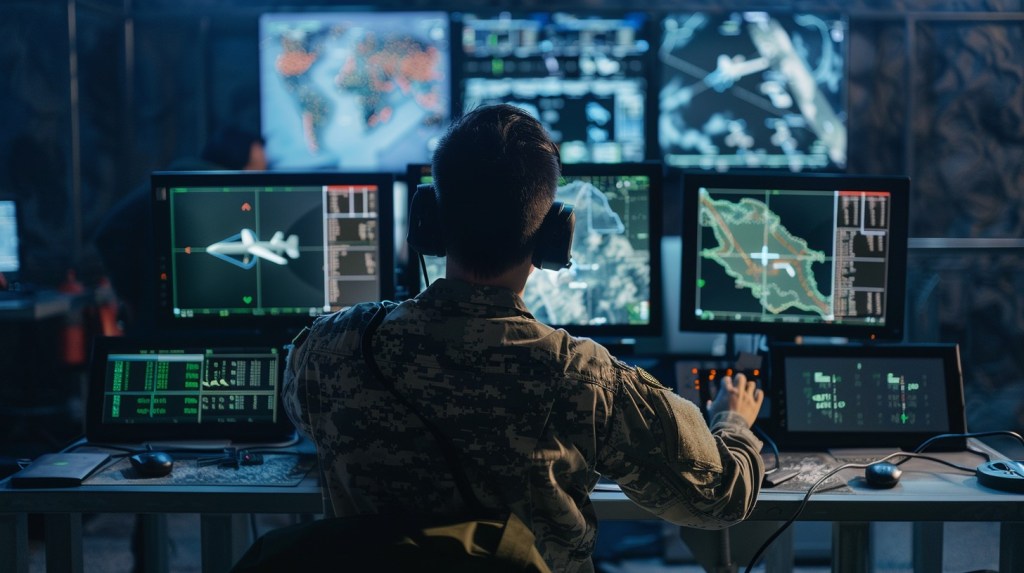
Recent operations have revealed how deeply AI is embedded in contemporary conflict. Reporting on U.S. actions in Venezuela indicated that commercial AI systems were integrated into intelligence workflows during planning. While operational details remain classified, the broader pattern is clear. AI assists in synthesizing vast quantities of information, correlating signals, identifying patterns, and supporting rapid decision-making.
The recent escalation involving the United States and Israel in strikes against Iran illustrates the same structural shift. Modern targeting depends on the fusion of satellite imagery, intercepted communications, predictive modeling, and logistical coordination. These processes increasingly rely on AI-enabled systems. The public may see only the kinetic event, yet upstream decisions are shaped by algorithmic analysis.
The war between Russia and Ukraine provides further evidence. Drone operations often incorporate machine vision for target recognition. Battlefield intelligence is filtered through automated systems. Logistics and troop movements are optimized through predictive tools. In these contexts, AI is rarely the weapon itself. It is the cognitive layer that informs action.
This incremental integration makes governance more complex. AI does not appear as a singular moment of weaponization. It seeps into existing structures. A commander may still authorize a strike, yet the informational substrate supporting that decision is partially algorithmic. Responsibility becomes shared between human judgment and machine recommendation.
The consequence is subtle dependence. Modern militaries may find it increasingly difficult to operate without AI assistance. What begins as augmentation evolves into expectation. The governance challenge lies not only in preventing dramatic misuse, but in managing normalization.
The Guardrail Dilemma
The dispute between the U.S. Department of Defense and Anthropic illustrates this tension vividly. Reports from Bloomberg describe a conflict over whether certain safety guardrails embedded in AI systems should be relaxed for military use. Anthropic’s leadership, including CEO Dario Amodei, declined to remove specific constraints, citing ethical concerns regarding autonomous weapons and mass surveillance.
On one level, the company’s stance reflects a principled commitment to responsible AI. Guardrails are designed to prevent harmful use. They signal a belief that not every technically possible deployment is morally acceptable. In a world anxious about unchecked automation, such caution appears commendable.
Yet another question emerges. In a democratic system, national security decisions are typically vested in elected authorities and the institutions accountable to them. If a private firm refuses a lawful government request related to defense, on what authority does it do so? Corporate governance is not democratic governance. CEOs are not elected officials. Their legitimacy derives from shareholders and internal policy, not from public mandate.
The dilemma is symmetrical. If governments can compel companies to remove safeguards at will, corporate ethics become fragile. If companies can override state requests unilaterally, democratic authority is diluted. Neither extreme offers stability.
The conflict is not a simple morality play. It is a structural confrontation between two forms of power. One is sovereign and electoral. The other is technical and infrastructural. Both claim responsibility. Both fear misuse. Each suspects that the other may overreach.
In this tension, familiar categories blur. A safety-minded corporation may resist what it perceives as dangerous deployment. A government may argue that restraint undermines national defense. The public is left to interpret events through incomplete information. Complexity resists easy judgment.
The Sovereignty Problem
Classical political theory located sovereignty within the state. The sovereign possessed the authority to command force, enact law, and defend territory. The monopoly on legitimate violence distinguished government from all other actors.
Artificial intelligence complicates this model. Power now resides not only in armies and legislatures, but in models, chips, and cloud infrastructure. A corporation that controls critical AI hardware influences the pace of global innovation. A company that develops widely adopted models shapes the cognitive tools available to millions.
This does not abolish sovereignty, yet it redistributes its practical expression. States still regulate, tax, and legislate. They still command military force. However, they increasingly depend on private technological ecosystems to exercise those powers effectively. Defense systems integrate commercial components. Intelligence agencies rely on civilian innovation.
The international dimension intensifies the challenge. If one democracy imposes strict limits on AI weaponization while rival states proceed aggressively, restraint may appear strategically costly. This creates an arms dilemma. Cooperative governance is desirable, yet geopolitical competition incentivizes acceleration.
Fragmentation becomes a risk. Nations may align around distinct technological blocs, each governed by its own standards and alliances. Cross-border trust erodes. AI ecosystems diverge. In such an environment, corporate actors are drawn into geopolitical alignment whether they intend it or not.
The sovereignty problem is therefore not a philosophical abstraction. It is an operational question. Who ultimately decides the acceptable uses of intelligent systems when those systems are globally distributed and privately developed? How can authority remain legitimate when capability is decentralized?
Governing the Subtle Power
Voluntary corporate ethics, while important, cannot bear the entire weight of governance. A company’s internal policy may shift with leadership or market pressure. Shareholder expectations influence strategic direction. Ethical commitments are meaningful, yet they lack the binding force of law.
At the same time, unilateral executive authority is insufficient. Concentrating decision-making power within a single branch of government invites overreach. Democratic legitimacy requires checks and balances. Legislative oversight, judicial review, and public scrutiny must shape high-risk deployments.
The architecture of governance must therefore be layered. Domestic legislation can define categories of high-risk AI use. Independent oversight bodies can audit compliance and evaluate systemic impact. Technical standards can require transparency in model training, testing, and deployment for sensitive applications.
Internationally, cooperative agreements may establish red lines regarding autonomous lethal systems. While AI differs from nuclear weapons in its diffuseness, certain principles can still be codified. Human accountability in the use of force, prohibitions against indiscriminate targeting, and restrictions on mass surveillance could be reinforced through treaty frameworks.
Transparency remains essential, even where security considerations limit disclosure. Classified systems should not become opaque zones immune from any oversight. Specialized review committees with technical expertise can examine sensitive deployments while protecting operational secrecy.
Such measures will not eliminate risk. They can, however, distribute accountability. When responsibility is shared across institutions rather than concentrated in a CEO’s decision or an executive order, the system gains resilience.
Living With Intelligent Power
Artificial intelligence is neither inherently benevolent nor inherently destructive. It is an amplifier. It amplifies human intention, organizational capacity, and strategic ambition. The moral character of its deployment depends on the structures that guide it.
Governments are not purely protective nor purely oppressive. Corporations are not saints nor villains. Each operates within incentives, pressures, and constraints. Simplistic narratives obscure the interdependence that defines the present moment.
The handling of AI resembles, in some respects, the handling of nuclear technology. Both require sober recognition of power. Both demand institutional maturity. Yet AI’s subtlety makes governance more difficult. It does not announce itself with a single flash. It embeds quietly into infrastructure, logistics, communication, and decision-making.
The task before us is to cultivate a moral imagination capable of holding complexity. We must resist the temptation to reduce conflict to heroes and adversaries. Instead, we must ask how authority can be structured so that neither state power nor corporate influence becomes unchecked.
Sovereignty in the age of intelligent machines will not look like sovereignty in the age of nuclear fire. It will be distributed, negotiated, and institutional rather than singular. The work of governance will be ongoing. It will require patience, technical literacy, and political courage.
AI is now part of the architecture of power. The question is not whether it will shape military and political life. It already does. The deeper question is whether our institutions can mature quickly enough to shape it in return.
Image: StockCake
 Tom’s Blog