
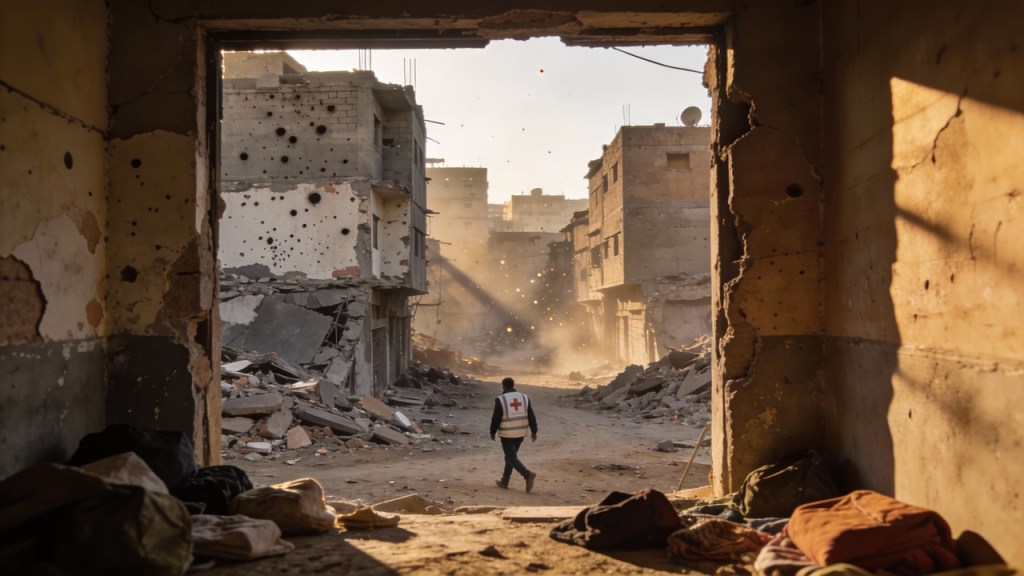
When I was a young student, Article 9 of the Constitution of Japan felt almost sacred to me. It was not merely a legal clause but a moral declaration that seemed to rise above the ordinary logic of power. In a world shaped by military competition and national rivalry, here was a country that had written into its supreme law the renunciation of war. The language was simple and severe:
Aspiring sincerely to an international peace based on justice and order, the Japanese people forever renounce war as a sovereign right of the nation and the threat or use of force as means of settling international disputes.
In order to accomplish the aim of the preceding paragraph, land, sea, and air forces, as well as other war potential, will never be maintained. The right of belligerency of the state will not be recognized.
Article 9 of the Constitution of Japan
Reading those words as a student, I felt their clarity almost physically. The commitment was not conditional. It did not speak in cautious diplomatic phrasing. It declared renunciation as permanent, categorical, and sovereign. In classrooms and discussions, Article 9 was often presented not only as a political framework but as a civilizational achievement. After the devastation of the Second World War, after Hiroshima and Nagasaki, after the collapse of imperial ambition, the promise never to wage war again felt like repentance transformed into principle.
I remember feeling proud, sensing that Japan, having experienced catastrophic failure, had discovered something ethically elevated. It was understandable that some once imagined nominating Article 9 for the Nobel Peace Prize, because it appeared to stand as a sign that humanity could learn from its own destruction. At that time, I did not question the conditions that made such renunciation possible. I did not think about alliances, power balances, or geopolitical calculations. The ideal itself was sufficient. It was clean, uncompromising, and luminous.
Yet time does not stand still, and neither does the world. The moral radiance of youth eventually encounters the complexity of reality.
When Reality Became Ambient
As I grew older, reality did not shatter the ideal, but it complicated it. The rise of China as a military power, North Korea’s missile tests, and Russia’s invasion of Ukraine were no longer distant developments discussed in abstract terms. They became part of the atmosphere of daily life. Missile alerts appeared on smartphones. News feeds showed maps and trajectories. Geopolitics became ambient, shaping the background of ordinary existence.
With that shift came an internal recalibration. It was no longer enough to admire renunciation. One had to ask how renunciation functions in a world where others do not renounce. Interestingly, the generational picture is not what many assume. It is not a simple contrast between idealistic youth and realistic elders. Many young people today have grown up in a world where China’s naval expansion and North Korea’s nuclear capabilities are persistent realities. Their formative years are marked not by postwar repentance but by strategic uncertainty. Their instinctive posture is caution, and their support for stronger defense measures often arises not from aggression but from exposure. Their ideal is stability secured against miscalculation.
Among older generations, the picture is divided. Some, like myself, began with idealism and gradually adopted a more cautious view. Others remain deeply committed to Article 9 as an almost untouchable symbol of peace. They remember a time when anti militarism felt like a moral safeguard against repeating catastrophe. The disagreement between these groups is not about whether war is desirable. It is about diagnosis. One side fears vulnerability. The other fears regression. Both believe they are protecting the future, yet their assumptions about how peace is preserved diverge.
This is the essence of the security dilemma. Actions taken for defense can be interpreted as preparation for aggression, while restraint intended as reassurance can be interpreted as weakness. The dilemma is structural rather than malicious. Beneath that structure, however, lies something even more fragile: trust.
The Photograph in the Pocket
There is a story told in many variations across wars. A soldier kills an enemy in battle. Later, searching the body, he finds a photograph in the fallen man’s pocket, a wife, children, a family standing together. In that moment, the abstraction dissolves. The enemy becomes a father, and the uniform no longer conceals shared humanity.
War requires abstraction. It reduces human beings to categories, targets, and opposing forces. Without that reduction, the act of killing would be psychologically unbearable. Yet once the abstraction falls away, the shared human condition reappears with painful clarity. No one who truly sees that photograph could romanticize war.
In our debates about defense and pacifism, it is essential to remember that both sides carry that image in their imagination. Liberals who defend Article 9 do not wish for battlefields, and conservatives who argue for deterrence do not celebrate bloodshed. They are trying, in different ways, to prevent the moment when a soldier looks into a stranger’s pocket and sees a reflection of his own life. The conflict lies not in desire for war but in differing judgments about how to avoid it.
Yet within our own society, something unsettling occurs. Citizens argue fiercely over how to prevent catastrophe, and the tone hardens. Voices rise. Each side sometimes accuses the other of recklessness or moral blindness. In those moments, the political opponent becomes caricature. Motives are questioned, character is attacked, and shared humanity fades into the background. It is as if we forget that the person on the other side of the argument also has a family, also fears instability, also wants peace.
The tragedy is subtle but real. When we dehumanize one another in the name of preventing war, we rehearse the very psychological mechanism that makes war possible. The security dilemma does not exist only between states. It can exist within a society that forgets how to argue without contempt.
The Locked Door
There was a time, or at least a memory of a time, when doors could remain unlocked. Neighbors knew each other, and trust felt natural rather than calculated. Whether that memory is entirely accurate or partly nostalgic matters less than the emotional shift it represents. Today, leaving a door unlocked feels unthinkable, not because everyone is malicious, but because uncertainty has increased and the cost of misplaced trust feels too high.
Perhaps this change was gradual. Societies grew larger and more anonymous. Digital communication amplified fear and outrage. Geopolitical tensions became more visible and persistent. Economic pressures intensified competition. Each factor eroded a little of the ease that once characterized everyday trust. As uncertainty increases, precaution becomes rational.
In cybersecurity, the concept of zero trust has become central. At first glance, the phrase sounds bleak, as if it assumes universal bad faith. In practice, however, zero trust does not declare humanity corrupt. It acknowledges systemic vulnerability. Access is not granted merely because someone is inside a perimeter. Verification is continuous, and assumptions are minimized. This is not cynicism. It is structured humility.
Trust remains valuable precisely because it is fragile. Verification protects it from catastrophic collapse. By embedding caution into systems, relationships can function without relying on blind faith. Democratic institutions operate in similar fashion. Separation of powers, independent courts, transparent procedures, these are not accusations of evil. They are acknowledgments that power can be misused and must therefore be constrained. The locked door does not signal hatred of neighbors. It signals awareness of vulnerability.
Deterrence Without Worship
Deterrence is morally uncomfortable because it rests on the implicit promise that if attacked, one can respond with force. For those who grew up admiring Article 9 as pure renunciation, this can feel like compromise. Yet total disarmament in a world where others are armed may create dependence on someone else’s deterrence, and that dependence carries its own moral tension.
The central question, then, is not simply whether to possess defensive capability, but how to possess it without allowing it to define identity. Strength can function as architecture rather than ideology. It can be bounded by law, transparency, civilian oversight, and alliances. It can exist without glorification. In that form, it becomes background stability rather than national pride.
Article 9 need not be discarded to accommodate realism. It can serve as moral gravity, pulling against excess and reminding society of the cost of militarism. It can shape tone and limits even as practical measures adapt to changing realities. The danger lies not in preparedness alone, but in worship of preparedness. When strength becomes identity, escalation follows. When strength remains structure, restraint remains possible.
Maturity often resides in this delicate balance, where ideals are neither abandoned nor left unprotected.
Trust as Deliberate Choice
Trust in childhood is natural and assumed. Trust in adulthood is constructed and chosen with awareness of risk. The early admiration of Article 9 was a form of moral innocence, beautiful and sincere. The later recognition of geopolitical tension is not betrayal of that innocence, but its integration into reality.
Zero trust as despair would say that humanity cannot be relied upon at all. Zero trust as maturity says that because humanity is complex, systems must be designed carefully. Trust remains a value, while verification becomes method. Doors may be locked, yet neighbors can still greet each other. Defensive capabilities may exist, yet war need not be romanticized. Political opponents may disagree sharply, yet still recognize one another’s shared desire for stability.
Peace does not arise from innocence alone, nor from power alone. It emerges from disciplined structures and remembered humanity. The image of the soldier discovering the family photograph remains a warning. The goal of every constitutional debate, every defense policy discussion, every heated argument about deterrence or pacifism, is to prevent that moment from becoming reality again.
Trust may be elusive. That is precisely why it is precious. The most realistic ideal may not be the absence of defense, nor the triumph of power, but the steady effort to preserve both security and humanity at the same time.
Image: StockCake
 Tom’s Blog