
It began with a small piece of news. Applications for the Japan Overseas Cooperation Volunteers have declined sharply in the 2020s. The program, widely known as JOCV and administered by the Japan International Cooperation Agency, or JICA, once carried a certain prestige. In the 1990s, it was visible, respected, and often admired. Many young people saw it as a meaningful way to step into the wider world.
As a graduate student during that period, I met several JOCV members. They were thoughtful, serious, sometimes idealistic, sometimes pragmatic, but rarely indifferent. They spoke about rural schools, agricultural projects, public health initiatives. Some were motivated by service, others by curiosity, others by the possibility that overseas experience might shape their future careers. These motivations coexisted without obvious contradiction. It felt natural that young Japanese would go abroad to contribute to development.
Now the numbers are smaller. The headlines suggest disinterest. It would be easy to interpret this as moral decline. Perhaps young people have become more career focused. Perhaps they are less willing to take risks. Yet such explanations feel too convenient. The world has changed. It is possible that the story which once made JOCV compelling no longer resonates in the same way.
The question, then, is not why young people have changed. It may be more accurate to ask whether the narrative surrounding programs such as JOCV has shifted. What once felt aligned with history’s direction may now feel uncertain, or misaligned with contemporary realities.
The Ambiguous Virtue of Doing Good
Even in the 1990s, admiration for JOCV was accompanied by questions. Young volunteers, often with limited professional experience, were dispatched to developing countries. Were they truly helping? Or were they primarily learning? Were they grassroots partners, or representatives of a state-backed presence, protected legally and diplomatically in ways that local actors were not?
The answer was never simple. JOCV members were sincere. They lived in unfamiliar environments, adapted to local conditions, and formed genuine relationships. At the same time, they were supported by the institutional framework of JICA. They were, in a subtle sense, soft diplomats. Their presence reflected Japan’s commitment to official development assistance and peaceful international contribution.
This ambiguity did not invalidate their work. It revealed its complexity. Human intention and institutional structure intersected. Volunteers could grow personally while contributing meaningfully. Yet the dual character of service and self-formation was always present.
The same tension appears within non-governmental organizations and non-profit organizations. NGOs and NPOs operate on donations, grants, and public support. Their mission is to address social problems. Yet their survival depends on the persistence of those problems. If poverty were fully eliminated, funding streams would disappear. The well-known metaphor of teaching people to fish invites reflection. But one might ask whether organizations sustained by external funding are themselves fishing, or being sustained by others who provide the fish.
This is not an accusation of hypocrisy. It is a structural observation. Issue-driven institutions exist within a paradox. They aim to reduce the very conditions that justify their existence. Over time, this can generate tension between mission and survival. It is a tension embedded in the design of the system rather than in the moral character of individuals.
Slum Tourism and the Economics of Compassion
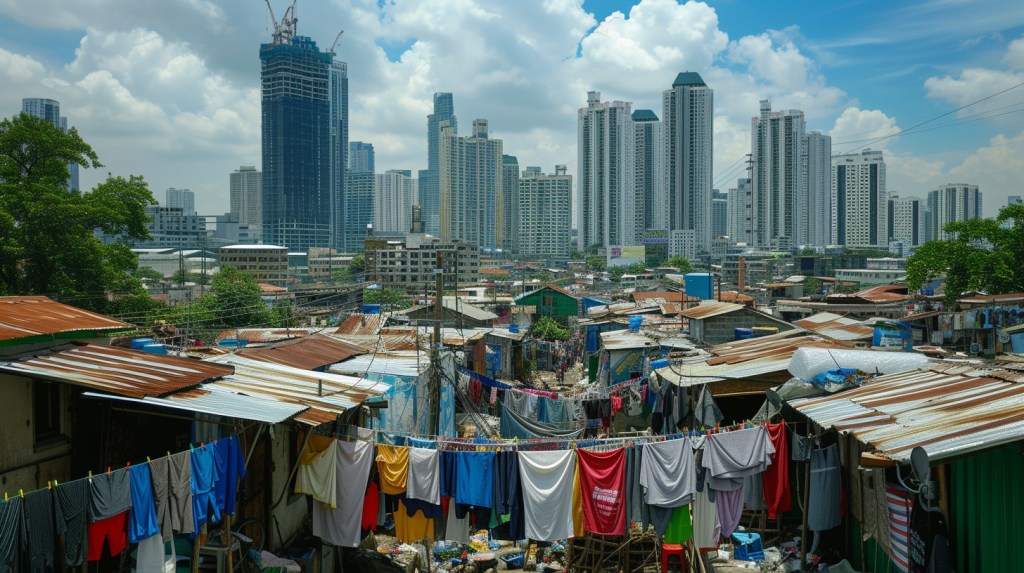
The tension becomes more visible in certain environments. In some well-known urban poverty areas, multiple NGOs operate side by side. They compete for funding, for visibility, for partnerships. Meanwhile, the surrounding society may be changing. Middle classes expand. Digital connectivity increases. Local entrepreneurship grows. Yet the imagery used in fundraising campaigns often lags behind this transformation.
In such settings, one can sense a competition over territory. Each organization defines its scope, its beneficiaries, its metrics of success. The effort to survive as an institution becomes intertwined with the effort to solve social problems. This does not mean that NGOs desire poverty to persist. It means that their continuity depends on maintaining relevance, and relevance is tied to the persistence of identifiable issues.
The same structural logic can appear in public agencies. The United States Agency for International Development, known as USAID, has faced restructuring and reduction in recent years. Official development programs encounter domestic scrutiny. Citizens question overseas spending when domestic needs feel urgent. As geopolitical priorities shift, institutions designed for a previous era find themselves under pressure.
In this environment, skepticism grows. Are we sustaining systems because they are still needed, or because they have become self-perpetuating? This question does not only apply to NGOs or development agencies. It touches many public sectors. Institutions, once established, rarely dissolve themselves gracefully. They adapt, but often slowly. The economics of compassion can intertwine with the economics of survival.
The Broken Promise of the 1990s
Behind these institutional tensions lies a broader historical shift. In the 1990s, globalization carried an implicit promise. Economic integration would foster political liberalization. Membership in international institutions would encourage convergence. The spread of technology would empower individuals and civil society. It was widely believed that development and democracy would advance together.
China’s accession to the World Trade Organization in 2001 symbolized that optimism. Integration into global markets was expected to gradually reshape governance. Instead, economic growth accelerated while political centralization remained strong. Technological advancement enhanced state capacity as well as economic dynamism. Prosperity did not automatically produce liberal democracy.
Russia’s trajectory added to the uncertainty. Post-Cold War hopes for steady integration into a cooperative international order gave way to renewed geopolitical tension. Economic interdependence did not erase strategic rivalry. The belief that modernization would naturally harmonize political systems proved incomplete.
Climate politics introduced further complexity. Activism flourished in open societies where criticism was possible. In more restrictive systems, public dissent was limited. This asymmetry sometimes created the perception that democratic countries were subject to disproportionate moral scrutiny. Whether fully justified or not, the perception fed frustration. The moral clarity of the earlier era began to fade.
What emerged was not only geopolitical tension but also disappointment. Many who believed in the 1990s narrative recognized that history did not move in a single, predictable direction. Economic growth did not guarantee political convergence. Technology did not inherently liberate. The confidence of that earlier decade began to appear overly certain.
The Collapse of the Arrow
The deeper change is philosophical. The 1990s carried a sense of teleology. History seemed to progress toward a defined horizon. Development assistance, volunteerism, and global integration were not merely policy choices. They felt aligned with a larger trajectory.
The 2020s do not offer the same assurance. Economic integration coexists with political divergence. Technological progress enables both empowerment and control. Climate change imposes constraints that no single ideology can resolve. Power remains central to international relations.
The disappearance of inevitability unsettles narrative formation. When history appears directional, it is easier to mobilize collective imagination. When outcomes are contingent, skepticism grows. It becomes harder to articulate a shared mission without sounding simplistic.
Yet relinquishing inevitability does not require abandoning responsibility. Cooperation can be grounded in necessity rather than destiny. The recognition that history does not guarantee convergence may invite a more sober, realistic form of engagement. It encourages humility. It asks institutions and individuals alike to operate without the comfort of certainty.
Institutions in a Changed World
Returning to JOCV and JICA, one can see how deeply they were shaped by the earlier narrative. Their founding ethos reflected postwar reconstruction, peaceful international contribution, and a belief in developmental partnership. The image of young volunteers contributing skills abroad resonated in a world where modernization seemed linear.
In a multipolar environment marked by technological complexity and strategic competition, that imagery feels less straightforward. Emerging economies possess their own expertise. Knowledge flows in multiple directions. Digital collaboration reduces the symbolic distance between societies. The idea of dispatching young volunteers as representatives of development may require reinterpretation.
Institutions, however, carry historical memory. Their legal structures, professional cultures, and public identities are anchored in earlier eras. Reinvention can threaten coherence. As a result, adaptation often occurs gradually. Declining applications to volunteer programs may signal not moral apathy but narrative fatigue. The story that once made such service compelling may need revision.
The challenge is not to abandon international cooperation. It is to recalibrate its framing. Assistance defined by hierarchy may give way to exchange defined by reciprocity. Programs may need to emphasize shared learning, joint problem solving, and networked collaboration rather than one-directional transfer.
After Optimism: Shared Fragility
If the earlier narrative emphasized helping others catch up, a new narrative might begin from shared fragility. Climate instability affects both advanced and emerging economies. Aging populations challenge societies in different but overlapping ways. Artificial intelligence reshapes labor markets and governance structures across political systems. Supply chains reveal mutual dependence.
In such a context, international engagement is less about elevating others and more about sustaining interconnected systems. Cooperation becomes pragmatic and relational. It does not promise convergence toward a single model. It acknowledges pluralism while addressing common vulnerabilities.
Volunteerism could evolve accordingly. Instead of symbolizing the transfer of knowledge from a developed to a developing context, it might represent reciprocal immersion. Participants might learn as much as they contribute, openly acknowledging that expertise flows both ways. Institutions such as JICA could position themselves as facilitators of mutual resilience rather than benefactors of development.
This narrative is humbler than that of the 1990s. It lacks the dramatic confidence of teleological progress. Yet it may be more aligned with present realities. It recognizes that no society stands outside systemic risk.
Living Without Certainty
The decline in JOCV applications is a small indicator within a larger historical transition. It reflects not only changing career calculations but also a shift in collective imagination. The world no longer appears to move along a single, reassuring arc. Institutions built for that arc must adjust.
For those who once found meaning in the clarity of the 1990s, the present can feel unsettled. Yet the absence of inevitability does not eliminate purpose. It reframes it. Cooperation remains necessary, even if it is no longer guaranteed to produce convergence. Solidarity can persist without romanticism.
The volunteers may be fewer. The narratives may be more cautious. History may resist simplification. Still, responsibility endures. To engage across borders, to learn from difference, and to address shared fragility are choices that do not depend on an arrow pointing forward. They depend on recognition that interdependence is real.
In that recognition, a more grounded and enduring form of commitment may take root.
Image: StockCake
 Tom’s Blog