
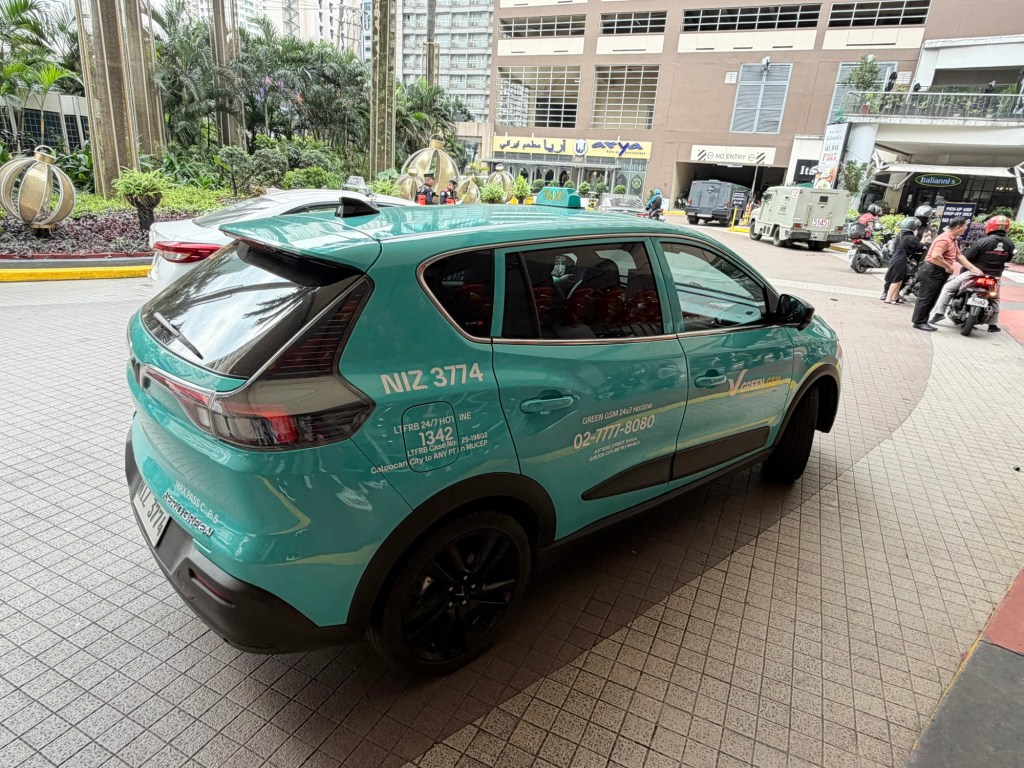
In recent months, electric taxis have begun to appear more frequently on the streets of Manila. At first they felt like isolated sightings, a curiosity rather than a pattern. Then one afternoon I stepped into one without much planning, and the pattern became unmistakable.
The car was quiet in a way that changed the rhythm of the ride. There was no vibration from an engine, no subtle growl beneath acceleration. The interior felt familiar, yet something about the silence gave it a different presence. The driver told me the vehicle was made by VinFast, a Vietnamese manufacturer expanding across Southeast Asia. He spoke with a mixture of curiosity and pride about the growing fleet, about how these units were being deployed through taxi networks rather than waiting for individual buyers.
As we moved through Manila traffic, I noticed other electric vehicles on the road. BYD units were visible as well, part of a wider shift that no longer felt theoretical. It was happening in ordinary commutes. The automotive hierarchy that had long been dominated by established Japanese, American, and European brands now seemed more fluid.
The change did not announce itself with fanfare. It simply accumulated in the streets. Yet sitting in that quiet cabin, listening to the driver explain how more units were arriving, I felt that I was witnessing more than a new product category. I was watching a structural adjustment unfold in real time.
That realization pulled me backward unexpectedly, toward a very different memory.
A River in Bataan
The first Vietnamese people I encountered were not industrial strategists or EV engineers. They were refugees.
In the 1990s, in Bataan, there was a refugee camp where Vietnamese boat people were processed and prepared for resettlement. I was young at the time. I did not understand geopolitics or development trajectories. I understood only that there were families who had crossed the sea under difficult circumstances, and that Filipino teachers were helping them learn English before they moved onward, often to the United States.
I remember a picnic by a river near the camp. We gathered with some of the refugees and the teachers. There was laughter, shared food, and songs. The Vietnamese youths sang pop songs that carried a distinct tonal quality. To my ears they sounded almost like French chanson. Later I learned that French cultural influence remained visible in Vietnam, not only in music but in bread and coffee traditions that traced back to colonial history.
What struck me even then was their hopefulness. Despite displacement, there was a forward looking energy in their faces. They were preparing for another chapter.
At that time, the Philippines appeared relatively stable in comparison. It served as a transitional platform. Vietnamese refugees learned English from Filipino teachers before beginning new lives elsewhere. The direction of movement seemed clear.
Three decades later, the direction feels more complex. Young Filipinos travel to Vietnam for leisure. Vietnamese companies deploy electric taxis in Manila. The river memory and the electric street exist in the same lifetime. The inversion is not absolute, but it is unmistakable enough to feel dramatic.
That emotional contrast opens into a broader question about technological waves and development paths.
When the World Became Flat
In the early 2000s, The World Is Flat captured the spirit of a particular moment. Thomas Friedman described phases of globalization, from colonial expansion to multinational industrialization, and then to a new stage in which individuals could collaborate across borders through digital networks. Fiber optic cables and internet platforms reduced the significance of geography for certain kinds of work.
The Philippines entered that third phase with unusual strength. English proficiency, a large young population, and cultural familiarity with Western markets made it well positioned for business process outsourcing. Call centers, back office operations, technical support, and accounting services grew rapidly. Manila and other cities became digital nodes in a global network.
This path differed from the industrial trajectories of Japan, South Korea, and China, which had earlier built dense manufacturing ecosystems. The Philippines leaned into services rather than heavy industry. It was a rational adaptation to the technological environment of that time. Internet connectivity allowed value to flow through language and coordination rather than through steel and assembly lines.
In many ways, this model worked. It generated employment and integrated the country into global supply chains of a different kind. The world felt flat because voice calls and data packets traveled seamlessly across oceans.
Yet this wave depended on human mediation. Behind every call, every document processed, every customer interaction, there was a person sitting in front of a screen. The digital infrastructure enabled the connection, but human cognition powered the service.
That distinction becomes important when the next wave arrives.
Batteries and Software: Reopening the Industrial Gate
For decades, entering the automobile industry was extraordinarily difficult. The internal combustion engine was a complex mechanical system requiring precision engineering, long supplier relationships, emissions control expertise, and vast capital. The ecosystem surrounding it developed over generations. It was not easily disrupted.
Electric vehicles altered the architecture.
Batteries remain technologically demanding, yet the overall system shifts emphasis from mechanical intricacy to energy storage and software integration. Motors have fewer moving parts than combustion engines. Control systems depend heavily on electronics and code. Updates can be delivered over the air. Vehicles increasingly resemble software platforms on wheels.
This change lowers certain barriers while raising others. It reduces the dominance of legacy engine expertise and elevates the importance of battery technology, supply chain coordination, and digital systems. Companies such as Tesla, BYD, and VinFast emerged within this reconfigured landscape.
When I sat in that VinFast taxi in Manila, I was not simply riding in a new brand. I was experiencing the result of a technological stack that had shifted. The difficulty of entering the automotive sector had not disappeared, but its nature had changed. The gate had reopened in a different form.
Vietnam’s rise in this context is not accidental. It reflects integration into regional manufacturing networks, deliberate industrial policy, and responsiveness to new technological platforms. The EV wave is not merely about sustainability. It is about who can assemble batteries, manage software, and coordinate supply chains in a digitally mediated environment.
The pattern resembles earlier technological transitions. When complexity migrates from one layer of a system to another, new entrants can compete.
The question is what happens when complexity migrates again, this time from physical production to cognition itself.
From Flat to Fully Digital
The internet flattened the world for services. Artificial intelligence may now compress it further.
Many of the tasks that defined the rise of BPO involve structured communication, document processing, translation, summarization, and customer interaction. Generative AI systems can perform portions of these activities with increasing competence. They draft responses, analyze data, and handle routine queries without direct human intervention.
This development does not eliminate the need for people, but it reshapes the value chain. Instead of thousands of agents responding manually, fewer workers may supervise systems, refine outputs, and handle complex exceptions. The center of gravity shifts from execution to orchestration.
If Globalization 3.0 empowered individuals through digital connectivity, what might be called Globalization 4.0 empowers machines to operate within those digital networks. Global integration becomes internal to platforms and algorithms rather than solely between human participants.
The emotional impact of this shift is complex. For countries that benefited from service globalization, AI introduces uncertainty. The comparative advantage that once seemed durable may erode. Yet the pattern mirrors earlier waves. When EVs restructured automotive manufacturing, they did not end mobility. They altered who could compete and how value was created.
Similarly, AI does not end work. It redistributes it.
The world is no longer merely flat. It is recursive. Digital systems now generate and process their own outputs. Intelligence becomes embedded within infrastructure.
Standing at this juncture, it is difficult not to feel the drama of compression. Within one lifetime, refugees became manufacturers. Service hubs confront cognitive automation. Streets once filled only with combustion engines now carry electric fleets built by countries that were once rebuilding from war.
Living Through Waves
Looking back across these decades, I see not winners and losers, but waves.
The refugee era in Bataan was shaped by geopolitical upheaval and post war reconstruction. The BPO era was shaped by fiber optics and internet connectivity. The EV era is shaped by batteries and software defined systems. The AI era is shaped by machine learning models that operate on vast digital corpora.
Each wave lowers certain barriers and raises others. Each reorders advantage. None permanently fixes hierarchy.
The river in Bataan and the electric streets of Manila belong to the same continuum. They are separated by technology as much as by time. The young people who once sang French inflected pop songs by the water grew up in a Vietnam that integrated into manufacturing supply chains. Filipino professionals who built careers in call centers now confront tools that automate parts of their expertise.
This is not a moral story about who advanced more wisely. It is a reminder that development paths are contingent on technological platforms. When platforms change, trajectories adjust.
The electric taxi I rode that afternoon did not announce a new era with grand language. It simply moved through traffic, quiet and efficient. Yet inside that cabin were layers of history. Refugee memories. Internet globalization. Battery chemistry. Artificial intelligence on the horizon.
Technological waves do not erase what came before. They accumulate. The river remains in memory even as the streets hum with electricity.
In that accumulation lies both uncertainty and possibility.
Image: A photo captured by the author
 Tom’s Blog