
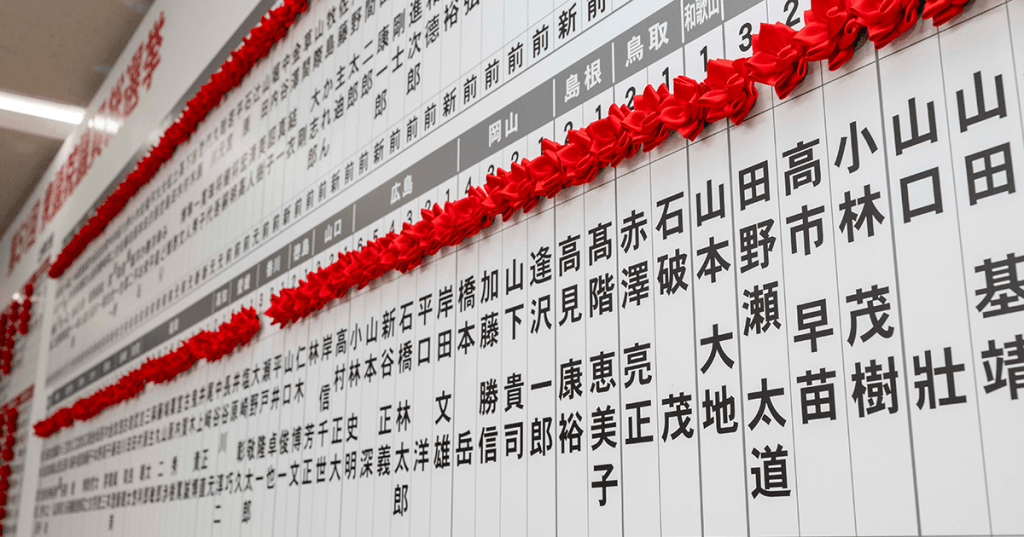
This election did not unfold as a slow reveal. By late evening, the direction was already unmistakable. Exit polls aligned closely with district level reporting, and proportional results reinforced the same conclusion. What is often a long night of speculation resolved itself quickly into certainty.
That speed mattered. It denied space for doubt to expand into grievance, and it prevented competing interpretations from hardening before the facts had fully emerged. There was no prolonged limbo in which claims of manipulation or procedural ambiguity could take root. Instead, the verdict formed clearly and publicly, while people were still watching.
By the time most households turned off their televisions, it was evident that the ruling bloc led by Sanae Takaichi and the Liberal Democratic Party had secured not merely a victory, but a commanding mandate. The remaining question was not whether they had won, but how decisively the electorate had spoken.
What followed was therefore not shock or celebration alone, but reflection. When results arrive this clearly, citizens are compelled to confront what they have chosen, and why.
What Made This Victory Historic
The scale of the outcome placed it beyond routine political turnover. The LDP did not simply hold power through narrow margins or opposition fragmentation. It expanded its seat count across districts and reinforced coalition stability in a way that few had predicted so confidently before election day.
This matters because the election was not driven by emergency. There was no war, no economic collapse, no sudden crisis that forced voters into consolidation out of fear. Instead, the decision was made under relatively stable conditions. Voters were not fleeing uncertainty. They were choosing continuity.
In many democracies today, ruling parties survive through erosion rather than confidence. They limp forward as alternatives fail to cohere. This result stood apart. Power was not scattered. It was entrusted.
That distinction changes how the outcome should be read. This was not an expression of resignation. It was an expression of judgment.
A Leader Respected Without Becoming Untouchable
At the center of that judgment stood Takaichi herself.
Her appeal did not resemble populism, nor did it rely on emotional mobilization. She did not promise dramatic rupture or present herself as a singular solution. Her tone remained measured, sometimes even austere. She spoke carefully, often emphasizing limits, tradeoffs, and institutional process.
For many voters, this restraint felt refreshing rather than cold. In a political environment saturated with performance, her seriousness signaled respect for the audience. She did not assume that persuasion required simplification or exaggeration.
This posture was reinforced by substance. Takaichi is widely regarded as one of the most knowledgeable and experienced lawmakers in the Diet. Her command of policy detail, legislative mechanics, and constitutional boundaries is not performative. It emerges naturally in how she answers questions, frames decisions, and acknowledges constraints.
Experience alone does not inspire trust. Experience paired with humility does. Voters sensed that her authority was not inherited or assumed, but accumulated through long engagement with governance itself. This allowed admiration to coexist with scrutiny.
Even after the scale of the victory became clear, her public remarks remained restrained. She spoke of responsibility rather than validation, of obligation rather than triumph. This mattered. It signaled that the mandate belonged to the office, not to her ego.
The Collapse of Aggressive Opposition Politics
The losses suffered by certain opposition figures become intelligible in this context.
Several politicians known for confrontational rhetoric, personal attacks, and moral denunciation failed to retain their seats. Their campaigns relied heavily on accusation and alarm, often framing disagreement as illegitimacy rather than difference. On election night, these approaches were rejected quietly but decisively.
This was not a blanket rejection of opposition. Voters did not demand silence or conformity. What they rejected was a mode of politics that substituted hostility for argument and volume for seriousness.
By contrast, opposition figures who practiced measured critique, who engaged policy rather than character, and who acknowledged institutional reality fared noticeably better. Some retained their positions. Others improved their margins. The electorate demonstrated an ability to differentiate rather than polarize.
This filtering effect suggests a shift in political maturity. Citizens showed that they could tolerate disagreement while rejecting intimidation. Democracy did not flatten into unanimity. It clarified its standards.
Media Framing and the Erosion of Borrowed Authority
The campaign also exposed a growing distance between sections of the mainstream media and public judgment.
For months, much coverage framed Takaichi’s leadership as dangerous, regressive, or democratically suspect. These narratives persisted even as her administration operated through parliamentary debate, international diplomacy, and transparent decision making.
Many voters noticed the rigidity. Criticism itself was not the problem. The problem was repetition without revision. When framing remains unchanged despite new evidence, it begins to resemble advocacy rather than analysis.
Election night made this visible. Predictions rooted in those frames collapsed quickly. Commentary struggled to adjust to results that contradicted long held assumptions.
What eroded was not journalism as a profession, but assumed interpretive authority. Audiences no longer accepted explanations simply because they came from established outlets. Credibility had to be earned again, in relation to facts rather than narratives.
Leadership Tested Under External Pressure
Another factor shaping voter response was how the administration responded to external criticism.
Takaichi faced sustained attacks from abroad, particularly from China aligned voices that questioned her legitimacy and portrayed her as anti democratic. Some domestic actors echoed these claims, often framing them as principled concern.
Her response was not rhetorical escalation. It was procedural clarity.
She placed herself before the electorate. She called an election. She accepted the risk inherent in open judgment. This choice reframed the entire debate.
Democracy is not defended by declaration, but by practice. Accusations lose force when confronted with the ballot box. Voters understood this distinction instinctively. Whatever their policy disagreements, they recognized a leader willing to be judged rather than insulated.
Younger Voters and Discernment Without Cynicism
Younger voters played a notable role in this election, not through blind enthusiasm, but through selective trust.
They did not inherit media narratives automatically, nor did they align reflexively with ideological camps. They compared claims against conduct and assessed tone alongside substance.
For many, Takaichi’s lack of populist theatrics did not diminish her appeal, but instead signaled seriousness rather than detachment. Her refusal to perform certainty resonated with a generation accustomed to evaluating credibility across fragmented information environments.
This did not reflect cynicism. It reflected discernment. Democracy, for them, was not something to cheer abstractly, but something to test.
Gratitude for a Democracy That Still Functions
At this point, reflection becomes unavoidable.
What invites gratitude is not the dominance of a party, but the functioning of the system itself. A democracy capable of elevating a leader widely respected for competence and character remains rare.
The contrast with China is structural rather than rhetorical. There, leadership is insulated from electoral correction. Here, authority was tested, contested, and reaffirmed.
Such systems endure only when citizens remain attentive. Gratitude without vigilance becomes complacency. Vigilance without gratitude becomes cynicism. The balance between them is what keeps democratic life intact.
After the Verdict, the Work of Attention
A decisive mandate does not conclude democratic responsibility. It intensifies it.
Takaichi’s humility after victory set an important tone. The electorate’s non-blind respect completed it. Admiration did not dissolve into exemption. Support did not erase scrutiny.
If a new era is arriving, it will not be defined by unanimity or silence. It will be defined by standards that apply to everyone. Serious leadership. Serious opposition. Serious citizens.
This election clarified those standards. The work now is to keep them alive, not through noise, but through sustained attention.
Image: LDP official website
 Tom’s Blog