
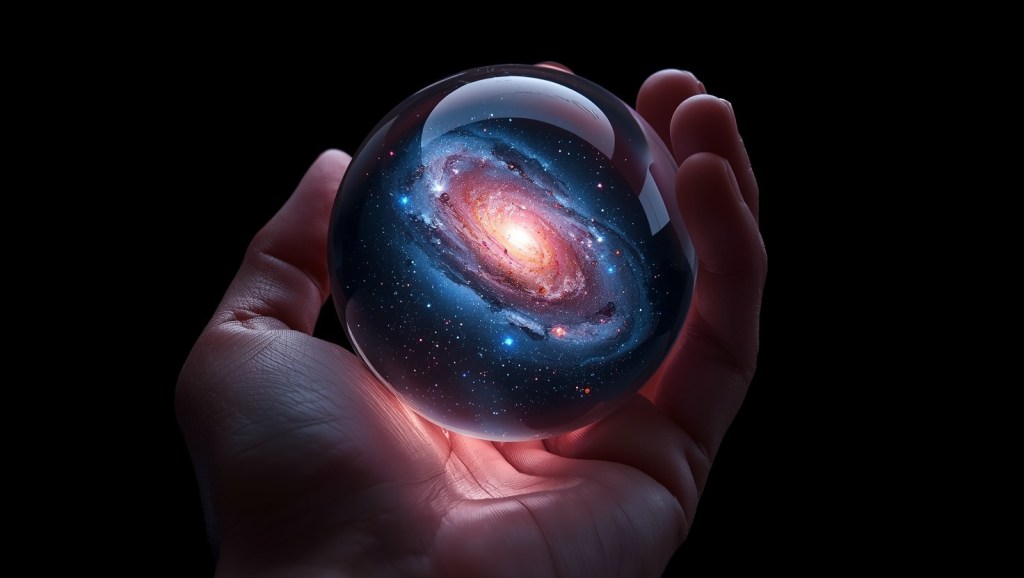
There are moments when the universe stops being beautiful and starts being heavy. It might happen while watching a documentary that calmly lists numbers too large for the body to hold, billions of years, billions of galaxies, distances measured in light rather than steps. It might happen at night, standing still under a clear sky, when the stars feel less like decoration and more like witnesses to one’s own smallness. The feeling is not curiosity. It is pressure.
What makes this pressure unsettling is not ignorance. Most of us already know the facts. We know that the universe is old beyond intuition and wide beyond imagination. We know that our lives occupy an almost negligible span within it. The unease comes from something else. It comes from the realization that our daily lives, with their waiting, aging, planning, and regret, are unfolding inside a framework that feels indifferent to them.
And yet, the next morning still requires coffee to brew. A flight still takes hours. A body still weakens. The vastness does not excuse us from sequence. We remain bound to distance and time even as we become aware of how overwhelming they are.
Rather than trying to escape that tension, it is worth asking what kind of reality gives rise to it. What if space and time are not the deepest layer of what is real, and yet remain fully real for creatures like us. What if our sense of being overwhelmed is not a mistake, but a clue.
The Interface and the World Behind It
A useful way to approach this question is through the idea of an interface. An interface is not a lie. It is a translation. The icons on a screen do not reveal the circuitry beneath them, but they are not arbitrary either. They are shaped so that a user can act meaningfully within a system that would otherwise be inaccessible.
Seen this way, space and time begin to look less like absolute containers and more like a kind of interface. Modern physics increasingly suggests that spacetime may be emergent, generated from deeper relationships such as information, correlation, or entanglement. This does not mean spacetime is unreal. It means it may not be fundamental.
The distinction matters. An interface can be accurate without being ultimate. A map can guide without revealing the molecular structure of paper. In the same way, space and time may be faithful representations of something deeper, even if they are not the final story.
This perspective does not diminish lived experience. If anything, it clarifies it. The fact that a folder icon is not a real folder does not make the files inside it meaningless. The interface is where meaning happens because it is where interaction happens.
The danger comes from confusing insight with escape. Recognizing that spacetime might be emergent does not allow us to bypass it. Knowing the structure of an interface does not let us step outside it while still remaining users. We are not spectators peering at spacetime from the outside. We are participants whose bodies, memories, and identities are written in its terms.
Why We Cannot Skip What We Suspect Is Not Ultimate
At first glance, this realization can feel disappointing. If spacetime is not ultimate, why are we still so constrained by it. Why does a journey still take time. Why does loss still hurt. Why does aging remain irreversible.
The answer is simple, almost tautological. Distance is distance for beings made of distance. Time is time for beings made of sequence. We cannot skip what we are composed of.
This is not a failure of imagination. It is a consequence of ontology. Our bodies are processes. Our thoughts unfold. Memory itself depends on irreversibility. To remove sequence would not free us. It would dissolve us.
This helps explain why older perspectives persist even after paradigm shifts. The transition from a fixed cosmos to a heliocentric one, from absolute space to relativity, from determinism to quantum probability, did not erase everyday experience. They reframed it. Newtonian intuition still works at human scale. The floor remains flat enough to walk on.
In the same way, the sense of vast distance and one way time remains valid where we live. It is not an illusion to be corrected. It is a condition to be inhabited. The discomfort arises when we expect ultimate answers to behave like local ones.
Understanding spacetime as an interface does not cancel its authority over our lives. It explains why that authority exists at all.
The Small Cheating That Keeps the Lights On
There is, however, one place where the rules soften. At the smallest scales of reality, nature allows behavior that feels like a quiet breach of common sense. One example is quantum tunneling.
In ordinary experience, barriers are barriers. If something lacks the energy to cross a hill, it remains trapped. At the quantum level, particles behave differently. A particle described as a probability wave can appear on the other side of a barrier without traversing the space in between in any classical sense.
This is not metaphor. It is measured behavior. And it matters profoundly. The fusion reactions that power the sun depend on it. Without tunneling, atomic nuclei would repel each other indefinitely. The sun would not shine. Life would not emerge.
What is striking is not that nature cheats the rules, but that the cheating is constrained. It works only at scales where individuality and complexity are minimal. As systems grow larger, probabilities collapse into near certainty. Billions of particles acting together behave predictably. The interface stabilizes.
This suggests a layered reality. At the micro scale, spacetime behaves like a loose guideline. At the macro scale, it becomes rigid. Our lives unfold where rigidity dominates, but they are powered by softness beneath.
The implication is subtle but important. The universe is not a sealed box. Its order rests on a foundation that is stranger and more flexible than the surface rules suggest. Our inability to skip distance does not mean skipping is impossible in principle. It means it is incompatible with being what we are.
Diversity as the Music of the Dots
If we follow reality down to its smallest components, distinctions begin to fade. An electron here is indistinguishable from an electron billions of light years away. At that scale, identity disappears. Everything becomes repetition.
This raises a deeper question. If the foundation is uniform, where does diversity come from. Why does anything feel unique.
The answer lies not in the dots themselves, but in their arrangement. A single pixel carries no image. Millions of pixels arranged in precise relation can produce a face, a landscape, a memory that makes the chest ache. Diversity is not located at the bottom. It emerges at the level of pattern.
Our scale is where pattern becomes experience. The structures are stable enough to persist and flexible enough to change. They can carry memory, expectation, regret, hope. They can age.
Mortality belongs here. So does wonder. Because we die, time matters. Because we cannot reach the stars, the stars remain distant enough to inspire awe. If everything were equally accessible, nothing would feel significant.
The interface is not a prison. It is a shaping force. Limits do not only restrict. They also give form. A melody exists because it ends. A life matters because it does not repeat.
The Irreplaceable Observer
Here the paradox sharpens. Measured against cosmic scale, a human life is negligible. Measured as an event in the history of the universe, it is singular.
No configuration of matter identical to this one has occurred before. None will occur again. Not because the atoms are special, but because the sequence is unrepeatable. The particular ordering of inheritance, chance, environment, and choice that produces a single consciousness does not recur.
This is not ego. It is arithmetic.
At our scale, something unprecedented happens. The universe becomes aware of itself locally. Not in the abstract sense of equations, but in the concrete sense of feeling overwhelmed by the night sky, of asking why anything exists at all.
An electron does not wonder what it is. A galaxy does not grieve. Awareness requires complexity, but also finitude. It requires a perspective that can be lost.
This may explain why concepts like omnipresence are intelligible without being attainable. We can understand what it would mean to exist beyond space and time precisely because we do not. We can accept our absence before birth and after death because we already know, intuitively, that existence is not exhausted by our personal timeline.
Our scale is where seeking becomes possible. God is not reached because reaching would end the seeking. Distance remains because longing needs space.
Inter Subjectivity and the Larger Mind
Awareness, however, is not only individual. The interface we inhabit is shared. We agree, often without noticing, on what counts as far, as late, as dangerous, as sacred. This shared structure allows meaning to pass between us.
In this sense, subjectivity is already inter subjectivity. The world appears to each of us privately, but along common axes. Without that overlap, there would be no language, no science, no mourning together.
From here, the idea of collective consciousness no longer feels careless or inflated. It feels like an extension of something already present. If awareness emerges where integration is high, then the human world itself is a field of partial integration. Each perspective is fragmentary, but not isolated.
Poetically, one might say that the universe sees itself through many apertures. Theological language has long suggested something similar. God sees Himself. Not as a mirror image, but as lived expression.
Whether or not our individual consciousness integrates into a larger whole after death is not something that can be settled here. What can be said is more modest. Even now, we are not as separate as we feel. Our seeing is already woven into a broader pattern of seeing.
The freedom this offers is quiet. We still walk the distance. We still wait for time to pass. But the vastness presses less heavily when we understand what kind of reality it belongs to.
We live at the scale where meaning appears. Not because it is the only scale that matters, but because it is the scale where matter becomes witness. We do not escape the interface. We learn to inhabit it with clarity, humility, and care.
Image: StockCake
 Tom’s Blog