
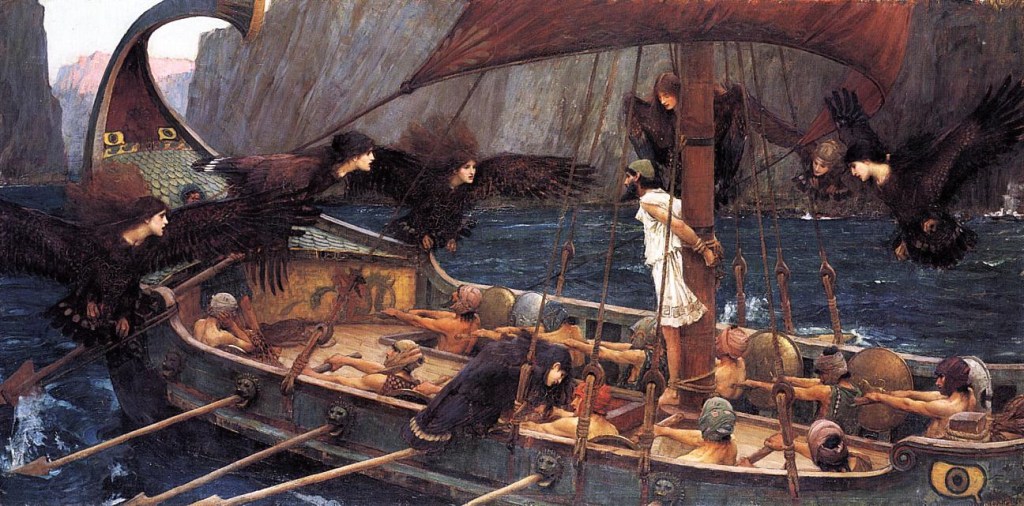
In Homer’s story, Ulysses knows something important about himself. He knows that when the sirens begin to sing, reason will not be enough. Their song will not argue. It will not persuade. It will simply feel irresistible. So he does something curious. He does not ask for better arguments or stronger resolve. He asks to be tied to the mast.
The wisdom of the act lies in its timing. Ulysses binds himself while his mind is still clear. He does not wait for temptation to arrive. He limits his future freedom in order to protect what matters more than freedom in the moment. He chooses constraint as a form of care.
Modern writers face a quieter version of the same problem. There is no dramatic song, no obvious danger. Instead, there is a steady hum of improvement. Advice appears constantly. Screenshots of writing setups circulate. Toolchains are displayed with pride. Writing is discussed as something that must be engineered correctly before it can safely begin.
This shift rarely presents itself as ideology. It arrives politely, through examples and recommendations. Someone writes in a code editor. Someone else keeps a journal in a repository. Another shares a carefully constructed knowledge graph. None of this feels aggressive. Yet a subtle message accompanies it. Serious writing, we are shown, looks like this.
What gives this message its power is not the tools themselves, but the confidence surrounding them. We live in a culture where complexity is often mistaken for discipline. A system that requires configuration appears more intentional than one that simply works. Over time, this aesthetic of seriousness begins to shape how writers judge their own habits.
The problem is not that tools exist. It is that tools begin to suggest what deserves attention. They whisper that improvement lies just one setup away. As the environment grows busier, even quietly busy, writing loses something delicate. The sentence starts responding to the system rather than to the thought that called it into being.
This is the moment when restraint becomes meaningful. Not as refusal, but as foresight. Like Ulysses, the writer begins to sense that future temptation will not be met by willpower alone. The solution is not better judgment in the moment, but a decision made earlier. A binding chosen in advance.
This is where the idea of a writer’s Ulysses Pact begins. Not as mythic decoration, but as a practical stance toward attention, one that treats limitation not as loss, but as protection.
The Migration of Method
There is a familiar historical pattern behind this moment. Human and social sciences once stood closer to philosophy, literature, and lived experience. Over time, they absorbed the methods and authority of the natural sciences. Measurement, objectivity, and formal structure brought credibility and reach. They also narrowed what could be said comfortably.
This was not an error so much as an inheritance. When a discipline succeeds, its methods begin to look universal. The danger lies in forgetting that methods are shaped by the nature of their objects. What works well for particles or cells may distort meaning when applied to culture, memory, or intention.
Something similar is happening now with engineering culture and writing. Concepts such as optimization, scalability, version control, and traceability migrate outward from software development into personal knowledge work. They promise clarity, safety, and rigor. Rarely do they ask whether writing actually benefits from those values in the same way.
Writing is not judged by execution. It is not expected to behave predictably. Its failures are rarely catastrophic, but they are deeply human. A loss of voice. A flattening of tone. A creeping self-consciousness that makes each sentence hesitate before it arrives.
When engineering methods are imported without reflection, writing becomes subtly reframed. The writer is encouraged to manage rather than inhabit the work. Attention shifts from listening inward to monitoring outward. The result can look impressive while feeling oddly distant.
This is not a criticism of engineering. It is an argument for boundaries. Disciplines thrive when their methods are aligned with their aims. Writing deserves tools that respect its interior rhythms rather than overwrite them.
Writing as Continuity, Coding as Convergence
The difference between writing and coding is often discussed as a difference of creativity versus logic. That framing misses something essential. The deeper difference lies in orientation.
Code moves toward convergence. It seeks a state where ambiguity is eliminated and behavior is correct. Revision is corrective. History matters because regressions matter. A single oversight can undo the whole.
Writing moves through continuity. It often begins without clarity and finds coherence by staying with uncertainty. Revision is not correction but transformation. Earlier sentences are not mistakes. They are steps that had to exist for later understanding to appear.
For programmers, seeing differences between versions is reassuring. It offers control and confidence. For writers, that same visibility can become intrusive. Writing depends on a certain kind of forgetting. The sentence needs permission to replace itself without explanation.
Version control systems externalize memory. They preserve every turn, every branch, every alternative. This is invaluable when correctness is the goal. It can be destabilizing when presence is the goal. The writer begins to write with an awareness of the archive rather than an openness to the moment.
There is also a psychological cost. Writing already involves exposure. When tools encourage constant evaluation, the writer risks becoming a curator of drafts instead of a participant in thought. The mind shifts from listening to managing.
Seriousness in writing does not require adopting engineering rituals. It requires patience with the slow formation of meaning.
Binding Ourselves in Advance
The idea of the Ulysses Pact offers a way to clarify this difference.
In the myth, Ulysses knows that future temptation will overwhelm present resolve. He does not trust his willpower in the moment. So he binds himself in advance, choosing limitation while he is still clear-minded. The wisdom of the act lies not in strength, but in foresight.
Engineers practice this instinctively. Tests are written so memory does not have to be trusted. Type systems constrain expression so errors are harder to introduce. Version control exists so mistakes do not become irreversible. These are pacts against failure, chosen before pressure arrives.
Writing faces a different danger. Not incorrectness, but interruption. Not bugs, but endless possibility. The sirens that call to the writer are not errors to fix, but distractions that promise improvement, insight, or mastery elsewhere.
The writer’s Ulysses Pact therefore binds against a different temptation. It limits tools not to prevent mistakes, but to protect attention. It reduces choice not because choice is bad, but because too much choice fractures presence.
Seen this way, the pact is not anti-discipline. It is discipline redirected. It accepts that the writer’s future self will be tempted to adjust, optimize, reorganize, and improve the system instead of staying with the sentence. The pact intervenes early, while clarity still exists.
This is where plain text begins to appear not as minimalism, but as strategy.
Plain Text as a Voluntary Constraint
Plain text is quiet. It does not advertise possibility. It does not ask to be customized. It waits.
Choosing plain text is not a rejection of sophistication. It is a conscious narrowing of the field in which distraction can arise. By limiting what can be done, the writer limits what must be decided. The surface area of hesitation shrinks.
Plain text files endure. They survive software trends and platform changes. More importantly, they survive shifts in ambition and mood. They do not demand that the writer demonstrate seriousness through setup.
A simple editor and ordinary cloud storage form a complete writing environment. Synchronization replaces surveillance. Trust replaces control. The writer knows the work will be there tomorrow without needing to prove it.
This is the writer’s Ulysses Pact in practice. Not a vow of deprivation, but a decision to remove temptations that masquerade as care. Plain text does not promise productivity. It offers continuity.
In a culture obsessed with improvement, continuity is a quiet form of resistance.
The Myth of the Hyperlink
Hyperlinks once felt transformative. They reshaped how knowledge could be traversed and connected. Their impact on research and reference is undeniable. Writing, however, is not traversal.
Writing depends on immersion. Each link introduces a decision, even when it is not followed. Should this be added. Should it be refined. Should it be explored now. Attention is pulled outward at the very moment it needs to remain inward.
Tools that emphasize linking often assume that more connection leads to deeper insight. For writers, this assumption deserves scrutiny. Insight frequently arises from staying with a single line of thought longer than feels efficient. Constant cross-referencing interrupts that stay.
Search offers a quieter alternative. Searching happens after thought has formed. It is intentional and contained. Copying a phrase to look it up later preserves flow rather than breaking it.
This is not an argument against hyperlinks. It is an argument against their automatic inclusion. Writing does not require visible networks to be meaningful. It requires coherence within the page.
Structure often reveals itself only after writing has been allowed to unfold without interruption.
Folders, Filenames, and Human Scale Order
Order supports writing best when it remains modest. Folders are among the oldest organizing tools humans have used. They tolerate ambiguity. They do not demand precision.
A shallow folder structure reflects how writers actually think. Broad groupings held loosely. Essays, notes, journals. The goal is not perfect classification, but ease of return.
Search completes the system. With search available, folders no longer need to carry full meaning. They become containers rather than declarations.
Filenames carry philosophy as well. Naming files by date respects the temporal nature of writing. Thought unfolds in time. The date anchors the work without forcing interpretation too early.
A format such as YYYYMMDD avoids ambiguity and friction. No symbols to manage. No sorting surprises. The file system remains predictable and quiet.
This approach abandons the fantasy of final versions. Writing remains provisional. Meaning accumulates through return, not through labeling.
Freedom Protected by Limits
The paradox at the center of this practice is simple. Freedom grows when limits are chosen deliberately.
By refusing excessive tooling, the writer avoids a subtle shift in identity. They remain someone who writes, not someone who manages writing. Attention stays with the sentence rather than with the system that surrounds it.
This is not a rejection of technology. It is a refusal of noise. Tools should support the interior conditions of writing, not compete with them.
Writing does not need to be optimized to be serious. It needs patience, trust, and space. Plain text, simple storage, modest order, and chosen limits form an environment where those qualities can survive.
The writer’s Ulysses Pact is not about discipline as punishment. It is about kindness toward attention. By binding oneself away from unnecessary choice, the writer protects the freedom to think in sentences.
Image: Wikipedia
 Tom’s Blog