
Science fiction is often praised for its ability to break free from the present. By projecting us into distant futures, alien civilizations, or unfamiliar physical conditions, it promises a way of thinking beyond the human world we inhabit. Its novelty is frequently measured by scale, distance, and scientific ingenuity. The farther the setting, the more radical the imagination is assumed to be.
Yet there is a limit that science fiction rarely crosses. No matter how far it travels in space or time, it almost never leaves behind the human story itself. The values, fears, political logics, and historical traumas that shape human societies continue to govern the imagined universe. What changes is the scenery, not the structure of thought.
This is why The Three-Body Problem, despite being widely celebrated as a groundbreaking work of science fiction, feels so familiar to me. It is praised for its originality, its cosmic ambition, and its scientific daring. Yet the more closely one reads it, the clearer it becomes that the novel operates squarely within the most classical mode of science fiction. It is, in this sense, very typical science fiction. And precisely for that reason, it is not the kind of science fiction that truly confronts the universe as something non-human.
The irony is striking. While the novel gazes at other solar systems and imagines alien civilizations, the story itself rarely leaves China at all. Its deepest concerns, its moral logic, and its vision of survival remain anchored in human history, particularly the political and psychological legacy of modern China. The universe becomes vast, but the imagination remains terrestrial.
Rather than diminishing the novel, this reading takes it seriously by locating it within its proper tradition. The Three-Body Problem reveals, with unusual clarity, the boundaries of science fiction as a form of thought. Even at its most ambitious, even when it reaches across solar systems and centuries, the narrative remains a reflection of human civilization. What it encounters is not an indifferent universe, but a familiar mirror shaped by history, politics, and collective memory.
Three Suns, Familiar Shadows
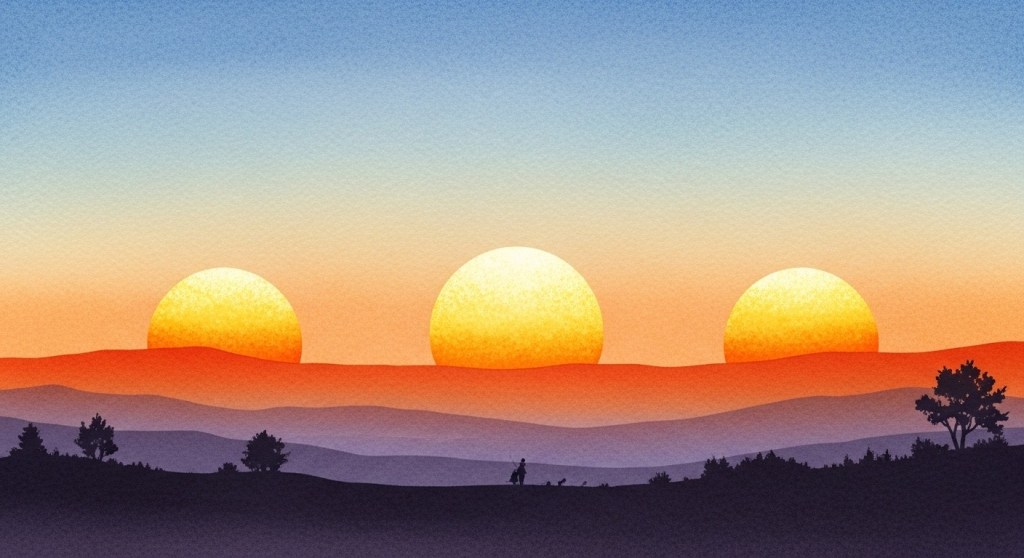
At first glance, the three suns are captivating. A planetary system governed by chaotic orbital dynamics feels genuinely alien, and the scientific imagination required to sustain such a world is impressive. The instability of Trisolaris creates a constant sense of precarity. Civilizations rise and collapse not because of moral failure or political error, but because the heavens themselves refuse consistency.
This aspect of the novel deserves its praise. The astrophysical premise stretches intuition and invites readers to imagine forms of life shaped by conditions radically different from those on Earth. It signals, at least initially, a willingness to think beyond familiar environments.
Yet almost immediately, a subtle dissonance appears. While the environment feels unfamiliar, the civilizational response to it does not. The Trisolaran world is unstable, but the way its inhabitants organize themselves under pressure feels instantly recognizable. Scarcity produces hierarchy. Instability demands discipline. Survival justifies sacrifice.
The three suns shape the setting, but they do not reshape the underlying imagination. The Trisolaran state looks less like an alien civilization and more like a familiar political formation placed under extreme stress. The sense of novelty begins to narrow. What remains strange is the physics, not the society.
Aliens Who Govern Like States
The Trisolarans are frequently described as radically other, yet their political logic is unmistakably human. They function as a centralized collective oriented toward long term survival. Individual lives are expendable. Dissent is treated as existential risk. Transparency is framed as weakness. Control is justified as rational necessity.
This is not an alien way of governing. It is the logic of totalitarian regimes throughout human history, particularly those that frame instability as permanent and threat as absolute. The Trisolarans do not invent a new political form. They refine an existing one.
What is especially revealing is how naturally this logic is presented. The narrative does not depict Trisolaran governance as ideological extremism. It presents it as realism. Ethics are not denied, but postponed. Compassion is not rejected, but subordinated. The state becomes the only legitimate moral agent because only the state can ensure survival across centuries.
Here, the resemblance to modern authoritarian rationality becomes difficult to ignore. The distance of space does not dissolve this familiarity. It disguises it. Readers are invited to observe a system that mirrors human political history, without having to confront that history directly.
Sophons, Disrupted Physics, and Old Tricks
Much has been said about the novelty of the Sophons. Intelligent particles that interfere with fundamental physics appear, at first, to represent an entirely new form of warfare. Science itself is destabilized. Experiments contradict each other. Confidence collapses.
Yet beneath the scientific surface, the strategy is familiar. Disturbing physics functions as a proxy for disturbing trust. What is being attacked is not matter, but belief. Not laboratories, but the legitimacy of knowledge.
This is cognitive warfare, refined and accelerated. The tactic is not to destroy infrastructure, but to undermine shared reality. When scientists no longer trust their results, coordination breaks down. Doubt spreads faster than clarification. Power asserts itself through epistemic confusion.
Human history offers countless examples of this logic. Propaganda, disinformation, and the strategic use of contradiction have long been tools of domination. The Sophons do not represent a fundamentally new idea. They represent a technological escalation of an old one.
The sophistication of the method distracts from its familiarity. Readers are impressed by the science, and overlook the continuity. What appears futuristic is, in fact, conventional.
When Environment Excuses Everything
The Trisolarans justify their actions through environmental necessity. Their solar system is unstable. Survival is never guaranteed. Under such conditions, moral hesitation becomes a liability. Ethics are framed as luxuries afforded only by stable worlds.
This argument is persuasive precisely because it is so familiar. Ideological systems grounded in material determinism have long used similar reasoning. When history is framed as necessity, ethics become negotiable. Violence is redefined as progress. Suffering is rendered meaningful rather than tragic.
The novel largely accepts this logic. The Trisolaran suspension of ethics is portrayed not as moral failure, but as adaptation. The environment demands it. The universe allows no alternative.
What remains unexamined is whether instability truly eliminates ethical responsibility, or merely challenges it. By treating moral compression as inevitable, the novel reinforces a worldview that readers already recognize from human political history.
From Cultural Revolution to Cosmic Pessimism
The opening scenes set during the Cultural Revolution are not simply historical background. They establish the emotional grammar of the entire novel. Trust collapses. Knowledge becomes dangerous. Moral certainty turns lethal.
These lessons do not remain confined to Earth. They expand outward into the cosmos. The famous Dark Forest hypothesis is less a discovery about the universe than a projection of historical trauma. Openness invites destruction. Visibility is fatal. Survival requires preemptive suppression.
The universe in the novel behaves as though it remembers human catastrophe. It mirrors twentieth century pessimism and elevates it to cosmic law. The result is not an encounter with a universe indifferent to human meaning, but a reaffirmation of historical despair rooted in human society.
In this sense, the novel never truly leaves the terrain of modern Chinese historical experience. Even as it imagines other solar systems, its moral and political imagination remains rooted in a specific historical condition. The cosmos becomes an extension of that experience, not a challenge to it.
The Comfort of a Familiar Cosmos
Many readers describe the novel as disturbing. Yet there is also comfort embedded in its vision. The universe, for all its danger, remains intelligible. Strategy matters. Power functions predictably. Intelligence prevails.
This familiarity reassures even as it frightens. The universe may be hostile, but it behaves according to rules we recognize. It is a place where human instincts about survival still apply.
Here, familiarity is mistaken for depth. The novel feels profound because it confirms a worldview shaped by trauma and political realism. It does not ask whether that worldview itself is limited.
Science fiction often operates this way. It enlarges the stage while keeping the script intact. The Three-Body Problem does this with exceptional clarity.
A Universe That Does Not Need Our Stories
The actual universe is not hostile. It is indifferent. It does not reward caution or punish openness. It does not care whether civilizations survive or vanish.
Imagining such a universe is difficult because narrative resists indifference. Stories require consequence. They require intention and response. Faced with silence, imagination retreats to familiarity.
The value of science fiction may not lie in escaping this tendency, but in revealing it. By showing how even the most ambitious cosmic narratives remain human through and through, works like The Three-Body Problem illuminate the boundary of our thought.
The universe in science fiction feels familiar because we cannot help but make it so. We look into the stars and see our own history reflected back at us. The three suns revolve, but the story remains human, and in this case, unmistakably Chinese.
Image: StockCake
 Tom’s Blog