
Kenosis is often spoken of as if it belongs to a particular season of the Christian calendar. It appears most clearly during Lent, intensifies during Holy Week, and culminates in the stark image of the crucified Christ. In those weeks, the language of self-emptying feels appropriate, even unavoidable. The cross dominates the imagination. Suffering, loss, and sacrifice take center stage. Kenosis seems dramatic, costly, and visibly severe.
Yet the Christian story does not begin with the cross. It begins earlier, more quietly, and with far less certainty. Before there is blood or wood or nails, there is waiting. Before sacrifice becomes visible, consent has already taken place. Advent, especially its final days, reveals that kenosis is not first about suffering. It is about availability. It is about allowing God to enter history without controlling the terms.
This realization came unexpectedly on a December Sunday. The Mass did not follow the expected rhythm of the lectionary cycle. Instead of Luke’s familiar account of Mary and Elizabeth, the readings moved through Isaiah, Paul’s letter to the Romans, and Matthew’s account of Joseph’s dream. At first this felt disorienting. Then it began to feel instructive. Two stories, often separated by liturgical structure, were being held together in the same space. The effect was not confusion but depth.
Kenosis was no longer confined to the cross. It appeared in bodies, in silence, in time given over. The Incarnation itself emerged as a form of self-emptying that precedes suffering and makes it intelligible. What unfolded that morning suggested that kenosis is not a single act but a shape, one that repeats across different lives, seasons, and vocations.
What Kenosis Means, and What It Does Not
Before moving further, it helps to clarify what kenosis actually names. The word comes from the Greek verb meaning to empty. In Christian theology, it refers most directly to Christ’s self-emptying, articulated most clearly in Paul’s letter to the Philippians. Christ, though in the form of God, does not cling to divine status, but empties himself and takes on human likeness.
This emptying does not mean that Christ ceases to be divine. It does not describe a subtraction of essence. Rather, it names the manner in which divinity is expressed. God reveals divine life not through domination or distance, but through entry into limitation. Kenosis is not weakness imposed from outside. It is power freely restrained.
This distinction matters because kenosis is often misunderstood as a general call to self-denial or moral humility. Those may be consequences, but they are not the core. Kenosis is first a movement of God toward humanity. It is an act of divine generosity that changes the structure of history itself.
Only after this movement occurs does kenosis become participatory. Human beings do not initiate kenosis in the same way Christ does. We respond to it. Our self-emptying is always secondary, shaped by circumstance, vocation, and limitation. It is not redemptive in itself. It is receptive.
With this in mind, Advent begins to look different. It does not prepare us for a dramatic intervention. It prepares us to recognize a God who arrives without spectacle.
The Quiet Beginning of God
The Incarnation is sometimes spoken of as a theological fact, something to be affirmed rather than contemplated. God became human. The Word became flesh. These statements are true, but they can become abstract if detached from the manner in which they occurred. The Gospels resist abstraction. They insist on telling the story slowly, through specific bodies, places, and relationships.
In Luke’s account, Mary’s kenosis is not framed as sacrifice. It is framed as receptivity. She is not asked to perform or to prove anything. She is asked to consent. That consent does not resolve uncertainty. It opens a path that must be walked without explanation. Mary carries God within her body, not as a symbol, but as a physical reality that changes her daily life.
This form of kenosis is deeply bodily. It involves risk, vulnerability, and exposure. Yet it is not dramatic. Mary does not announce herself. She does not claim authority. She visits her cousin. She listens. She waits. Even her song, the Magnificat, is not self-focused. It points outward, upward, and forward.
Mary’s self-emptying is not about diminishing herself for moral effect. It is about making space where life can take root. Her body becomes the place where God enters history, quietly and without spectacle. Kenosis here appears not as suffering, but as openness.
Seen this way, Advent reveals kenosis in its earliest and most fragile form. God does not begin by demanding sacrifice. God begins by asking for space.
The Silence That Protects Life
Matthew’s Gospel tells the same mystery from a different angle. Where Luke centers on Mary’s interior consent, Matthew centers on Joseph’s exterior restraint. Joseph’s kenosis is not bodily in the same way. It is social, legal, and ethical. He is a man with authority, with options, and with the power to define the situation publicly.
Joseph’s response to Mary’s pregnancy is often described as righteousness. But that word can obscure what is actually at stake. Joseph is faced with the possibility of shame, misunderstanding, and loss of honor. He is also faced with the temptation to control the narrative. He could explain himself. He could defend his position. He could assert his innocence.
He does none of these things.
Joseph listens to a dream, but more importantly, he acts without explanation. He takes Mary into his home. He names the child. He protects the family. He moves when instructed. Throughout the Gospel narratives, Joseph never speaks. His silence is not absence. It is discipline.
This silence is kenotic because it relinquishes power. Speech can dominate. Explanation can center the self. Joseph refuses both. He empties himself of the need to be seen as right. In doing so, he becomes the guardian of the Incarnation.
This form of kenosis is easily overlooked because it lacks visible markers. There is no song, no proclamation, no dramatic gesture. Yet without Joseph’s restraint, the vulnerability of the Incarnation would not survive the world into which it is born. Mary receives life. Joseph makes space for it to endure.
Two Directions of Emptying
At this point, an important distinction becomes visible. Christ’s kenosis and our kenosis move in opposite directions, yet meet at the same place.
Christ’s kenosis moves outward and downward. God enters history, time, and flesh. Eternity accepts finitude. Power accepts vulnerability. This movement is unique and unrepeatable. It establishes the possibility of communion between God and humanity.
Our kenosis moves inward. We empty ourselves so that Christ may dwell within us. We loosen our grip on self-ownership, control, and self-narration. When Paul says that he no longer lives but that Christ lives in him, he is describing this participatory emptying. It does not create salvation. It receives it.
These two movements are not symmetrical. They are relational. God empties himself to be with us. We empty ourselves so that God may remain with us.
This is why Christian life is neither pure mysticism nor mere ethics. It is indwelling. Kenosis becomes the shared grammar through which communion unfolds.
Paul and the Shape of a Given Life
The life of Paul offers another lens on kenosis. Unlike Mary or Joseph, Paul’s self-emptying is not primarily domestic or hidden. It unfolds across travel, conflict, misunderstanding, and endurance. Yet it is no less kenotic.
Paul relinquishes status, education, and certainty. He allows his former credentials to lose their value. He accepts weakness, failure, and dependency. His letters are filled with frustration, vulnerability, and perseverance. When he speaks of strength being perfected in weakness, he is describing experience, not theory.
Paul’s kenosis is vocational. It takes the shape of a life given over. He does not control outcomes. He does not protect his reputation. His identity becomes porous. Christ’s life flows through his own, often at great cost.
This shows why imitation of Christ does not mean duplication. It means resonance. Each life echoes the pattern of kenosis differently. The form adapts to the life that bears it.
Time Given Over
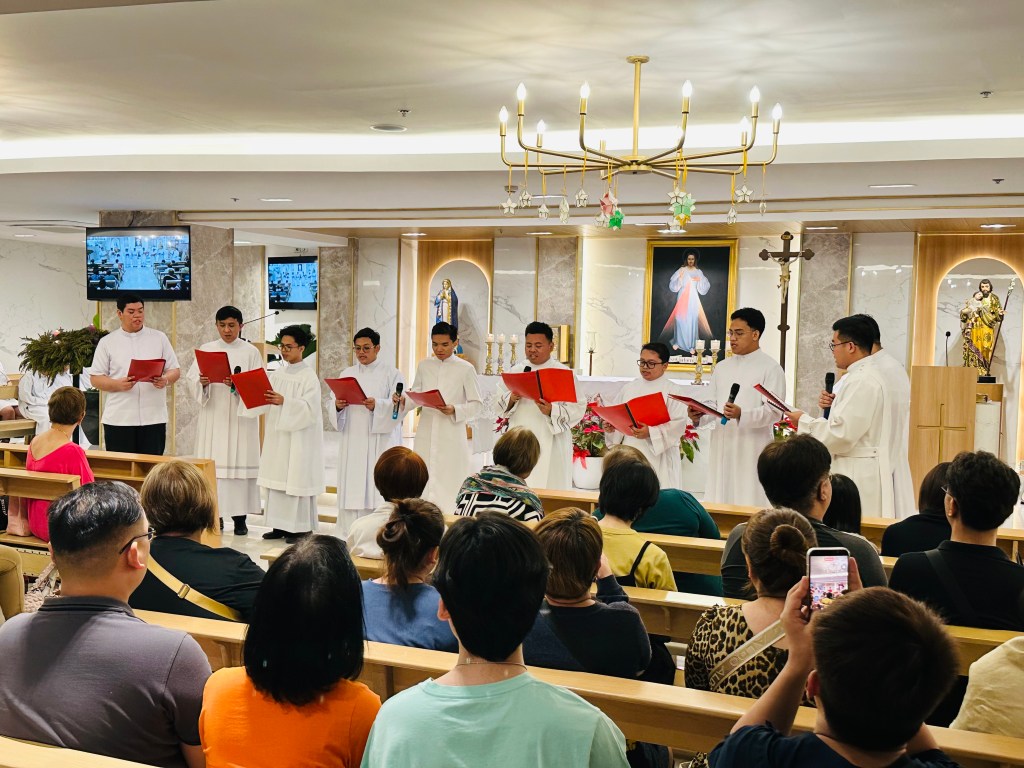
This truth became especially tangible after the Mass. Young seminarians stood before the congregation for a second collection, explaining the long years of formation that lay ahead. Four years of philosophy. Four years of theology. Years of discipline, study, and uncertainty.
This was not framed as heroism. It was presented as fact. Time would be given. Autonomy would be delayed. Certainty would be postponed. Their lives would be shaped slowly, often invisibly.
This too is kenosis.
To give years over is to accept narrowing. It is to allow one’s future to be formed by something larger than preference. It is not dramatic. It is durable.
A gentle joke from my wife followed. She said I might have been interested if I were younger. The comment brought a smile, not regret. It carried recognition. Kenosis takes different forms across a life.
The Cross as Form
This is why the cross endures as the symbol of Christianity. It holds both movements of kenosis at once. On it, Christ’s self-emptying is made visible in the most concrete way. God enters history fully, bodily, and without reserve.
At the same time, the cross turns toward us. It does not demand performance. It teaches form. It asks where we are still clinging, asserting, or securing ourselves unnecessarily.
Christ empties himself into the world.
We empty ourselves in response.
The cross is where these movements meet.
Advent trains this recognition. It prepares us not for spectacle, but for presence. To recognize kenosis is already to participate in it.
God enters history through a body, not through spectacle.
We learn to live by making space, not by asserting meaning.
That is the shape of emptying the Church quietly hands us, year after year.
Image: A photo captured by the author
 Tom’s Blog