
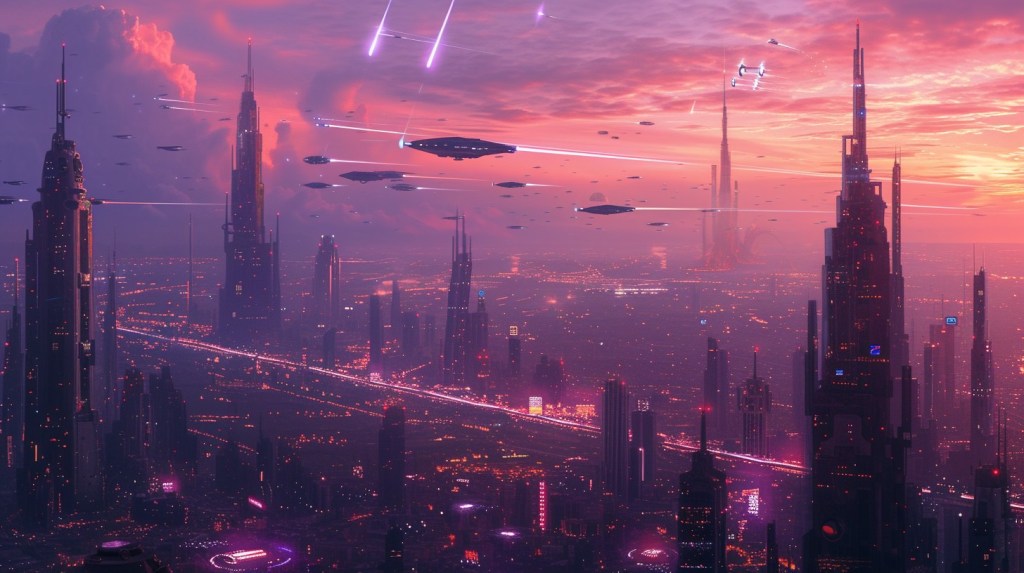
Science fiction has long occupied a special place in modern culture. It is often treated as a genre that stretches human imagination forward, offering visions of futures shaped by advanced knowledge, technology, and discovery. To engage with science fiction is commonly understood as an exercise in openness, curiosity, and intellectual courage.
At a personal level, this attraction is easy to understand. Space operas, speculative films, and futuristic novels are compelling. They offer scale, drama, and wonder. They allow audiences to experience conflict and meaning against a backdrop that feels larger than ordinary life. Enjoyment here does not need justification. Art does not have to teach in order to matter.
Yet over time, a subtle discomfort can arise. Beneath the unfamiliar settings and futuristic language, something feels repetitive. The emotional arcs, moral conflicts, and narrative resolutions resemble those found in much older stories. What initially appeared as expansion begins to feel like displacement.
This recognition does not diminish science fiction. Instead, it reframes it. Rather than serving as a window into what lies ahead, science fiction may function more honestly as a reflection of how human imagination works, even when it reaches for the stars.
Space as a Stage Rather Than a Reality
In most science fiction, space is treated as a place where stories unfold. Planets function as locations. Star systems resemble regions. Galaxies become vast arenas where events can occur with dramatic distance between them. This treatment allows narrative continuity to survive despite the unfamiliar scale.
Yet space itself resists this narrative domestication. Outer space is not an environment in the ordinary sense. It does not support life, movement, or orientation. It is defined by vacuum, radiation, isolation, and the absence of biological continuity. It offers no background that humans can inhabit naturally.
Because this reality is difficult to integrate into story form, it is quietly replaced. Space becomes something else, something closer to land or sea. It becomes traversable, populated, and narratively convenient. This replacement is not careless. It is necessary for storytelling to function at all.
As a result, space in science fiction behaves like the symbolic landscapes of myth. It resembles deserts, oceans, or distant kingdoms from older epics. The setting changes, but the underlying logic remains human. Space becomes a stage, not a condition.
Space Opera as Modern Epic: Star Wars and the Return of Myth
Few works illustrate this more clearly than Star Wars. Despite its futuristic imagery and galactic scale, its narrative structure is unmistakably ancient. Chosen figures emerge from obscurity. Moral dualism defines the universe. Destiny, lineage, fall, and redemption drive the story forward.
The galaxy of Star Wars does not operate as a physical universe governed by scientific constraints. It operates as a symbolic world. Planets function like isolated realms with distinct cultures and moral tones. Travel between them resembles pre modern journeys rather than encounters with vast, indifferent distance.
The Force, often described with ambiguous scientific language, functions as a spiritual principle. Balance, corruption, awakening, and mastery are not discoveries. They are moral and existential states. These themes echo religious and mythological traditions across cultures and eras.
What makes Star Wars revealing is not its lack of scientific realism. It is how naturally audiences accept its universe as coherent. This acceptance reveals how strongly human imagination gravitates toward familiar narrative structures. Even when dressed in futuristic aesthetics, meaning remains anchored in ancient forms.
The Metaphor of the Spaceship
Language shapes imagination quietly but decisively. Few terms demonstrate this more clearly than spaceship. The word immediately evokes travel, exploration, and continuity with human history. It suggests that space can be crossed in ways similar to oceans or skies.
This metaphor is deeply misleading. Oceans are environments. They have resistance, density, currents, and ecosystems. Ships interact with water through physical laws that allow orientation and survival. Space offers none of this. There is no medium, no shelter, no natural frame of reference.
Calling a spacecraft a ship reassures us. It implies familiarity where there is none. It suggests that space is simply a more difficult version of something already known. This linguistic comfort smooths over existential rupture.
Scientifically and existentially, space travel is not travel in the ordinary sense. It is sustained isolation within lethal conditions, entirely dependent on artificial life support. The metaphor conceals fragility behind adventure, and absence behind motion.
Mars and the Myth of Migration
The idea of settling other planets often borrows language from human migration. Mars is described as a future home, a new frontier, or a second Earth. These phrases carry historical resonance and emotional appeal.
All human migration has occurred within a single biosphere. Even the most extreme environments on Earth share atmosphere, gravity, and biological compatibility. Human bodies evolved within these conditions. They are not interchangeable variables.
Mars is not another continent. It is not an extension of Earth. It is an ontologically different condition. Survival there requires continuous technological intervention. Life does not belong there in any meaningful sense.
To imagine Mars as a future home is to mistake technical possibility for existential belonging. It reflects a desire to believe that intelligence can detach itself from its planetary origins. This belief is understandable, but it remains a projection shaped by terrestrial experience.
Star Trek and the Nation State Among the Stars: Exploration as Projection
If Star Wars represents myth, Star Trek represents institutional modernity. Its tone is scientific and ethical. Its language emphasizes exploration, research, and progress. It presents itself as a rational alternative to epic fantasy.
Yet beneath this surface lies a deeply human political imagination. The USS Enterprise is organized hierarchically, disciplined, and mission oriented. Its name carries historical weight, inheriting the legacy of naval power and exploration associated with nation states.
The Federation functions as an idealized political order. It has borders, treaties, strategic interests, and diplomatic norms. Encounters with alien civilizations often replay patterns familiar from anthropology, Cold War politics, and colonial history.
Even the Prime Directive reflects a familiar ethical tension. When to intervene, when to observe, and how to justify action in the name of progress are modern political dilemmas. They are not cosmic problems. They are human ones projected outward.
The Irony of the Final Frontier
The opening narration of Star Trek famously describes space as the final frontier. The phrase sounds scientific, aspirational, and expansive. Yet it reveals a deep limitation in imagination.
A frontier is a human concept. It presupposes expansion, movement, and eventual settlement. Frontiers exist within environments that can be crossed, mapped, and inhabited. Applying this concept to space assumes continuity where none exists.
In reality, space is not a frontier. It does not invite crossing. It does not resist or welcome. It is indifferent. The phrase reveals more about human psychology than cosmic reality.
Here, scientific language becomes a carrier of myth. Expansion becomes destiny. Exploration becomes entitlement. The irony lies in how confidently this framing is accepted as neutral or objective.
Alien Intelligence and the Limits of Otherness
Imagined extraterrestrial intelligence almost always resembles humanity. Aliens have languages, cultures, motivations, and moral frameworks that humans can understand. Even when appearance differs, inner life remains familiar.
This pattern reflects the history of human encounters with difference. Unfamiliar cultures were interpreted through analogy. Science fiction extends this habit beyond Earth, transforming cosmic difference into manageable variation.
A truly non human intelligence might not communicate, negotiate, or even persist as a bounded entity. It might not be local in space or linear in time. At that point, imagination falters.
Science fiction rarely ventures there, not because of creative failure, but because narrative itself collapses without shared ground. Total otherness resists story.
Technology as a Mirror of the Present
Every era imagines the future using its most advanced tools. Early science fiction featured mechanical minds driven by gears and steam. Later visions emphasized electricity and automation.
Today, artificial intelligence occupies this role. AI is imagined as the next form of intelligence, often modeled closely on human cognition. This reflects present experience rather than future certainty.
Such projections feel forward looking, but they remain anchored in current conditions. They assume continuity where rupture may occur. They mistake present limits for ultimate horizons.
History suggests otherwise. The most transformative changes often arrive without fitting existing categories, precisely because imagination could not reach them.
2001 and the Persistence of Transcendence
2001: A Space Odyssey stands apart for its restraint. Its silence, ambiguity, and minimalism resist spectacle. It invites contemplation rather than reassurance.
Yet even here, the narrative resolves into ascent. Humanity evolves. Consciousness transforms. A higher state of being emerges. The monolith functions like a god object, silent yet directive.
This structure mirrors ancient spiritual narratives. Enlightenment, awakening, and transcendence appear across cultures. The language changes, but the movement remains upward.
The achievement of 2001 lies in revealing how deeply myth persists, even when stripped of ornament and dialogue.
The Fermi Paradox Reconsidered
The Fermi Paradox asks why no evidence of extraterrestrial intelligence has appeared. It assumes that intelligence leads to expansion, communication, and visibility.
These assumptions reflect human history. Exploration, signaling, and technological display are human strategies shaped by Earth conditions.
Intelligence elsewhere might favor stability, invisibility, or equilibrium. Silence may not indicate absence. It may indicate incompatibility.
The paradox dissolves when expectation is examined. The universe may not resemble our stories.
God, Consciousness, and Projection
Religious imagination offers a parallel lesson. Anthropomorphic images of God are easy to recognize, but even abstract spiritual systems remain human centered.
Enlightenment, liberation, and salvation are framed through human experience. Even when God is denied form, meaning remains oriented around humanity.
The claim that humans are made in the image of God can be read in reverse. Humans create images of ultimacy using themselves as reference.
Theology and science fiction both orient humans toward mystery. Neither escapes projection.
The Inescapability of Anthropocentrism
Anthropocentrism is not simply an error to be corrected. It is the condition of human thought. Every concept arises within it.
Even critique remains inside the frame. There is no external vantage point available to human cognition.
Ancient cosmologies, modern science fiction, and future speculation all share this limitation. Each era mistakes its frame for a view from nowhere.
Recognizing this replaces illusion with honesty.
What Remains When Escape Is Impossible
If escape is impossible, restraint becomes meaningful. Humility replaces projection. Care replaces conquest.
Science fiction can still be enjoyed as art and myth. It does not need to predict or justify destiny.
Space does not need to be humanity’s future home. Earth does not need a backup. It needs attention.
The universe may never confirm human significance. That does not diminish life. It clarifies its scale.
Living Within Limits
Maturity does not require cosmic validation. It requires learning to live well within constraint.
Human imagination will always reach beyond itself. Wisdom lies in recognizing when imagination turns into self deception.
The universe does not promise familiarity. It simply exists. Within a fragile pocket of that existence, human life emerged.
Living lightly within that pocket may be the most honest aspiration available. Not as resignation, but as care. Not as failure, but as fidelity to what made us possible.
Image: Stockcake
 Tom’s Blog