
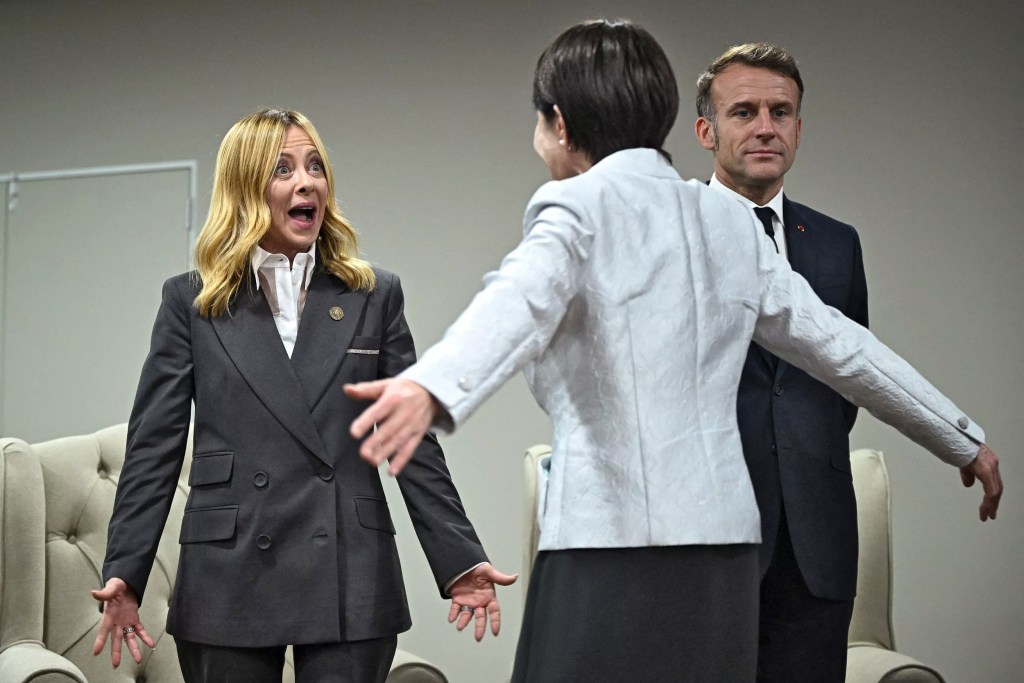
The recent G20 summit in Johannesburg offered an unexpected moment of warmth when Japanese Prime Minister Sanae Takaichi greeted Italy’s Prime Minister Giorgia Meloni with an open expression of recognition. In a gathering defined by order and tightly coordinated interactions, their exchange felt unusually free. Cameras captured Takaichi calling out “Meloni!” with a smile before opening her arms and greeting her Italian counterpart in a manner that felt like a reunion rather than a standard diplomatic encounter. Meloni responded with visible warmth. The exchange was brief, yet it stood out immediately.
The atmosphere of such summits tends to follow a predictable rhythm. Lines of suited leaders gather for photographs, deliver measured comments, and move through carefully planned schedules. A gesture that breaks from this pattern gains attention. The embrace between Takaichi and Meloni felt spontaneous and sincere. In the middle of an environment filled with symbolic formality, their moment carried a sense of genuine human connection.
Observers in Japan and Italy reacted quickly. In Japan, the scene aired repeatedly on television and spread across social media as viewers commented on the unexpected naturalness of the exchange. In Italy, it was received with curiosity and a sense of interest in the personal dimension of international relations. Many noticed that the presence of two women leaders amid a crowd of men created its own contrast, yet the deeper resonance came from the way they acknowledged each other.
Although the moment was simple, it touched on many layers of shared experience. Both leaders carry stories of personal struggle, cultural history, and national memory that rarely surface in formal diplomatic settings. Their embrace, even if brief, revealed a closeness rooted in more than political alignment. It hinted at parallel journeys, similar pressures, and deeper cultural narratives that quietly link their countries across oceans.
Two Leaders Who Rose Without Dynastic Power
Part of the authenticity of their meeting comes from the fact that neither Meloni nor Takaichi inherited her political position. They are self-made leaders in societies where political dynasties have long defined public office. Their presence at the summit marked a departure from the usual path to power. People who build their careers without established connections often project a sense of inner strength, and both leaders embody this quality.
Meloni’s background in Italy is widely known. She grew up far from the world of traditional elites and entered politics through grassroots activism. Her rise was unexpected for many who assumed that Italian politics would continue to be shaped by established families and long-standing networks. Her supporters often see her journey as evidence that determination can reshape the political landscape. Her perspective carries the tone of someone who understands the value of every step taken against the odds.
Takaichi’s story carries a similar note of independence. In Japan, politics has often moved through family lines, yet she entered the world of public office without the support of a powerful household name. Her ascent involved years of persistence, strategic decisions, and careful cultivation of trust among constituents. Many Japanese voters admire her for having built her authority largely through consistent effort rather than inherited influence.
This shared element in their backgrounds gives their meeting a special quality. When two leaders who carved their own paths encounter each other, there is often a sense of mutual understanding. Their embrace at the G20 seemed to reflect this recognition. It did not appear to be an exchange between members of entrenched elite circles. Instead, it looked like a meeting between two individuals who know what it means to create their own opportunities.
Public reaction to the gesture may have been shaped by this awareness. People tend to respond positively to leaders who reflect familiar backgrounds and relatable struggles. The connection between Meloni and Takaichi reminded viewers that political life can still include stories shaped by resilience and personal effort. Their meeting suggested that leadership sometimes grows strongest in places far from inherited privilege.
The Quiet Strength of Maternal Leadership
Another dimension of their connection lies in the form of leadership they each represent. Both Meloni and Takaichi embody a quiet, steady, maternal strength rather than the assertive or confrontational tone often associated with traditional political authority. This maternal element is not sentimental. It reflects a sense of responsibility, protection, and care that appeals to societies undergoing uncertainty.
In Italy, Meloni openly embraces motherhood as part of her identity. She speaks about family life with a tone that combines affection and duty. Many Italians see in her a leader who approaches public issues with the same seriousness that a mother brings to the well-being of her household. This resonates strongly in a country where family remains central to cultural life. Her leadership style suggests firmness rooted in care rather than aggression.
Takaichi does not define herself through motherhood in a literal sense, yet her public presence carries a similar feeling of responsibility. She conveys steadiness and composure, as if guided by an internal sense of duty toward the nation. Many Japanese people view her approach as thoughtful and controlled. Her tone reflects the resolve often admired in women who take on significant burdens for the sake of others. This quiet firmness gives her leadership its emotional depth.
The greeting between the two leaders at the G20 seemed to reflect this shared sense of maternal authority. The warmth in their interaction did not soften their public images. Instead, it illustrated how responsibility can coexist with human connection. Their embrace suggested a recognition of the emotional labor required to lead countries that are searching for stability in uncertain times.
This maternal archetype also connects to deeper cultural narratives in both nations. Italy and Japan share stories of women who carried families through hardship, women who kept households strong during periods of poverty or upheaval. These stories shape how societies perceive resilience. The moment between Meloni and Takaichi resonated because it echoed these familiar images. It was not a demonstration of sentimentality. It was a gesture that reflected the weight of responsibility they both carry.
Migration Memories and the Shape of National Identity
Beyond personal biography and leadership style, the histories of Italy and Japan hold an unexpected but powerful link through their shared experiences of emigration. Both nations once sent many of their people abroad in search of stability or opportunity. These memories remain alive in cultural stories, historical accounts, and public consciousness. They form part of the emotional backdrop against which both leaders govern.
Italy’s history of migration is remembered across generations. During periods of poverty and economic uncertainty, countless Italians sought opportunity in countries such as Argentina, Brazil, and the United States. Families were separated for long periods, and letters from across the ocean became lifelines. This experience entered global culture through a remarkable medium: a Japanese anime.
3000 Leagues in Search of Mother was produced in the mid 1970s during the early careers of Hayao Miyazaki and Isao Takahata, long before Studio Ghibli became known worldwide. The series is based on an Italian novel and follows the journey of a young boy named Marco from Genoa. His mother leaves Italy to work in Argentina, hoping to support her family during hard times. When her letters stop, Marco sets out to find her. The anime was created in Japan but portrayed an Italian family with sensitivity and care. It became deeply loved in Japan and created a cultural bridge between the two countries through its shared themes of sacrifice, parental love, and the emotional cost of migration.

Japan carries its own memories of migration. After the Second World War, many Japanese families journeyed to Brazil, Argentina, and Peru, searching for new opportunities in distant lands. These communities still preserve elements of Japanese culture. The stories of their departure remain part of Japan’s national memory. Many Japanese also remember the history of Karayuki-san, women from poor regions who left the country for various parts of Asia in the late nineteenth and early twentieth centuries. Their journeys were often marked by hardship and exploitation, yet they represent a powerful image of women who crossed borders to support families who depended on them.
The striking connection between Italy and Japan lies in how both nations remember these women. Marco’s mother in the anime embodies courage and sacrifice. Many Karayuki-san carried the same burden, traveling into uncertainty to ensure the survival of those they left behind. These shared narratives reveal an emotional link between the two societies, a recognition that family survival often fell on the shoulders of women who had little choice but to endure.
Although Italy and Japan today face different migration pressures, the memory of emigration still shapes public attitudes. People who remember their own history of leaving home may feel empathy toward newcomers, yet they also fear repeating the instability that once affected their families. These emotional contradictions influence modern debates. When Meloni and Takaichi met, they carried these long histories with them, even if unspoken.
Modern Immigration and the Search for Order
The contemporary challenges of migration faced by Italy and Japan differ in form but arise from a similar emotional landscape. Both societies deal with concerns about identity, stability, and demographic change. Leaders must show compassion toward migrants while maintaining a sense of order that reassures their citizens. Meloni and Takaichi both address these issues with a balance that reflects the historical memories of their nations.
Italy’s situation involves the pressure of irregular migration across the Mediterranean. The humanitarian and political complexities are immense. Meloni’s approach emphasizes establishing clarity and restoring predictability. She does not advocate shutting the door entirely. Instead, she focuses on rules that protect both migrants and the communities that receive them. Her tone reflects Italy’s own historical experience of sending families abroad in search of a future. The memory of those departures gives depth to contemporary concerns.
Japan faces a different set of circumstances, centered on demographic decline and the need for skilled workers. The country has gradually opened pathways for foreign labor, yet public sentiment remains cautious. Many Japanese remember stories of Karayuki-san and postwar migrants, the women who crossed borders under hardship to support their families. These memories remind the nation that the movement of people carries emotional weight and requires thoughtful management. Takaichi often speaks with this sensitivity in mind. Her focus is on ensuring that change proceeds gradually and respectfully.
The meeting between Meloni and Takaichi reflected this shared search for balance. Their embrace symbolized a common understanding that societies need both kindness and structure. Leaders must protect the integrity of their communities while also creating fair and humane systems. This quiet convergence between Italy and Japan underlies their diplomatic warmth.
Their connection at the G20 shows how historical memory shapes modern policy. It is a reminder that each country’s approach to immigration is influenced not only by data and economics but also by stories of hardship, departure, and the resilience of families who once crossed borders in difficult times.
Parallel Histories of Anxiety and Renewal
Italy and Japan appear very different on the surface, yet their modern histories share remarkable parallels. Both experienced rapid development in the twentieth century and now face demographic and economic challenges that create a sense of uncertainty. Both societies speak often about renewal, stability, and cultural continuity. These concerns inform the leadership styles of Meloni and Takaichi.
In Italy, worries about declining birth rates, economic stagnation, and an unclear national direction influence public debate. Italians seek leadership that understands their anxieties and offers a path forward rooted in steadiness. Meloni presents herself as a figure who carries the weight of these concerns with seriousness and clarity. Her supporters trust that she recognizes the emotional dimensions of Italy’s challenges.
Japan faces similar patterns. The country’s aging population, low birth rate, and questions about national identity create a constant sense of introspection. Many Japanese people desire leadership that acknowledges these issues without causing further unrest. Takaichi’s steady manner appeals to voters who want reassurance during times of change.
These parallel conditions help explain why Meloni and Takaichi appeared to connect so naturally. They govern societies that feel caught between the need for transformation and the desire for stability. Their embrace at the G20 seemed to express this shared tension. It looked like a recognition of the common burdens they carry, even though their countries stand far apart geographically.
Their meeting highlights the ways in which nations with distinct cultures can still share similar emotional landscapes. Both Italy and Japan seek to preserve social coherence while acknowledging the realities of global shifts. Their leaders reflect this balance, and their interaction at the summit made these parallels visible.
A Human Moment in a Tired Geopolitical Climate
The embrace between Meloni and Takaichi also stood out because it contrasted with the heavy tone of global diplomacy. The international conversation in recent years has been dominated by tension, suspicion, and escalating rhetoric. The atmosphere surrounding relations with China has grown increasingly strained. Many people feel fatigued by constant disputes and the repetition of familiar accusations.
In this environment, a moment of human warmth gains significance. It reminds observers that diplomacy can still include gestures of recognition rather than only posturing. The embrace brought a sense of relief, even if momentary. It offered a glimpse of authenticity within a setting where sincerity can feel rare.
This contrast was especially noticeable given the lack of meaningful communication between Japanese and Chinese leaders at the same summit. The ongoing strain in Japan China relations has become predictable. People have grown accustomed to the pattern of tense exchanges or complete silence. Against this backdrop, the meeting between Meloni and Takaichi felt like a breath of air in an environment packed with political humidity.
The public response reflects a wider longing for diplomacy that includes empathy. People want to see leaders who can acknowledge each other as human beings rather than only as actors in a strategic contest. The embrace became a symbol of that desire. It suggested that even in a climate of geopolitical fatigue, individuals can still create moments that feel genuine.
In a world where headlines often amplify conflict and suspicion, the gesture between Meloni and Takaichi carried an unexpected softness. This softness was not weakness. It reflected confidence, understanding, and the recognition that personal connection can foster trust even when policies differ. Such gestures do not resolve global tensions, but they shape the emotional environment in which dialogue occurs.
The Deeper Symbolism Behind the Viral Image
The meaning of this moment becomes clearer when all these layers are considered together. The embrace between Meloni and Takaichi represented the meeting of two leaders who built their political lives through effort rather than inheritance. It reflected the maternal strength that both women project in different ways. It echoed the migration stories that shaped their nations and the women who carried families across borders during times of difficulty. It linked two societies facing similar anxieties about identity, demographic change, and the need for renewal.
The image gained attention not only because it was unexpected but because it felt emotionally true. It revealed a connection between Italy and Japan that is rarely acknowledged in public discourse. It showed that cultural memory, historical struggle, and personal character can influence international encounters as much as policy or strategy.
The scene also suggested a form of leadership grounded in steadiness and responsibility rather than spectacle. Both Meloni and Takaichi stand for versions of conservatism that seek order without harshness and identity without exclusion. Their embrace demonstrated that leaders can embody strength without abandoning compassion.
The viral image invites reflection on the nature of political life. It suggests that even in a world dominated by geopolitical friction, moments of sincerity remain possible. It reminds viewers that history continues to shape the ways leaders behave, often in subtle and deeply human ways. The photograph from the G20 captured a connection that resonates far beyond the summit itself. It is a symbol of shared paths, shared histories, and the unexpected ties that link distant nations.
Image: The Spokesman Review and 3000 Leagues in Search of Mother
 Tom’s Blog