
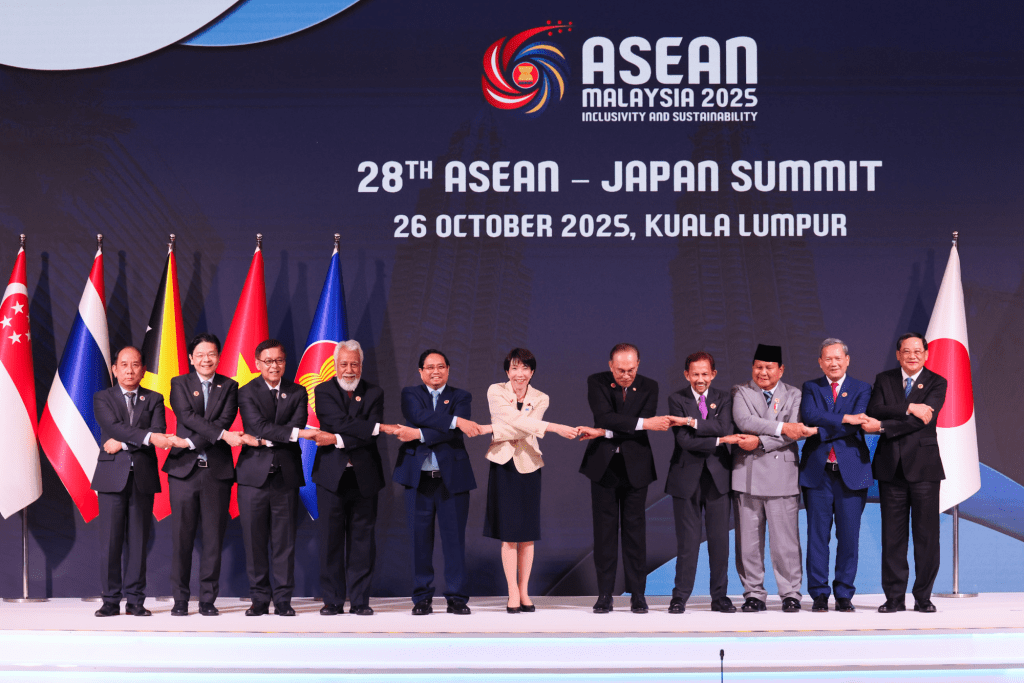
Something about this year’s ASEAN Summit in Kuala Lumpur felt quietly different. The atmosphere carried not only the usual diplomatic ceremony but also a sense of curiosity, even anticipation. As Japan’s new Prime Minister Sanae Takaichi stepped onto the stage to meet her Southeast Asian counterparts, the warmth of the welcome was visible. Smiles were genuine, handshakes lingered, and the tone of conversation seemed lighter, more natural. It was as if a new rhythm had entered the room.
There was no trace of the awkward stiffness that often marked the appearances of past Japanese leaders. Instead, there was grace, clarity, and confidence without pride. Many ASEAN leaders appeared to recognize something beyond protocol; a sincerity that made the exchanges feel personal. For Japan, a nation searching for renewal after years of cautious politics, this was more than a diplomatic debut. It was the reappearance of spirit.
Takaichi’s presence in Kuala Lumpur symbolized both continuity and change. She inherited the structure of policy from her predecessors, but the tone was unmistakably her own. Beneath her calm demeanor was the quiet energy of someone who had spent years preparing not for performance, but for understanding. That difference, almost intangible, was what made her debut stand out.
The Inheritance of FOIP and the Spirit of Abe
The Free and Open Indo-Pacific (FOIP) vision has long been one of Japan’s most enduring strategic ideas, first articulated by the late Shinzo Abe. It was not simply a policy but a worldview that tied together maritime freedom, economic openness, and the belief that stability arises from shared rules rather than dominance. In many ways, it defined Japan’s identity as a responsible and principled power in the region.
Takaichi’s appearance at the ASEAN Summit carried the emotional echo of that legacy. She was one of Abe’s closest protégées, shaped not only by his political philosophy but also by his sense of historical mission. Her understanding of FOIP goes beyond memorized talking points. It is grounded in study, experience, and conviction. She speaks of it not as an inherited slogan but as a living framework that must evolve with the times.
Under Kishida, FOIP continued with measured diplomacy, and under Ishiba it acquired a defensive tone. With Takaichi, it has regained moral clarity. Her emphasis is not on competition or containment but on cooperation grounded in respect. For ASEAN nations that constantly balance between larger powers, this attitude feels reassuring. It signals that Japan is not returning to the region with demands but with partnership.
Learning Instead of Drinking
One story often told about Takaichi reveals the source of her quiet strength. Unlike most politicians in Japan’s male-dominated environment, she was known for avoiding the drinking sessions that serve as informal hubs of influence. Those gatherings, often seen as vital to political networking, were uncomfortable for her. Instead, she spent those evenings studying laws, reviewing legislative cases, and understanding the institutional background of governance.
Over time, this difference became decisive. While many politicians rely on the briefings and scripts prepared by bureaucrats, Takaichi earned a reputation for knowing more than the officials who briefed her. She could ask sharper questions, identify gaps in reasoning, and discuss the roots of laws with precision. It was not a performance but the result of genuine work. Her knowledge gave her independence, and her independence gave her dignity.
Ironically, what was once seen as a weakness became her defining strength. The same culture that excluded her from informal circles ended up protecting her from their intellectual stagnation. While others rehearsed hierarchy, she cultivated competence. In an environment where appearances often matter more than substance, she chose the path of preparation. That discipline now radiates through her leadership style.
The Flattery Trap
Japan’s political and corporate culture shares an uncomfortable habit: the overreliance on flattery as a form of communication. Seniority often substitutes for sincerity, and the rituals of politeness can easily drift into avoidance of truth. In politics, the “drinking session” culture amplifies this problem. Leaders are constantly surrounded by subordinates who praise them, shield them from criticism, and make them believe they are better communicators than they truly are.
The result is subtle but corrosive. The more they are praised, the less they listen. The more they are accommodated, the less they understand. Over time, many leaders lose the ability to read a room that is not arranged for them. Their confidence becomes theatrical, and their words lose warmth. The problem is not confined to Japan; it is a pattern visible in many hierarchical organizations. But Japan’s social formality makes the effect particularly visible.
Takaichi’s rise offers an antidote to this decay. Her distance from those circles preserved her self-awareness. She did not become insulated by constant affirmation, and as a result, she remained curious. That humility, the willingness to keep learning rather than assuming mastery, is what allows her to communicate naturally with others. She does not need to assert her authority; she simply embodies it.
A Different Kind of Communication
At the ASEAN Summit, Takaichi’s communication style drew quiet admiration. She smiled sincerely, listened attentively, and responded thoughtfully. There was none of the defensive stiffness that sometimes defines political conversation. Instead, she seemed to meet each leader as a person, not as a counterpart. This subtle human warmth carried a diplomatic power that no policy document could replicate.
Observers noted how her demeanor contrasted with that of earlier Japanese prime ministers, who often appeared polite but distant. Her gestures were simple yet grounded. When she spoke, her tone carried both clarity and restraint. This balance made her presence stand out, not as a performance but as a genuine act of connection.
What she demonstrated is that communication is not a skill learned through training but an outcome of inner alignment. Those who are self-assured yet humble can listen without fear and speak without pretense. In her calm engagement, Takaichi reminded everyone that diplomacy begins not in the words we say, but in the quality of attention we give.
Breaking the Glass Ceiling with Grace
Takaichi’s ascent to Japan’s highest office is a historic achievement, but it is also a deeply personal one. In a political culture that has long been skeptical of women in power, her rise was not propelled by populism or symbolism but by years of effort and consistency. She did not break the glass ceiling with noise or confrontation; she did it with study, patience, and integrity.
Many ASEAN leaders seemed aware of this background. Their respect toward her was not merely formal but genuine. They knew that her journey was difficult, that she had walked a path of persistence through an often indifferent establishment. Seeing her stand as Japan’s representative, treated as an equal among peers, felt significant not only for her country but for the idea of merit itself.
What her success reveals is that true strength comes not from aggression but from inner steadiness. Her leadership redefines what it means to represent Japan: to be competent, informed, and self-respecting, without the trappings of ego. Her quiet confidence projects an image of a Japan that has matured beyond posturing; a Japan that leads by understanding rather than imposition.
Leadership as Study, Presence, and Humility
The deeper lesson in Takaichi’s example lies in how she understands leadership. It is not charisma that sustains authority but attention. It is not dominance that inspires trust but humility. To lead well, one must first learn to learn again. This seems almost forgotten in modern politics, where image often replaces reflection.
Takaichi’s method of leadership, grounded in study and sincerity, offers a counterexample to the theatrical style that dominates public life. Her curiosity is not decorative but functional. It keeps her grounded in the complexity of real issues and allows her to meet others without pretense. Such leadership creates an atmosphere where dialogue becomes possible, and cooperation becomes natural.
In this sense, her debut at ASEAN is not only a diplomatic success but a moral statement. It suggests that the future of leadership, in Japan and beyond, may depend less on charisma and more on the capacity to think, to listen, and to stay human. She shows that strength and gentleness can coexist, that authority can walk with humility.
A New Beginning for Japan
Watching the warm exchanges in Kuala Lumpur, one could feel a shift in Japan’s image. For years, the country’s diplomacy has carried the weight of caution, often overshadowed by global turbulence. With Takaichi, that weight seems to have lifted slightly. There is a quiet confidence in her gestures, a sense that Japan can lead not by volume but by integrity.
The ASEAN leaders’ reception reflects something profound: respect not only for Japan’s policies but for its renewed character. Through Takaichi, Japan appears again as a nation of learning and respect, willing to engage others as equals. It is a soft power of a different kind, born from wisdom rather than wealth.
This moment in Kuala Lumpur feels like the beginning of a new chapter. It is not about gender alone, nor ideology, nor political faction. It is about the return of sincerity to leadership. For those who have watched Japan’s political scene grow cautious and formulaic, this sight was quietly moving. It reminded us that renewal begins not through slogans but through presence.
In that summit room, Japan seemed to rediscover its voice, not the loud voice of power, but the calm one of dignity. And that voice, guided by a leader who has learned from solitude, study, and perseverance, may well carry farther than anyone expects.
 Tom’s Blog