
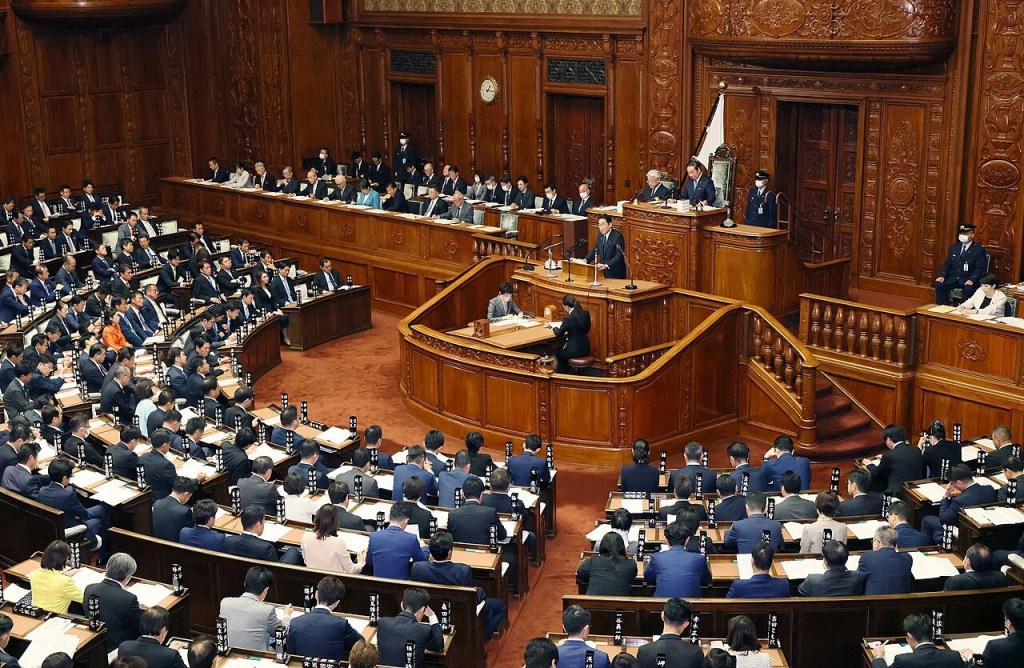
On October 21, 2025, Japan entered a new chapter in its political history. For the first time, a woman stood at the center of power as the country’s 104th prime minister. Yet what made the day remarkable was not only the symbolism of a female leader, but the sheer persistence it took for Sanae Takaichi to reach that moment. Her victory did not arrive through fanfare or consensus. It came through resistance, through storms of criticism, and through a long journey of composure in the face of hostility.
The Diet’s session that day carried the tension of a national test. The Liberal Democratic Party had already chosen her as leader weeks earlier, but the road to confirmation as prime minister was uncertain. To lead Japan, she needed to secure a majority in both houses, something far from guaranteed. Many doubted she could gather enough votes after Komeito’s abrupt decision to abandon the long-standing coalition. Opposition parties sensed an opportunity to unite against her. Even within the LDP, some quietly wished to see her stumble, calculating their futures beyond her leadership.
By late afternoon, the final votes were counted. She had won. The chamber broke into applause, some measured, some spontaneous. Outside, the autumn sky over Tokyo felt unusually clear, as if mirroring a moment of calm after weeks of turbulence. For those who had followed her career, it was not just a political event. It was the arrival of a leader who had endured almost every form of opposition, yet refused to bend.
Against the Current
Few politicians in recent memory have faced such wide-ranging resistance. Takaichi was challenged not only by rival parties but also by segments of her own. Some in the LDP doubted her pragmatism. Others questioned her ability to hold alliances together. When Komeito ended the 26-year coalition, it was seen by many as an act bordering on political bullying, a deliberate attempt to isolate her before she could even begin.
Opposition groups tried to coordinate their votes to block her ascent. Liberal parties framed her as a hardliner who would reverse Japan’s social progress. International media amplified this portrayal, describing her as “far-right,” “hawkish,” or “nationalist.” The tone was often more dramatic than factual. What these narratives missed was that her agenda was neither ideological nor emotional. It was, in her words, about protecting life, sustaining growth, and ensuring security. These are ordinary goals for any government, yet in today’s world, even moderation can appear radical.
The drama of this election cycle revealed a deeper issue within global politics. The boundary between conviction and extremism has grown dangerously thin in public discourse. Anyone who speaks firmly, especially on national defense or social order, is instantly placed in a category. Takaichi did not conform to such framing. She stood firm in the middle, confident that the public could see through the noise.
A Leader Misread
Much of the misunderstanding around Takaichi stems from the way her words are framed. The media, both domestic and international, often fixate on isolated phrases rather than full contexts. When she once said she was willing to “forget about work-life balance” in her duties, it was taken as an attack on working citizens or women. Commentators accused her of promoting unhealthy labor culture. Yet she was speaking of her own attitude toward public responsibility, not setting a social standard. Her message was personal dedication, not policy prescription.
This pattern of distortion became so common that after becoming party leader, she made a quiet but revolutionary move. Her public relations team began publishing full transcripts of press interviews online. It was a simple act, yet deeply symbolic. By sharing her words directly, she made it harder for narratives to twist them. In an age when transcription is effortless through AI, the gesture was both transparent and strategic. It allowed citizens to engage with her unfiltered voice rather than secondhand impressions.
This initiative also reflects a larger transformation in how truth is mediated. For decades, political communication depended on journalists and networks to interpret public statements. But technology has changed that landscape. When information can be recorded, transcribed, and distributed instantly, accuracy no longer needs to be gatekept. Takaichi’s decision anticipates this shift. It represents a new model of trust between leaders and citizens, one based on direct communication rather than curated narratives.
The Meaning of Balance
Takaichi’s political philosophy has always been grounded in balance. She believes that economic vitality, national security, and cultural continuity are interconnected. Her approach is pragmatic rather than ideological. She has never sought to dismantle Japan’s pacifist principles, but she argues that true peace requires readiness. She supports women’s empowerment not through slogans, but through tangible participation and accountability. These positions are often misunderstood in a world that prefers clear divisions between left and right, progress and tradition.
Her conservatism is sometimes compared to Margaret Thatcher’s, yet the resemblance is more structural than philosophical. Takaichi’s ideal of governance is not domination but stewardship. Her conservatism is a discipline of care, a recognition that leadership means protecting what sustains people’s daily lives. Her economic vision focuses on stability and productivity rather than spectacle. She speaks less about ideology and more about continuity, reminding the public that change without foundation can collapse under its own weight.
The criticism that she is “too right-wing” overlooks the cultural context of Japanese conservatism. In Japan, conservative thought often aligns with moderation, community, and quiet responsibility. It is a temperament rather than a doctrine. Takaichi’s strength lies in understanding this sensibility. She is modern without being restless, assertive without being reckless. That equilibrium is precisely what makes her leadership relevant in a time when many societies are driven by outrage rather than order.
The Media and the Mirror
Media scrutiny is part of any democracy, yet Japan’s recent political climate has blurred the line between oversight and obsession. For years, public trust in mainstream media has declined, not because of censorship but because of selective framing. Takaichi’s rise made this tension visible. Reporters often emphasized her nationalism, her Shinto background, or her gender, sometimes treating these as contradictions. But the real contradiction lay in how narratives were constructed around her sincerity.
Her new policy of publishing interviews was therefore not an act of defiance, but of restoration. It reminded both politicians and journalists that transparency is a two-way street. In the age of AI transcription, truth can be verified instantly. What matters is not access but integrity. The citizens themselves now have the tools to compare statements and headlines, to see where distortion begins. This quiet revolution in communication may ultimately reshape Japan’s democratic culture more deeply than any constitutional reform.
Her approach also poses a challenge to the media industry. When politicians speak directly, the role of intermediaries must evolve from gatekeeping to analysis. Facts will remain essential, but interpretation must regain humility. In this sense, Takaichi’s transparency is not just self-protective. It is pedagogical. It invites society to think critically rather than consume reactively.
The Coalition of Courage
One of the most dramatic turns in her rise was the unexpected alliance with the Japan Innovation Party, known as Ishin. After Komeito’s departure, her path to a parliamentary majority seemed blocked. But leaders Hirofumi Yoshimura and Fumitake Fujita made a bold decision. Instead of deepening opposition, they sought collaboration. Their support changed the course of Japanese politics and brought new vitality to the concept of reform.
During the press conference that followed, Fujita shared a story that has since become symbolic. He cited the 19th-century philosopher and teacher Shōin Yoshida, who said, “The foolishly passionate are to be loved, the cleverly detached are to be feared.” Fujita interpreted this as a call to act with such sincerity that it may appear madness to the cautious. Then he recalled telling Takaichi during coalition talks, “Please, be crazy.” To which she replied, “I understand.” It was a small exchange, but it captured the moral essence of that political moment.
The phrase “be crazy for righteousness” soon spread across social media, resonating beyond party lines. It reminded many Japanese that idealism, when disciplined by sincerity, can still shape history. The partnership between Takaichi and Ishin was not simply a political deal. It was a demonstration that courage and respect can coexist across differences. In a time when politics often means polarization, this gesture revived something Japan had long missed — the sense that conviction can unite rather than divide.
A Leader Beyond Labels
Despite her achievements, Takaichi continues to be targeted by certain groups who misunderstand her intentions. Some feminist activists criticize her for not aligning with their agendas, while overlooking that she has done more to open doors for women in politics than most of her predecessors. She broke the glass ceiling not through advocacy, but through example. Her leadership itself is proof that women can command authority in the highest circles of government without reducing themselves to symbols.
Her personal life adds another layer of authenticity. She has cared for her husband after his brain stroke for years while managing one of the most demanding careers in the nation. Few leaders carry such private responsibilities while maintaining such public focus. It gives her an understanding of real social burdens that cannot be learned from theory. When she speaks of supporting families or reforming welfare systems, her tone is not academic. It comes from lived empathy.
Those who label her as cold or rigid fail to see the emotional realism behind her discipline. She does not dramatize her struggles because she respects the dignity of privacy. She leads through steadiness, not spectacle. In an era where politicians often seek visibility before substance, her restraint has become her strength.
Truth and Technology
The growing accessibility of AI tools has paradoxically revived an old value: authenticity. As political communication becomes more automated, sincerity becomes more precious. Takaichi’s use of technology to publish unedited transcripts exemplifies this balance between modernity and integrity. It is an act of technological realism, using innovation to preserve honesty rather than manipulate perception.
The idea that “we do not need the media anymore” is simplistic, yet it reflects a real shift. What people seek now is clarity, not commentary. They want to hear a person’s words without intermediaries. The public is learning to cross-check, to think independently, and to treat language as evidence rather than rumor. If this trend continues, Japanese politics may become not just more transparent but more intelligent.
Technology cannot replace journalism, but it can purify it. When every statement can be recorded and verified, honesty becomes the only sustainable strategy. In this sense, Takaichi’s leadership symbolizes the convergence of two eras: the age of information and the age of conscience.
The Measure of Courage
Courage is often misunderstood as confrontation. In truth, it is the ability to remain steady when every external force demands reaction. Takaichi’s political journey embodies this principle. She did not shout over her critics or retaliate against their words. She continued her work with precision and clarity. Her victory today is therefore not only political but moral. It confirms that quiet persistence can outlast both outrage and manipulation.
Her leadership also redefines strength. It is not loud, not charismatic in the conventional sense, but deeply persuasive. She leads through consistency, which in itself has become rare in public life. People sense that she means what she says, even when they disagree. That trust, once earned, becomes a nation’s anchor.
In this light, Japan’s new chapter is not just about gender or ideology. It is about reclaiming the dignity of leadership. For too long, politics has been shaped by spectacle, slogans, and temporary enthusiasm. Takaichi’s rise suggests that endurance still matters. The world may call her conservative, but what she truly embodies is constancy, the ability to hold the line when others retreat.
The Day Japan Stood Firm
As dusk fell on October 21, the significance of the day became clear. It was not simply the election of a new prime minister. It was the reaffirmation of Japan’s collective steadiness in a world of instability. The nation had chosen not the easiest path, but the one that demanded maturity. Her government will face challenges ahead, economic recovery, demographic decline, regional security, yet the foundation has been set by her composure and courage.
For those watching around the world, the message is unmistakable. Leadership in Japan is evolving. It is becoming transparent, balanced, and quietly resilient. It refuses both populism and moral panic. It seeks truth through patience, not noise. And at the center of that change stands a woman who, after decades of persistence, has shown what it means to stand firm.
This is more than a political victory. It is a moral reminder that sincerity can still prevail in public life. The day Japan stood firm is the day it remembered that courage does not always roar. Sometimes, it speaks softly, corrects patiently, and endures gracefully until the storm passes.
Image: The House of Representatives
 Tom’s Blog