
The news of Charlie Kirk’s death struck with sudden force. In the middle of a public gathering, at 12:23 in the afternoon, a single shot cut across the noise of a crowd and silenced a voice that had been shaping conversations in America for years. The official timelines placed the moment just before 12:24, but in the days that followed, mourners began to notice the coincidence. At his funeral, one speaker turned to the words of the Gospel of John, chapter 12 verse 24, which speaks of a grain of wheat that must fall into the ground and die in order to bear fruit.
For many, this connection did not feel like a forced attempt at mystical interpretation. Instead, it came as a form of mercy. In the shock of losing a leader so suddenly, in the confusion of trying to find meaning in senseless violence, here was a verse that offered language for both the loss and the hope. To die at the hour of 12:24 and have that number reflected in a verse about death bringing forth life was a sign, not of fate or superstition, but of comfort. It allowed mourners to see that even in this tragedy, there might be a larger story being told.
When we think of death in this way, it shifts the ground beneath our feet. No longer is life measured only in the years we manage to accumulate or the achievements we can list. Life becomes something else entirely. It is measured by conviction, by surrender, by what remains when we are gone. This, perhaps, is why John 12:24 has carried such weight through centuries of Christian thought, and why it resonates again today in the memory of a man who died in public at midday.
The Grain of Wheat in Scripture
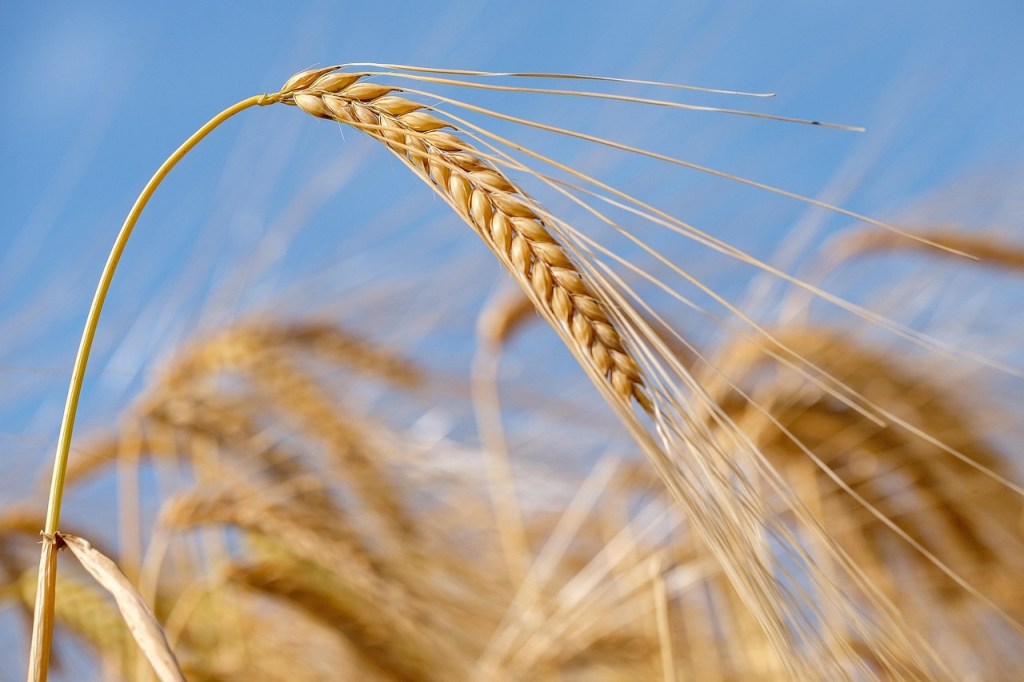
John 12:24 is one of the most striking verses in the Gospel. Jesus is speaking on the eve of his passion, knowing that death is near, and he tells his listeners, “Unless a grain of wheat falls into the earth and dies, it remains alone. But if it dies, it bears much fruit.” The imagery is simple, taken from the fields that surrounded every village. A seed only fulfills its purpose by being buried and broken. Its life is not preserved by holding on to itself but by being surrendered to the soil.
The context makes the meaning even sharper. This is not a parable about agriculture. It is a foretelling of the cross. Jesus is the grain of wheat, and his death will be the sowing that brings forth life for many. At the same time, it is also an invitation. He immediately follows with words about discipleship, saying that those who love their life will lose it, and those who hate their life in this world will keep it for eternal life. The principle is not only about him, but about all who choose to follow.
What makes this verse so central is that it captures the paradox at the heart of the Christian faith. Life comes through death. Fruitfulness comes through surrender. Glory is revealed not in triumph but in loss. These words have been repeated in countless sermons, written into hymns, and carried by martyrs as they faced their final moments. To see them linked to a modern death, timed to the very numbers of the verse, reminds us that their meaning has not faded.
Voices in Theology and Philosophy
The Church Fathers were among the first to take John 12:24 as a key for understanding the Christian life. Augustine saw in it a summary of salvation: the Son of God became human, entered into death, and from that burial brought forth the community of believers. Thomas Aquinas later described it as both sacrifice and example, meaning that Christ’s death was not only a once-for-all offering but also a pattern that disciples are called to imitate.
The Reformation carried this theme further. Martin Luther insisted that Christians must resist the temptation of a theology of glory, the idea that God’s work is revealed in strength and success. Instead, he argued for a theology of the cross, where God is revealed in weakness and suffering. John 12:24 was one of the verses that illustrated this truth. The seed must die. The soil must cover it. Only then does fruit come.
In the twentieth century, Dietrich Bonhoeffer echoed the verse when he wrote, “When Christ calls a man, he bids him come and die.” For Bonhoeffer, who would himself be executed for resisting the Nazi regime, this was no abstract principle. It was the cost of discipleship lived out in a world of cruelty. To follow Christ was to accept the grain-of-wheat principle as a personal reality.
Philosophers outside strict theological circles have also turned to this image. Søren Kierkegaard wrote about the paradox of losing the self in order to find it, a thought that resonates closely with John’s verse. The grain cannot remain whole and self-contained if it wants to live. It must be given away. Simone Weil, the French mystic and philosopher, spoke of “decreation,” a process of emptying the self so that divine love could take root. Her reflections are almost a direct philosophical commentary on the grain of wheat: only by letting go of self-possession can real life appear.
Seeds That Bore Fruit in History
History gives flesh to the metaphor. From the earliest centuries, Christians saw the martyrs as living examples of the grain of wheat. Tertullian famously wrote, “The blood of the martyrs is the seed of Christians.” Each death was like a sowing, and from those buried lives, new communities of faith sprang up. What looked like loss became the beginning of growth.
Francis of Assisi embodied the verse in a different way. He was not killed for his faith, but he chose to die to wealth and privilege. By stripping himself of all worldly honors and embracing poverty, he allowed a new form of Christian witness to flourish. His life, like a seed surrendered to the soil, bore fruit that reshaped the Church.
In the modern era, figures such as Mother Teresa of Calcutta carried the same truth. Her life was poured out among the poorest of the poor, and she often quoted John 12:24 as a way of explaining her mission. By losing herself in service, she believed she was allowing Christ’s life to bear fruit in the most forgotten corners of humanity.
Oscar Romero, the Salvadoran archbishop, provides perhaps the most poignant modern example. On the day before his assassination, he preached about John 12:24, saying that if he were killed, his life would become seed for his people. The next day, he was shot while celebrating Mass. His words were fulfilled in his death, and his memory became a rallying cry for justice and faith in Latin America.
Beyond Politics
Charlie Kirk’s death occurred in a context of political tension and deep national division. Yet the memorial reflections around his passing chose not to dwell on the controversy but on conviction. By linking the time of his death with John 12:24, mourners lifted the event out of the realm of partisanship and placed it within the larger story of life, death, and meaning.
To speak of Kirk as a grain of wheat is not to canonize him or to deny the contentious aspects of his work. It is to recognize that he lived with conviction, and that conviction led to his death. In that sense, his story reflects the same pattern that has been seen in countless lives before: those who hold to their beliefs, even when it costs them everything, embody the truth of the verse. Their lives, cut short, become seeds planted in the soil of history.
The link to John 12:24 also allowed his funeral to be more than a political rally. It became a moment of pastoral care. Mourners were invited to see beyond the horror of the act and into the hope that fruit may yet come from it. This does not erase the grief, but it gives it a frame. The number 12:24 became a reminder that even in senseless tragedy, there may be a divine whisper pointing toward meaning.
Life Is Not the Years We Live
The grain-of-wheat principle challenges our ordinary measures of life. We often count years, accumulate accomplishments, or weigh success in terms of visibility and power. John 12:24 overturns that calculus. It insists that life is measured not by duration or recognition but by surrender. A seed that remains whole produces nothing. A life that is held tightly, guarded and preserved, ends up empty.
This means that even a short life can be abundant if it is given away. The martyrs who died young, the reformers who risked everything, the servants who lived in obscurity, all demonstrate that fruitfulness is not tied to longevity. Their deaths, in the language of the verse, became sowings that bore lasting fruit.
Seen in this light, Charlie Kirk’s death at midday is not simply a tragic end. It is also a challenge to think about how we measure our own lives. Are we grains of wheat that refuse to fall, content to remain intact and alone? Or are we willing to be buried, to give ourselves away, trusting that something larger will grow from our loss?
A Grain for Our Own Time
The image of the grain of wheat is not confined to Jesus, the martyrs, or leaders who die in public. It is a call addressed to everyone. Each of us is asked to consider what it means to fall into the ground and die in our own circumstances. For some, it may mean letting go of pride or ego. For others, it may mean surrendering comfort for the sake of service. For still others, it may mean living with integrity even when it carries a cost.
The verse assures us that such losses are not wasted. Just as a seed hidden in soil eventually bursts with life, so our surrender can yield fruit we may never see. The promise is that nothing truly given away is ever lost.
In moments like Charlie Kirk’s death, this truth comes to the surface with particular power. His life, whatever one thinks of his politics, was marked by conviction. His death, timed in a way that echoed Scripture, became a symbol that pointed beyond himself. For those who mourn, this connection is not about superstition but about hope. It is a reminder that life is not about years counted but about love given, truth held, and convictions carried to the end.
The Mercy of Fruitfulness
John 12:24 has echoed through centuries because it tells a truth that human beings recognize in every age: life comes through death, and fruitfulness comes through surrender. From the cross of Christ to the martyrs of Rome, from Francis of Assisi to Oscar Romero, from ordinary saints to public figures like Charlie Kirk, the same principle emerges.
Life is not the sum of years or the preservation of self. It is the gift of oneself, planted like a seed, so that others may live. When we see death at 12:24 and hear the words of John 12:24, we are reminded again of this strange mercy. In the silence of loss, we hear a whisper of hope: the grain has fallen, but fruit will come.
Image by Bruno
 Tom’s Blog