
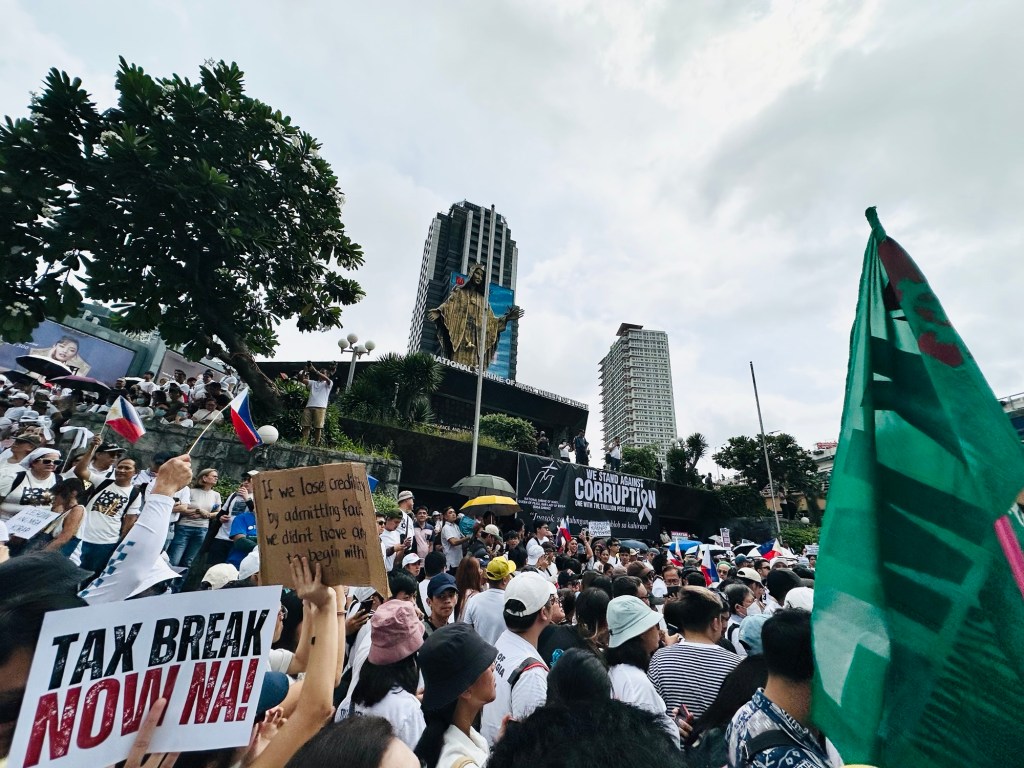
The day began with ordinary anticipation, yet it became one of those moments that settle deep into memory. I joined thousands of Filipinos gathered at the EDSA Shrine, each of us clothed in white, each carrying a quiet determination. The sky threatened rain, and by the time we started moving toward the People Power Monument, the drizzle had become steady. Yet the rain did not weaken the crowd. It strengthened it.
There was something familiar about the sight of people coming together at EDSA. The wide avenue that once carried the roar of protest decades ago was again filled with ordinary citizens demanding accountability. For me, being physically present mattered. It is one thing to read articles online or to express outrage on social media, but standing shoulder to shoulder with strangers, feeling the weight of the rain and the heat, creates a bond that cannot be replaced by screens.
We walked slowly, carried along by the press of the crowd. People shared umbrellas, passed bottles of water, and lifted flags. Even in discomfort, smiles and laughter found their way through. There was unity in the air. The gathering was not simply a march. It was a living reminder that the voice of the people, though often silenced or ignored, still carries power.
The Cry Against a Trillion
The rally was called the Trillion Peso March, and the name alone was enough to stir anger. A trillion pesos is not an abstract number. It is the accumulation of sweat, taxes, and sacrifice from millions of citizens. It represents roads that were never built, flood control projects that remained unfinished, and protections that should have saved lives but instead lined the pockets of the powerful.
Flooding is not a distant problem in the Philippines. It happens year after year, taking lives, damaging homes, and disrupting communities. People know this pain personally. That is why the revelation that such vast amounts of money, allocated over more than a decade, had disappeared into ghost projects and private luxuries struck so deeply. It was not just waste. It was betrayal.
The crowd carried placards with slogans that cut straight to the point. Accountability. Justice. Enough is enough. The anger was not wild or chaotic. It was disciplined, as if everyone understood that this protest was both an act of remembrance and a demand for change. Standing there, I felt the weight of history. EDSA has always symbolized the refusal of ordinary people to accept silence in the face of abuse. This march continued that tradition.
A History of Public Trust and Betrayal
Large-scale projects are rarely left in the hands of private companies alone. Railways, dams, heavy industries, and flood control systems require resources that go beyond private capacity. That is why governments step in, combining public funding with expertise, sometimes with foreign assistance. In the early stages of Japan’s nation building, government partnerships helped create modern infrastructure that would support the country’s rise.
Developing countries have done the same, relying on official development assistance, bilateral loans, and large public budgets. These investments are not luxuries. They are the foundations of national survival and growth. They are meant to protect lives, to make economies stable, and to prevent disasters.
But where public money is vast, temptation grows. The tragedy is that those entrusted with responsibility often forget why they were given power. Instead of guardianship, they choose selfishness. Instead of building safety nets, they build mansions. Every peso that vanishes into corruption is stolen from the future. What makes this betrayal so bitter is that the projects were never optional. They were urgent necessities, delayed or destroyed by greed.
Democracy and Its Family Business
Democracy was meant to be the great equalizer. Any citizen could rise, speak, and even govern. In theory, elections were the safeguard against corruption, ensuring that the people’s voice could remove leaders who betrayed their trust. Yet reality often looks different.
Politics in many nations has become a family business. In the Philippines, names repeat from generation to generation. The same is true in the United States, where certain families dominate political life. The barriers for newcomers are immense. To run for office requires money, networks, and access that ordinary citizens rarely possess.
This creates a form of tribal succession rather than genuine representation. Populism replaces meritocracy. Instead of leaders rising because of vision or ability, they inherit positions as if public office were family property. The result is a class of politicians more concerned with preserving their lineage than serving their people. The crowd at EDSA knew this truth instinctively. Their anger was directed not only at missing funds but at the deeper reality that politics has been captured by dynasties.
Noblesse Oblige Forgotten
There was once an ideal that power came with responsibility. The French called it noblesse oblige, the idea that those with privilege must serve. It was not perfect, but it carried at least the expectation that leadership meant sacrifice. That spirit seems forgotten today.
Modern politicians rarely speak of duty. They speak instead of entitlement. Positions become rewards, not burdens. Privilege is seen as permanent, something to be expanded and defended, not as something borrowed for the sake of others. When families control politics for decades, the original idea of service fades. What remains is calculation: how to maximize privilege and ensure its continuation.
This shift is not only a political problem. It is an ethical collapse. Leaders who should be examples become warnings. Instead of inspiring trust, they inspire cynicism. Instead of guiding society, they entrench inequality. The tragedy is not only what they steal, but what they destroy in the moral fabric of the nation.
The Poison of Sustainability
Ironically, elites are masters of sustainability. They know how to make privilege endure. They use education, networks, and appearances of sophistication to justify their position. They present themselves as chosen, as if their wealth and influence were proof of merit. Yet this is a pseudo-meritocracy.
Prestigious universities often play a role. Families donate large sums, and in return, their children carry prestigious degrees. On paper, it appears as if merit has been proven. In reality, money has opened the door. These graduates return home, not to serve, but to secure the family’s position. The knowledge they acquired becomes a tool to maintain systems of privilege, not to reform them.
This poison is subtle. It wears the mask of legitimacy. To the outside world, it looks like competence. Inside, it is corruption disguised as sustainability. The system sustains itself, not for the people, but for the few. That is why corruption often seems unbreakable. It is not chaos. It is order designed for the benefit of dynasties.
Systemic Failure and Ethical Collapse
Some argue that corruption is simply a systemic issue. While this is partly true, it should never be an excuse. Systems may allow corruption, but individuals choose to participate in it. To blame only the system is to absolve those who betrayed their oaths.
The flood projects in the Philippines were not small contracts. They were massive undertakings meant to protect citizens from disasters. The failure to complete them has real consequences. Every flooded street, every destroyed home, every lost life is part of the cost. Corruption here is not abstract. It is measured in grief.
The systemic failure is grave, but the ethical collapse is even graver. Leaders forgot that their first responsibility was to protect the people. Instead, they protected their wealth. Accountability is not vengeance. It is the recognition that choices have consequences. To let such betrayals pass unpunished is to declare that the lives of ordinary people are expendable.
Beyond the Philippines, a Global Illness
It would be comforting to think that such corruption is unique to one nation. It is not. Around the world, democracies struggle with dynasties, populism, and the decay of public trust. Corruption takes different forms, but the logic is the same: privilege protects itself.
In some countries, corporations capture politics, bending regulations to their advantage. In others, military power merges with political control. In still others, families dominate, passing seats from one generation to the next. The language may differ, but the result is similar. Ordinary citizens feel that their voices do not matter.
Even nations with strong institutions face the same challenges. The illusion of choice is maintained, but real alternatives are rare. This is why gatherings like the Trillion Peso March matter. They remind us that corruption is not just a local problem. It is a global illness that requires vigilance everywhere.
The Power of Ordinary Citizens
Standing at EDSA, I saw the antidote to despair. It was not in speeches or banners alone, but in the presence of ordinary citizens who chose to show up. They were teachers, workers, students, mothers, and fathers. They stood in the rain not because they expected instant change, but because they refused to be silent.
The symbolism of EDSA runs deep. It was the site of People Power in 1986, when dictatorship gave way to democracy. That memory lingers, and by gathering again, people renewed the message that authority cannot silence conscience forever.
In every chant, in every shared umbrella, there was a lesson. Democracy is not only about elections. It is about citizens holding leaders accountable, even when the barriers seem unbreakable. The power of ordinary people is not always quick or visible, but it is enduring. Without it, nothing changes. With it, history can shift.
Toward Accountability and Renewal
The call now is clear: accountability. Leaders must answer for the funds they misused, for the projects left undone, for the lives placed at risk. But accountability is not enough. There must also be renewal.
Renewal means reforming systems to make corruption harder. It means creating transparency in how projects are funded and monitored. It means empowering citizens to demand answers and expect honesty. It also means cultivating a culture where power is seen as responsibility, not privilege.
This is not a naive hope. It is a practical necessity. A nation cannot thrive if its resources are drained into private pockets. Renewal is the only path forward, and it begins when citizens insist on it. The Trillion Peso March was a start. The next steps depend on how that unity is sustained.
Standing for Tomorrow
As I left the crowd, wet and tired but strangely uplifted, I thought about what it meant to stand there. I was with family and friends, yet also with strangers who felt like companions. We were joined not by blood but by conviction.
Democracy survives when ordinary people refuse to give up. The march at EDSA was a reminder that corruption may be strong, but conscience is stronger. Each voice, though small, adds to the chorus. Together, they form a sound that cannot be ignored.
The Trillion Peso March was not the end. It was a beginning, or perhaps a renewal of something that has always lived in the hearts of Filipinos. A refusal to accept betrayal as normal. A determination to demand better. A hope that the voices raised in the rain will echo long after the streets have dried.
Image: A photo captured by the author
 Tom’s Blog