
Every year the rains return to the Philippines with the same relentless force. In low-lying neighborhoods the water rises quickly, filling living rooms, turning streets into rivers, and carrying mud into schools and markets. Families move furniture upstairs, children wade through murky water to attend class, and mothers boil drinking water with a constant worry about disease. For many, the rainy season is not only a natural event but a yearly trauma that erodes dignity and security.
Flooding is part of the geography of the country, shaped by rivers, typhoons, and the sea. But what makes it unbearable is not the rain itself, it is the failure to prepare for it. When drainage canals are clogged, when pumping stations are broken, and when dikes are poorly built, the floods do not recede quickly. They linger, turning temporary hardship into prolonged suffering.
This is why flood control has always been presented as an urgent national task. Politicians promise to protect communities, engineers propose master plans, and foreign lenders fund ambitious projects. Yet behind the words and the budgets lies a cycle of betrayal. Funds meant for safety become tools for enrichment, and every monsoon season the evidence of this betrayal becomes visible again. The floods remind the people not only of nature’s force but also of the corruption that steals their protection.
Rizal’s Warning and the Streets Unrepaired
José Rizal understood this cycle long before the modern republic was born. In Noli Me Tángere, Crisóstomo Ibarra returns to Manila after years of study in Spain. He expects to see progress, but instead he notices the same unrepaired streets, the same canals in decay, the same public works left unfinished. For him, it is a shock. For the people who never left, it is simply life as usual.
That moment in the novel is more than a literary scene. It is a mirror of the Filipino experience across generations. Infrastructure is announced with grandeur, budgets are allocated, and yet the street outside the window remains broken. The problem is not lack of knowledge or lack of funds, it is the capture of resources by those who serve themselves first.
The current scandal around flood control projects echoes Ibarra’s disappointment. Billions have been poured into public works since the time of Duterte and continuing into the Marcos Jr. administration. Contractors multiplied, documents were signed, and ribbon cuttings were staged. Yet when the rains came, the water still entered the houses of the poor. Rizal would not have been surprised. He knew that corruption in infrastructure is not a technical error, it is a moral failure repeated again and again.
The Machinery of Corruption
Flood control became a favorite target for corruption precisely because it is so technical and difficult for ordinary citizens to monitor. A dike that is thinner than promised looks the same from a distance. A drainage system that lacks proper foundations is hidden beneath the ground. A ghost project can be listed on paper and forgotten until someone notices its absence years later. The complexity of the engineering makes it an ideal place for politicians and contractors to demand commissions without immediate scrutiny.
Under Duterte, large sums were already being allocated for flood projects. By the time Marcos Jr. took power, the budget exploded to over half a trillion pesos in just three years. Yet according to audits, only a handful of contractors received a significant share of the funds. Many of the projects were substandard or missing altogether. What was supposed to protect lives instead became a network of kickbacks, commissions, and political rewards.
The Discaya couple, who ran some of the construction firms, testified in the Senate that lawmakers and public works officials demanded around a quarter of project costs as their cut. They described dates, meetings, and the mechanics of the corruption. Their testimony revealed what many already suspected: that the system of flood control had become less about controlling water and more about controlling money. Continuity across administrations shows this is not the work of a few bad actors but a structure that survives political transitions.
The Other Side of the City
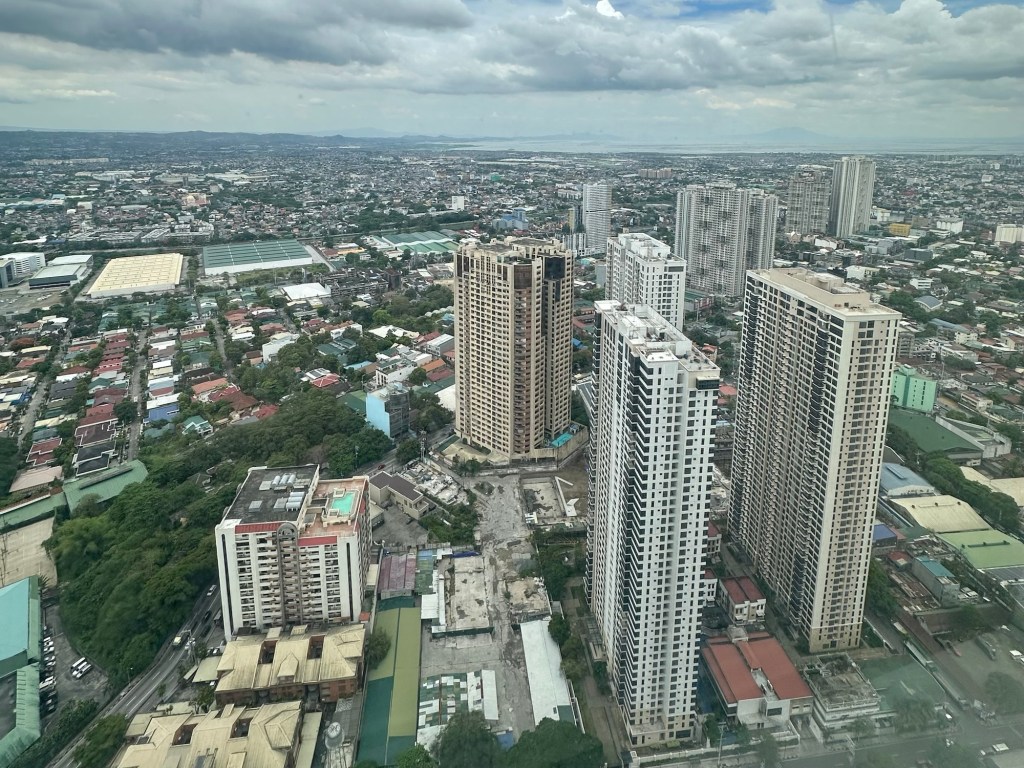
While flood defenses fail, another side of the city thrives. In the business districts of Makati, Bonifacio Global City, or Ortigas, glass towers rise one after another. Shopping malls undergo renovations every few years, food courts expand, and luxury brands appear in ever more elaborate storefronts. Roads are smooth, streetlights shine, and the architecture presents a face of constant progress.
The difference is rooted in incentives. Private developers maintain and beautify their properties because profit depends on it. A clean and modern mall attracts shoppers, a sleek tower secures tenants, and a well-paved road to the parking lot keeps customers returning. The beneficiaries are visible and paying, so the cycle of investment sustains itself.
Public works, on the other hand, serve everyone and therefore profit no one in particular. A functioning drainage canal does not charge fees. A pumping station does not collect rent. Because the benefits are diffuse and the work is hidden, corruption becomes easier. The architecture of consumption shines in malls and towers, while the architecture of survival, hidden in sewers and embankments, collapses under neglect. The result is a city where progress is polished for display but fragility remains beneath the surface.
Foreign Money and Civic Goodwill
The Philippines has not been abandoned by the world. On the contrary, it has been the recipient of vast amounts of international support. The Asian Development Bank funds flood control master plans. JICA invests in river dredging and transport resilience. The World Bank provides loans for disaster risk management. Countless NGOs and NPOs arrive with programs for community preparedness, emergency relief, and environmental advocacy.
These efforts are often well-designed. Foreign engineers understand how to reduce flood risks. NGOs understand how to strengthen local resilience. Yet once the funds and plans enter the domestic pipeline, they encounter the same vulnerabilities. Contracts pass through political filters, subcontracts are awarded to favored firms, and oversight becomes symbolic rather than real. A technically sound project can still fail when corruption corrodes the execution.
The paradox is painful. The Philippines is not short of money, expertise, or goodwill. It is short of accountability. Foreign-backed projects become showcases, with ribbon cuttings and speeches, but around the showcase the everyday infrastructure remains fragile. NGOs deliver relief after each disaster, but their scale cannot match the billions lost to misused budgets. What could be a chain of support becomes a cycle of frustration.
The People Who Live Between
For ordinary citizens, the contrast is almost unbearable. They hear of loans worth billions, they see donor logos on tarpaulins, they watch contractors’ names on billboards, and yet when the rain falls, their homes are still inundated. The distance between the promise and the reality creates a wound of trust.
At first, people hope that the next project will finally solve the problem. Then they begin to adapt by building makeshift barriers, elevating their furniture, and storing boats or rubber tires. Over time, resignation sets in. Flooding is treated as fate rather than failure, as if it is the natural order of things rather than the result of stolen resources. This resignation is the deepest damage. It is not only the body of the community that is weakened but the spirit.
Meanwhile, the spectacle of malls and towers deepens the sense of injustice. Families can watch advertisements celebrating the latest luxury brands while they mop up dirty water from their floors. The gap between what is displayed as national progress and what is lived as daily survival reveals the cruelty of selective development. Resilience becomes less a source of pride than a necessity forced upon the poor.
A Nation in Reflection
The scandal of flood control is not new, it is part of a pattern that reaches back into colonial history. Rizal’s novels exposed how public works were neglected while resources were diverted by officials and elites. The present repeats the same story with new actors, new companies, and new budgets. Continuity across administrations shows that the problem is not tied to individual leaders but to structures of governance that have normalized corruption.
The Philippines presents itself as a modernizing nation, eager to attract investment and celebrate its global ties. But the image of progress is selective. Shiny facades cover rotting foundations. Progress for consumption coexists with fragility for survival. The scandal is not just about missing money, it is about the moral failure of a system that chooses malls over drainage, towers over dikes, and ribbon cuttings over long-term protection.
To reflect on this is to face a hard truth: the unfinished streets Rizal described remain unfinished today. The betrayal has been passed from colonial administrators to postcolonial leaders, from one administration to the next, always dressed in new promises. What should have been the infrastructure of dignity has become the infrastructure of corruption.
The Unfinished Work
The image of unfinished streets is a fitting symbol for the Philippines today. It is not only that roads are left unrepaired or canals left clogged, but that the deeper work of building a trustworthy system remains incomplete. Money has never been the real shortage. What is scarce is the moral will to serve the public without stealing from them.
The floods will come again next year, as they always do. The question is whether they will be met with genuine protection or with more excuses. Will contractors continue to thrive while communities drown, or will accountability finally break the cycle? The choice is stark: continue polishing facades while leaving foundations to rot, or finally build the infrastructure that grants safety and dignity to all.
The scandal of flood control is therefore more than a story of kickbacks. It is a mirror that asks the nation what kind of progress it values. If malls can be renovated every few years, why can dikes not be built to last? If towers can rise in months, why do canals remain clogged for decades? The answers lie not in engineering but in ethics. The unfinished streets will remain unfinished until the will to serve outweighs the hunger to steal.
Image: A photo captured by the author
 Tom’s Blog