
The first words of The Sickness Unto Death can feel almost impenetrable: “the self is a relation that relates itself to itself.” At first encounter, it appears to be another specimen of nineteenth century philosophy, where abstract categories often dominate the page. Yet when we pause over it, we find Kierkegaard sharpening an idea that is both precise and profound. The self is not a fixed substance, nor is it an independent essence that can be isolated. The self is a relation, an ongoing dynamic that holds together finite and infinite, necessity and possibility, body and spirit.
Kierkegaard was surrounded by the towering figure of Hegel, whose dialectical method sought to explain history and spirit in terms of dynamic contradictions and reconciliations. Marx took this method and gave it a materialist foundation, interpreting history as the clash of economic forces. Kierkegaard, however, took the dialectical method in a radically different direction. For him, the real battleground was not history, nor society, nor even world spirit. It was the inward drama of the individual before God.
The enigmatic formula of selfhood becomes clearer when read against this background. To be human is to be caught in tension, always relating and re-relating. But when this relation fails, when the self tries to ground itself in itself rather than in God, despair arises. Despair is not merely emotional pain. It is the condition of being misrelated to oneself, either by refusing to be oneself or by arrogantly trying to be self-sufficient. It is this misrelation that Kierkegaard calls the sickness unto death.
Reflection without Commitment
This diagnosis of despair finds another angle in Kierkegaard’s The Present Age, a work that contrasts two historical moods. The first is the age of revolution, where action is marked by passion and decisiveness. People in such an age may be rash, but they live with commitment and risk. The second is the present age, which Kierkegaard saw unfolding in his own Denmark. This is the age of reflection, where analysis replaces action and every decision is dissolved into commentary.
In the age of revolution, something actually happens. A crowd rises, a person acts, a risk is taken, consequences follow. In the age of reflection, by contrast, nothing happens though everything is discussed. Passion is cooled, initiative is restrained, and the dominant attitude is that of spectatorship. Each act becomes a kind of performance, staged in full awareness of the gaze of others, or even of one’s own inward gaze.
The danger here is not that reflection is bad in itself. Reflection has its place in deepening understanding. The danger comes when reflection becomes so total that commitment is paralyzed. When action is swallowed up in commentary, the possibility of decision evaporates. Even the most daring gesture risks being drained of seriousness, turned into a spectacle that is consumed by the public and quickly forgotten. This is why Kierkegaard warns that in such an age, nothing ever happens but everything is publicized.
Truth as Subjectivity
Kierkegaard’s provocative statement that “truth is subjectivity” belongs to this same insight. He did not mean that truth is simply whatever one happens to feel, nor that truth is relative in the shallow sense of opinion. What he meant is that truth, especially in matters of existence, is inseparable from the way one lives in relation to it. To know the truth is not merely to grasp an abstract idea but to stand within it, to live it, to commit oneself to it.
This means that even the most profound idea, if held only reflectively, remains hollow. A person might understand the doctrines of faith, might recite the words, might even analyze them with brilliance, but without commitment the words remain a performance. The difference between reflection and authenticity lies not in the complexity of thought but in the presence of inwardness, passion, and decision.
For Kierkegaard, this is why despair is so insidious. One can be trapped in despair while looking outwardly secure or even pious. The despair lies in the lack of genuine relation, the absence of subjective truth. Only when the self grounds itself transparently in God does subjectivity become truth, because only then does commitment replace performance.
The Cross and the End of Performance
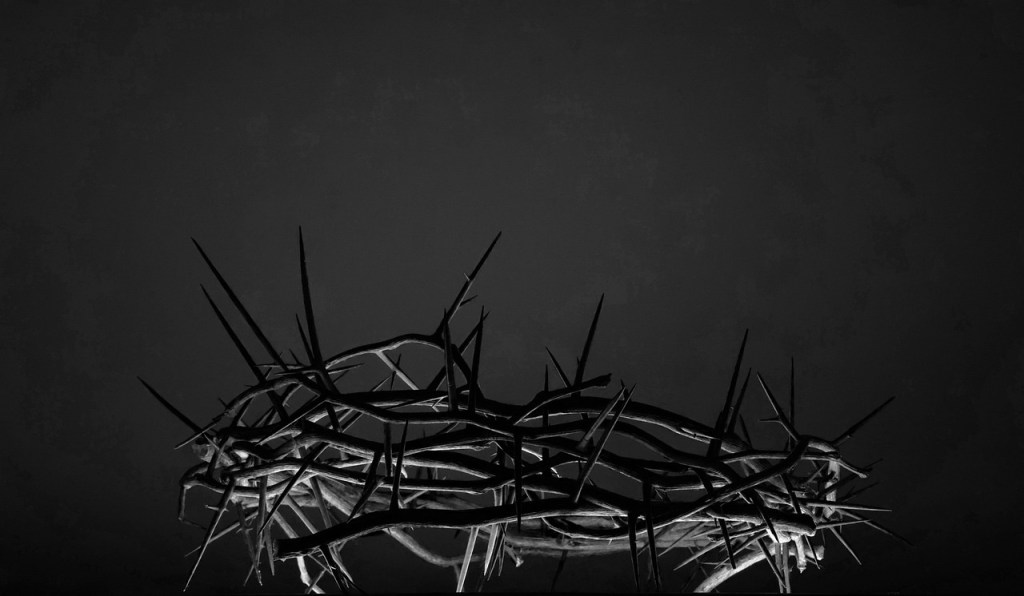
The starkest example of this difference is the death of Christ. The crucifixion was not a carefully staged spectacle meant to inspire applause. It was abandonment, exposure, and obedience to the point of forsakenness. When Christ cried out, “My God, my God, why have you forsaken me?” he revealed the full depth of exposure. There was no safety net, no audience to affirm him, no worldly proof of success. His death was not performance but the ultimate act of faith.
Kierkegaard saw in this moment the pattern of authentic existence. To live before God is to risk exposure, to step beyond the safety of spectatorship. It is to have skin in the game in the deepest possible sense. Christ’s obedience cannot be reduced to reflective commentary, nor can it be understood as mere martyrdom. It was the concrete act of surrender, the very opposite of the reflective paralysis of the present age.
This contrast helps us see why Kierkegaard was so severe toward the Christianity of his own time. For him, the church had turned the Cross into a Sunday performance, something heard in sermons and recited in creeds but emptied of the inward passion of faith. The danger was that even the most serious truths could be absorbed into the reflective spectacle of culture, leaving no room for genuine commitment.
Abraham’s Trial and the Silence of Faith
Nowhere does Kierkegaard’s analysis cut deeper than in his reading of Abraham in Fear and Trembling. God commands Abraham to sacrifice Isaac, the very son through whom God’s promise was supposed to be fulfilled. From the outside, this command is absurd. If Abraham treated it as performance, announcing it to the crowd or staging it as a dramatic show of obedience, the act would be reduced to spectacle.
But Abraham walks in silence, inwardly trembling, keeping even Isaac in the dark. The point is not the external deed but the hidden inwardness of faith. Abraham’s leap cannot be understood from the outside, because it belongs to the paradox of the individual standing before God. He becomes what Kierkegaard calls the knight of faith, who cannot be measured by public categories. His act is incomprehensible to reflection, yet it is the most authentic relation to God.
This silence is important. In an age of reflection, where everything is spoken, analyzed, and published, Abraham’s silence resists the temptation to make faith into drama. His authenticity lies in his refusal to let his obedience be seen as performance. The story shows us how faith requires not display but exposure, not rhetoric but surrender.
Job and the Stripping Away of Proof
If Abraham’s trial is about doing the unthinkable, Job’s trial is about enduring the unbearable. Job loses his wealth, his family, his health, and his standing in the community. His friends interpret his suffering as proof of hidden guilt, yet the story insists otherwise. The effect is that Job is left with no external validation, no worldly signs to prove his faith or his innocence.
This stripping away is itself a test. If Job’s faith had rested on blessings, or on the ability to display piety through outward circumstances, it would have collapsed. Instead, the trial forces him into naked relation with God, where faith cannot be performance because there is nothing left to perform. Job becomes the man of endurance, holding on even when all supports are taken away.
In this way, Job’s story parallels Abraham’s. Both are pushed into conditions where reflection and performance collapse. Abraham cannot justify his act to anyone, Job cannot prove his faith to anyone. Each is brought to the point where only the inward relation remains. In both cases, what looks absurd or meaningless from the outside becomes the place of authentic faith.
Fragility and Antifragility
Kierkegaard’s critique of reflection can be seen as an early analysis of fragility. A life lived in commentary and performance becomes brittle, because it cannot withstand trial. It depends on appearances, on the gaze of others, on the safety of distance. Such a life avoids risk, but in doing so it loses the strength that only risk can bring.
Modern thinkers like Nassim Taleb give us useful language for this. His notion of “skin in the game” means that authenticity requires exposure. If one risks nothing, one’s decisions are hollow. His idea of “antifragility” goes further: some things grow stronger through trial and stress. Faith, in Kierkegaard’s sense, is like this. It is not preserved by safety but deepened through risk, suffering, and despair.
Kierkegaard would agree that the self is not meant to be fragile. The self is meant to be strengthened by relating itself to God in the midst of trial. Despair, though deadly if left unresolved, can also be the condition that forces the self into faith. In this way, fragility is overcome not by more reflection but by exposure, risk, and commitment.
Death as Performance, or Death as Faith
One of Kierkegaard’s most haunting insights is that in the age of reflection even death can become performance. A person might face death with public composure, admired by onlookers, praised for dignity. Yet if inwardly the self is misrelated, the death remains a spectacle rather than a true passage of faith. Seriousness is not truly serious when it is lived as theater.
This diagnosis feels unsettling because it resonates with our own condition. Modern life, amplified by media and technology, often turns even private moments into performances. Weddings, births, and even funerals are staged, photographed, and shared. The danger Kierkegaard saw has only intensified: that existence itself becomes content, an endless cycle of performance with no inward grounding.
Against this, Kierkegaard offers the alternative of faith. Death, like life, becomes authentic not by how it appears but by how it is lived inwardly before God. To die in faith is not to stage a performance but to surrender the self to the power that established it. Only then is death not the final act of despair but the passage into truth.
Toward Authentic Existence
When we bring together The Sickness Unto Death, The Present Age, Fear and Trembling, and the story of Job, a coherent picture emerges. Kierkegaard is warning us against the sickness of reflection, where life collapses into performance, where even seriousness is hollow. He is urging us to live with passion, risk, and exposure, to relate ourselves to God with inwardness rather than commentary.
Abraham shows us what it means to obey in silence, Job shows us what it means to endure without proof, Christ shows us what it means to surrender even unto forsakenness. Each figure embodies what modern thinkers might call skin in the game and antifragility. Their authenticity does not lie in performance but in commitment that transcends reflection.
In our own reflective and performative age, Kierkegaard’s words retain their sharpness. We are surrounded by commentary, spectacle, and analysis, yet often deprived of decision, risk, and inwardness. His call is not nostalgic but urgent. It is a call to live authentically, to let faith break through performance, and to let existence be more than a drama staged for others.
Image by hnance
 Tom’s Blog