
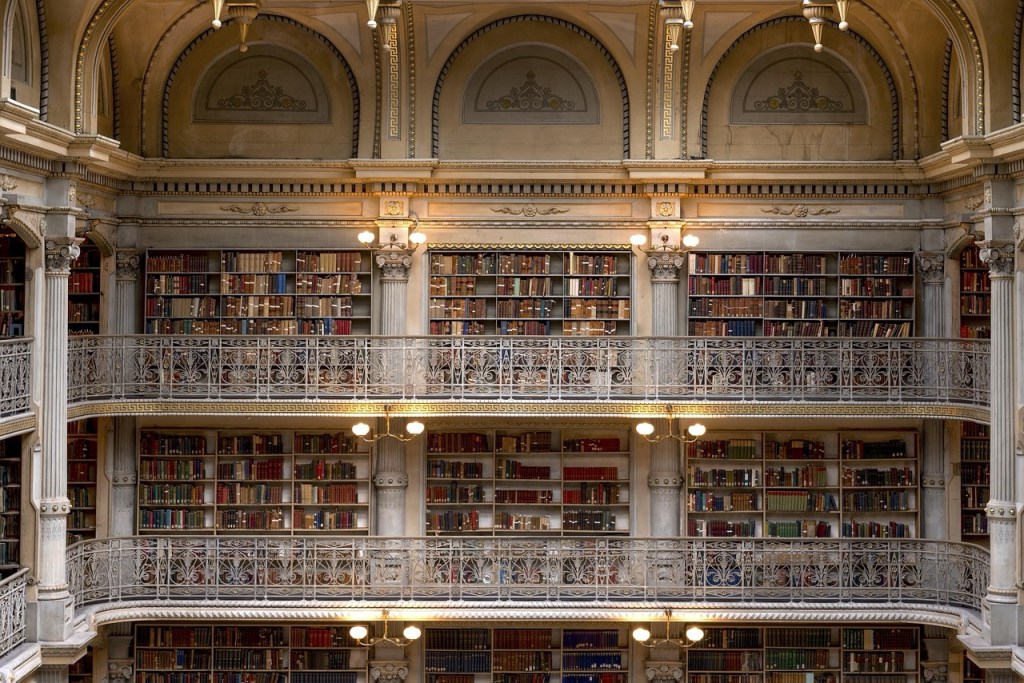
A library at rest is almost a contradiction. The shelves are filled with books, each holding the trace of someone’s thought, yet in the stillness there is no thinking taking place. The pages wait. The words rest in lines, perfectly preserved, but silent.
We often imagine that a library is full of knowledge. In truth, it is full of the possibility of knowledge. The marks on the page become living ideas only when they meet the mind of a reader. Without that encounter, the books are closer to an archive of ink and paper than to a conversation.
This is not just about books. Any stored form of thought, a voice recording, a painting, a digital file, is dormant until someone enters into a relationship with it. Knowledge is not the thing stored, but the event that happens when storage meets a living mind.
Reading as Performance
Reading is not simply the transfer of information from page to mind. It is an act, a performance. Even silent reading is filled with an internal rhythm and tone, a private voice that gives the text life.
When you read aloud, the performance becomes visible. The sound, the pauses, and the gestures shape the meaning. In religious and ceremonial contexts, reading aloud is not only about communication, but about making knowledge present in a collective moment. The congregation, the chant, the shared attention; these are part of the knowledge itself.
A text that is never read remains a seed that has never sprouted. Its full reality depends on the act of reading. In that sense, the reader is not a passive receiver, but a performer who brings the text into being again.
Writing as First Performance
Writing is also performance. It is the moment when what has lived in your mind, memory, and experience takes on a form in the world. The act of choosing words, arranging them, and letting them flow is the first time the knowledge appears outside you.
Once the words are written, the performance pauses. The text becomes dormant again, resting until it is read. When you return to your own writing, you are staging a second performance. The same words speak anew because you are not exactly the same person as when you wrote them.
The most pleasant surprise is when someone else reads your words. You have set in motion a performance you will never see, one where your text comes alive in another mind. Writing, in this way, plants the possibility of future awakenings of thought.
Oral Tradition and Living Knowledge
In oral traditions, there is no dormant shelf of fixed pages. The library exists only in the voices and memories of people. Knowledge lives in performance alone.
A story told by an elder is never identical to the last telling. It shifts with the audience, the setting, and the needs of the moment. The pauses, the emphasis, the digressions; these are part of the knowledge.
Some cultures resisted writing down sacred stories because they understood that fixing the form also fixed the relationship. Once written, anyone could read without the rituals, mentorship, and community that gave the knowledge its full meaning. The knowledge in its true sense could only exist when spoken and heard in the right setting.
AI and the New Library
AI stores patterns rather than pages. These patterns are not arranged on visible shelves, but in mathematical weights shaped by vast amounts of training data. There are no labels to browse, only a hidden structure that comes alive when prompted.
In one sense, AI is more like oral tradition than print. Every answer is a fresh telling, generated in the moment, and no two responses are exactly the same. In another sense, it is like a written archive, because the patterns are fixed until they are activated.
What AI lacks is its own lived context. It can generate a telling, but it cannot experience the meaning. The relationship that makes knowledge real is still between the human and the output. Without someone to interpret, even the most perfect answer is as silent as an unopened book.
The Timeless Present of Knowledge
When you read a book written two thousand years ago, the age of the text disappears. The words speak now. In that instant, the knowledge is as present as it was in the mind of the original writer.
This is one reason knowledge feels timeless. The storage may be ancient, but the performance is always in the present tense. Each reading is not a step back into history, but the arrival of history into the now.
Plato might say that the written form is a shadow of the idea, and the act of reading is the moment the idea shines through. The same thought can lie dormant for centuries, then become fully alive again when activated. In this way, knowledge is eternal not by lasting unchanged, but by being capable of renewal in any moment.
Life as the Performance of Understanding
If reading and writing are performances of knowledge, then living is the performance of understanding. We respond to the prompts of the world, people, events, and questions, by activating what we know and reshaping it in light of new experience.
Intelligence is not a possession we store, but a capacity we enact. It is a living relationship between mind and world, renewed every time we face something unfamiliar. In this sense, every day is a stage for understanding.
The knowledge of life and the universe does not exist in a vault somewhere. It exists in the ongoing work of perceiving, reflecting, and acting. It is as present as the breath we take in the moment of awareness.
Planting Performances Across Time
To write is to send a performance into dormancy with the hope that it will awaken again. You set in place a structure that may sleep for years, then come alive in someone else’s reading.
You may never see those awakenings, yet they are linked to your original act. A sentence you write today might one day set off a chain of thoughts in a reader far away, in another time, in another language.
In this way, writing becomes a form of planting. Each piece of text is a seed for future performances of understanding. Some may never sprout. Others may bloom in places and ways you could not have imagined. And each time they do, knowledge wakes again, as if it had been there all along, waiting for that exact moment to come alive.
Image by Falkenpost
 Tom’s Blog