
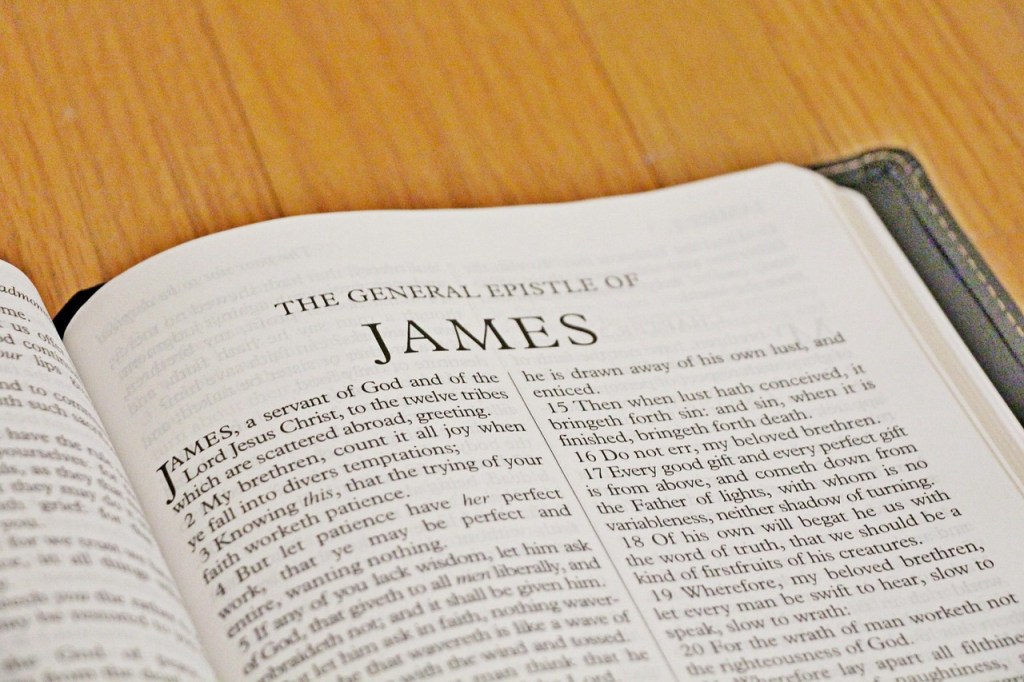
If someone asked which book in the Bible I return to most often, one of my answers would be James. From the very start, it speaks in a way that both encourages and challenges. It opens not with comfort, but with a strange command: to rejoice when facing trials, because they produce perseverance. That kind of message unsettles modern sensibilities. It asks for more than faith. It asks for transformation.
James is not content with inward belief alone. He insists on outward fruit, on conduct that matches conviction. Yet for many Christians, especially those formed by Protestant teaching, this emphasis on action feels somewhat at odds with what we are taught about salvation. From early on, we learn that we are saved by faith alone. We are taught to rest in the assurance of grace, not to measure our lives by effort. That idea comes mostly from Paul, especially in his letter to the Romans.
This difference has long been a source of confusion. Some see James and Paul as speaking past each other. Others treat James as secondary. Martin Luther even once dismissed James as an “epistle of straw.” But the truth is deeper than this surface tension. Faith and action are not enemies. They are parts of the same spiritual movement. The contradiction, if it can be called that, is not a flaw. It is the mystery through which the Christian life unfolds.
Paul and the Foundation of Faith
When Paul wrote Romans, he was addressing both Jewish and Gentile believers who were struggling to understand their identity in Christ. Some clung to the Law of Moses, believing that circumcision, dietary observance, and festival rituals still marked them as righteous. Paul confronted this mindset with directness.
He wrote, “For we hold that one is justified by faith apart from works of the law” (Romans 3:28). For him, the heart of salvation was not performance, but trust. Abraham, he said, was not justified by his actions. He was declared righteous because he believed God’s promise (Romans 4:2–3). This faith brought peace with God, not by what Abraham had done, but by what he had believed (Romans 5:1).
Martin Luther would later seize upon this message with immense force. In the face of a Church burdened with rituals, penance, and indulgences, Luther cried out for the freedom of the gospel. “Faith is a living, daring confidence in God’s grace,” he wrote. “So sure and certain that a man would stake his life on it a thousand times.” For Luther, faith was not a soft belief. It was bold, alive, and generative. It worked, but not to earn anything. It worked because it was already full of life.
This is the key to understanding Paul. He was not arguing against good works. He was arguing against works as currency. His point was not that actions were meaningless, but that they were never meant to be the foundation of righteousness. True faith, once received, would indeed produce fruit. But fruit is not the tree. It is the evidence that the tree is living.
James and the Fruits of Faith
James begins in a different tone. He speaks not to abstract theologians, but to real communities trying to live out the teachings of Christ. He sees people claiming to believe while showing partiality to the rich. He hears words of blessing spoken without acts of mercy. And he confronts these contradictions directly.
“What good is it, my brothers, if someone says he has faith but does not have works?” he asks. “Can that faith save him?” (James 2:14). His answer is unambiguous: “Faith by itself, if it does not have works, is dead” (2:17). And again, “You see that a person is justified by works and not by faith alone” (2:24). These verses have caused discomfort for centuries. They appear to challenge the very foundation that Paul established.
But James is not arguing against Paul. He is speaking to a different danger. Where Paul warns against trusting in legal obedience, James warns against empty belief. He is addressing those who claim to have faith but live without compassion, justice, or sacrifice. In that context, his words are not an attack on grace. They are a defense of its power to change lives.
He, too, uses the example of Abraham. But while Paul focuses on the beginning of Abraham’s faith journey, his belief in the promise, James focuses on its fulfillment. Abraham’s willingness to offer Isaac on the altar, says James, was the moment when his faith was made complete. “You see that faith was active along with his works, and faith was completed by his works” (2:22). The offering was not a substitute for belief. It was its expression.
Abraham in Stereo: From Belief to Sacrifice
To hold Paul and James together, we must listen to Abraham’s story in both its moments. In Genesis 15, he believes God’s promise, and it is counted to him as righteousness. This is Paul’s Abraham. But in Genesis 22, he raises the knife over his son in a test of total trust. This is James’ Abraham. The same man, the same faith, seen through two lenses.
The philosopher Søren Kierkegaard turned his gaze to that moment of sacrifice in Fear and Trembling. He saw in Abraham not a moral hero, but a paradox. Abraham believed that God would keep His promise, even if Isaac died. He moved beyond ethics into what Kierkegaard called the absurd. Faith, he wrote, is not reasoned certainty. It is “the infinite passion of inwardness.” It is the leap, not the calculation.
Abraham did not act because he was righteous. He acted because he trusted. And in that trust, he did something no system could explain. Kierkegaard’s vision helps us see that James and Paul are not debating doctrines. They are describing different stages of a single encounter. Abraham believed. Abraham obeyed. Both were faith.
Karl Barth and the Obedience of Faith
Karl Barth, writing in the ashes of the twentieth century, returned to Paul’s language with renewed clarity. For him, faith was not a psychological state or a rational conclusion. It was a miracle. It was the moment when God speaks and a human hears. In Church Dogmatics, Barth wrote, “Faith is not the human act of believing, but the divine act of addressing man.”
Faith comes by hearing, Paul had written (Romans 10:17). But what is heard is not just information. It is a command, a summons. “Through Christ,” Paul wrote, “we have received grace and apostleship to bring about the obedience of faith” (Romans 1:5). Barth took this phrase seriously. Faith is not passive. It listens, responds, and obeys.
Barth’s Christ-centered theology shows us that the faith James demands is already inside the faith Paul describes. The Word of God never calls us without changing us. And if it changes us, it moves us. Barth did not separate justification from obedience. He simply refused to make obedience the condition. Instead, he treated it as the evidence of the encounter.
Beyond the Binary: Life in the Living Christ
It is tempting to turn these conversations into neat categories. Paul stands for belief, James for action. Protestantism for grace, Catholicism for works. But these are false binaries. They fracture the unity of a life that was never meant to be split. Jesus Himself warned against fruitless trees. “You will recognize them by their fruits,” He said (Matthew 7:16). He did not say the fruit made the tree alive. But He did say a living tree cannot help but bear fruit.
The metaphor matters. Faith is the root. It draws life from the soil of grace. Works are the fruit. They are not demanded by law, but produced by love. The danger lies on both sides. Faith without action becomes cheap grace, an excuse for spiritual laziness. Works without faith become moralism, a form of pride dressed as piety.
James is not anti-faith. Paul is not anti-action. They are both witnesses to a fuller truth: that Christ lives in us, and that this life moves. When the Spirit dwells in us, we are not merely improved. We are transformed. And that transformation shows itself in ways we cannot fabricate. It shows up in the fruits of love, humility, courage, and sacrifice.
Living the Paradox
The Bible is not a logical system designed to satisfy intellectual consistency. It is a living testimony to God’s presence among people. It contains tensions, contradictions, and mysteries. These are not errors. They are invitations. They draw us into a deeper engagement, one that asks not just what we believe, but how we live.
Paul and James are not enemies. They are companions in a sacred paradox. One guards against self-righteousness. The other guards against hypocrisy. Together, they point to Christ; the one who justifies, and the one who transforms.
In Him, faith is not a doctrine. It is a life. And that life cannot remain hidden. It is like a tree planted by streams of water, yielding fruit in season. We are called not just to think rightly, but to live faithfully. Not just to receive grace, but to walk in it.
Faith and action are not two paths. They are one way. His way.
Image by Joshua Lindsey
 Tom’s Blog