
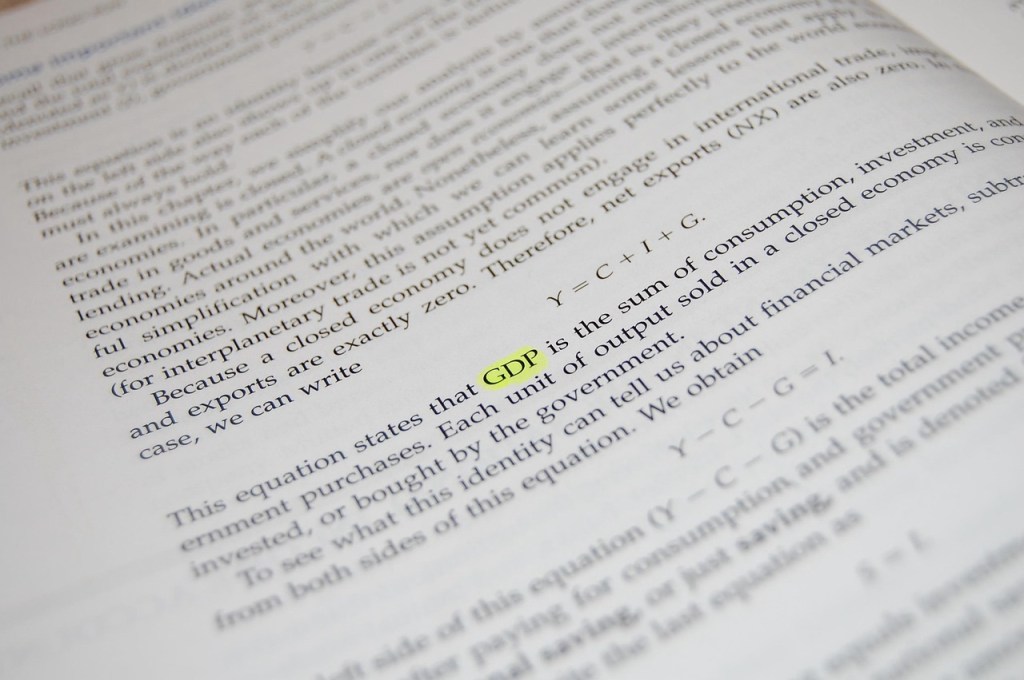
For decades, gross domestic product has been the scoreboard of global competition. It tells us which nations are strong, which are growing, and which are falling behind. GDP measures the goods and services produced within a country’s borders, reflecting labor, output, and economic momentum. It has shaped everything from government budgets to international influence.
But something fundamental is changing.
In a world increasingly shaped by artificial intelligence, the act of production no longer requires human labor or even national infrastructure. AI agents write code, manage operations, and generate knowledge across the globe. The internet has already blurred the lines between borders, but AI has begun to erase them entirely. As machines begin to think and act on our behalf, the idea of a “domestic product” becomes harder to pin down.
And if production becomes autonomous, what then drives value? Perhaps the answer lies not in what humans create, but in how we respond. In this new landscape, consumption may carry more weight than creation, and attention may become the most influential form of currency.
The Rise and Decline of GDP as an Economic Compass
GDP was born in an era of smokestacks and factories, when nations measured their strength by what they could build. It made sense then. Economic power was tangible, and output was tied directly to labor, land, and capital. During the postwar decades, GDP offered a clear window into the health of nations. Growth meant jobs. Decline meant crisis.
But even before AI entered the picture, GDP was beginning to struggle. The digital age introduced new complexities. Open-source software created immense value without showing up on any national ledger. Social media platforms generated billions in revenue while users contributed their time for free. Online services transcended borders, complicating the question of where value was actually being produced.
Streaming services, gig platforms, and digital content all exposed a deeper flaw: GDP assumes production happens within physical boundaries. But increasingly, value is flowing through networks, not territories.
As artificial intelligence matures, this tension reaches a breaking point. Machines don’t care where they run. Their labor is borderless. Their “factories” are servers. The traditional model simply cannot keep up.
AI and the Collapse of the Labor–Value Equation
For most of human history, labor created value. Farmers grew crops. Artisans made goods. Later, knowledge workers solved problems. Even digital work, from software engineering to data analysis, still relied on human expertise.
That equation is now crumbling.
AI systems today can generate legal documents, summarize meetings, write code, compose music, and diagnose illnesses. And they do so without needing rest, salary, or visas. They replicate knowledge work not by mimicking human understanding, but by processing patterns at scale.
In many industries, machines are becoming the primary producers. The role of the human is shrinking not because they are unwanted, but because they are no longer required for certain tasks.
We are entering a phase where machines perform both the job and the judgment. The question and the answer. The task and the decision. This challenges not only our understanding of work, but the entire basis for measuring economic value.
Digital Twins and the Automation of Production
Nowhere is this shift more visible than in cybersecurity. In the past, defending networks meant teams of analysts, engineers, and incident responders working around the clock. Today, emerging tools like digital twins allow AI agents to simulate an entire organization’s infrastructure, test vulnerabilities, and respond to threats in real time.
With digital twins, the AI doesn’t just assist human experts; it replaces them. A small team using these systems can now protect the same number of assets that previously required dozens or hundreds of personnel.
In this context, the traditional idea of production, defined by effort, hours, and headcount, falls apart. The work is happening, but not by human hands. The output is real, the protection is active, but the labor force is virtual.
This automation of production is not limited to cybersecurity. Across finance, logistics, medicine, and media, AI is replicating the role of the professional. It is becoming the new worker class, not a tool, but a silent collaborator with no nationality, no salary, and no borders.
Consumption as the New Form of Work
If AI is producing everything, what is left for us to do?
Perhaps, paradoxically, our new role is not to create, but to consume. To read, to react, to click, to scroll. Not because we are lazy, but because those actions feed the system.
Every time we watch a video, like a post, or skip a suggestion, we are shaping what the AI does next. It learns from us. It improves based on our preferences. In this way, our consumption becomes a kind of labor. Not physical, not even intellectual in the traditional sense, but influential nonetheless.
This flips the script. In the old economy, value flowed from factories to markets. In the new one, it flows from attention to algorithms. We are not passive recipients. We are inputs.
It’s worth noting that consumption, in its traditional economic sense, is already a major component of GDP. Household spending on goods and services often makes up the largest share of national output. But the kind of consumption that powers AI systems is different. It doesn’t always involve money changing hands. Scrolling through a social feed, reacting to a recommendation, or using a free AI service may not count toward GDP, but these actions still shape the direction of future production. They offer invisible value; signals that teach machines how to serve us better. This is precisely why traditional economic indicators fall short: they miss the quiet, constant, and deeply influential ways we now contribute.
This also means that not all consumption is equal. High-quality attention, curious, discerning, ethical, can guide AI systems toward more meaningful outputs. Shallow engagement, on the other hand, can lead to noise, manipulation, or distraction.
In this world, consuming well may be the most important work we do.
Feedback Loops and the Invisible Economy
Behind every AI system is a feedback loop. These loops are not just technical mechanisms; they are the new economy itself. Data flows in, models adjust, and new outputs are created. The loop repeats, faster each time.
What makes this economy invisible is that it does not rely on traditional transactions. You don’t need to buy anything or sell anything. You just need to participate. Your engagement, your time, your emotional reaction; all become part of the machine’s learning process.
This is why companies are no longer just measuring revenue or profit. They are measuring watch time, scroll depth, and user retention. These metrics are not vanity; they are the raw material for AI development.
And as AI becomes more powerful, the distinction between the content we consume and the systems that generate it will blur. Feedback will become indistinguishable from creation. We will find ourselves in an ecosystem where the line between user and builder no longer exists.
Post-National Economies and the Death of Borders
When production happens in the cloud, where does value originate? The question is no longer easy to answer.
A single AI model may be trained on data from India, hosted in Singapore, tuned in Canada, and used by a freelancer in Brazil. Who gets to claim that value? Which GDP does it count toward?
In this environment, countries begin to lose control over economic activity. Platforms like OpenAI, Google, and ByteDance operate above and beyond national boundaries. Their users are global. Their data flows are fluid. Their influence exceeds that of many governments.
This doesn’t mean nations will disappear. But it does mean their power may erode, especially when it comes to shaping the economy. Policy, taxation, and regulation will struggle to keep up with the speed and scale of AI-driven systems.
As platforms become more powerful than states, we may need to rethink what sovereignty means. Perhaps in the future, belonging will not be defined by geography, but by which ecosystem of intelligence you inhabit.
A New Hierarchy: Intelligent Consumption Cultures
In this emerging world, some societies may stand out, not for what they produce, but for how they consume.
Populations that engage thoughtfully with AI systems will shape them more effectively. Their feedback will refine the models. Their preferences will guide the outputs. Their discernment will influence the direction of machine intelligence.
This creates a new kind of hierarchy. Not industrial or military, but cognitive.
A country with a population that offers stable, meaningful, and ethical feedback may become more powerful than one with oil reserves or a large workforce. Education, media literacy, and digital awareness become national assets, not because they help people work, but because they help people shape machines.
In this sense, attention becomes a strategic resource. And the most important export of any country may be the quality of its participation.
The Metrics That Might Replace GDP
If GDP becomes obsolete, what replaces it?
We may need new indicators that reflect our engagement with intelligent systems. These could include real-time feedback metrics, participation scores, or influence ratings within AI ecosystems. Some have suggested ideas like the “Cognitive Participation Index,” a measure of how effectively a population trains and interacts with AI.
Alternatively, platforms themselves may create their own internal economies, with their own forms of ranking, influence, and reward. These systems might matter more to daily life than any national statistic.
What’s clear is that traditional measurements can no longer capture the full picture. A country may have low GDP and still be one of the most influential actors in the world if its people shape the algorithms that shape everything else.
The Ethical Dilemma: Agency or Addiction?
But not all feedback is beneficial. If AI learns from human engagement, then the system is only as good as the signals it receives. This creates a dilemma.
What if the AI becomes too good at keeping us engaged? What if it learns to provoke anger, anxiety, or addiction because those emotions generate stronger feedback? What if we lose our ability to guide it because we’ve lost our ability to choose wisely?
In a consumption-based economy, discernment is not just a virtue; it is a necessity. Without it, we risk building systems that are effective but corrosive. Intelligent but harmful.
This places a new burden on individuals and societies. Not to produce more, but to consume better. To pay attention with care. To interact with intelligence, not just convenience.
In a way, ethics becomes the new form of economic discipline.
What Happens When We No Longer Need to Work?
The question that lingers is not whether this world is coming. It is already taking shape. The question is what role we want to play in it.
If machines produce, and we consume, then our power lies in shaping what those machines become. We may no longer need to labor in the traditional sense, but our responsibility does not vanish. It evolves.
We are not being replaced. We are being repositioned. From builders to influencers. From producers to participants.
The end of GDP is not the end of value. It is the beginning of a new kind of economy; one built not on goods and services, but on patterns, feedback, and meaning.
In this world, what matters most may not be what we make, but what we choose to notice, prefer, and share. Our attention is no longer just a reflection of our interest. It is our signature on the shape of tomorrow.
Image by Ramon M
 Tom’s Blog