
The idea of perfection is strangely intoxicating. We are drawn to clean lines, flawless execution, ideal forms. Think of the perfect triangle; three equal sides, three exact angles, balanced in absolute harmony. It exists, but only in theory. In the world we live in, you cannot draw it. Even the most precise tools will fail to make it truly perfect. And yet, that failure is not always a defect. Sometimes it is the beginning of something more beautiful.
A triangle drawn by hand wobbles ever so slightly. One side might lean inward, one corner might soften. But somehow, this is not a loss. It has character now. It has presence. It carries the weight of the person who drew it. It is no longer just an idea; it is a moment, made visible.
This quiet truth applies not only to shapes on paper, but to everything we love most deeply. The face of a loved one is rarely symmetrical. The voice that comforts us is not without breaks. The places we remember most fondly are rarely polished or pristine. It seems that the very things we cherish most are the ones that carry the marks of time, error, and care. Perfection may belong to the heavens, but beauty lives with us, slightly uneven, often weathered, and always real.
The World Is Not Geometry
Reality resists perfection. Wood warps. Paint runs. People falter. Try as we might, our best plans lean sideways the moment they touch the ground. This is not a tragedy. It is a kind of invitation. We are not here to replicate ideals. We are here to inhabit life.
In Japan, there is a word for this way of seeing: wabi-sabi. It names a deep appreciation for things that are simple, modest, and imperfect. It recognizes beauty in what is incomplete, worn, or fading. The cracked teacup, the crooked shelf, the wilted leaf in a quiet garden; none of these are failures. They are part of a world that is alive, shaped by time and softened by use.
Wabi-sabi does not offer excuses for carelessness. It is not about embracing flaws for their own sake. It is about seeing with different eyes. Instead of reaching for what is ideal and untouchable, it invites us to draw close to what is humble and true. In this way of seeing, imperfection is not a mistake. It is the very thing that allows connection to happen.
The Crack Is the Story
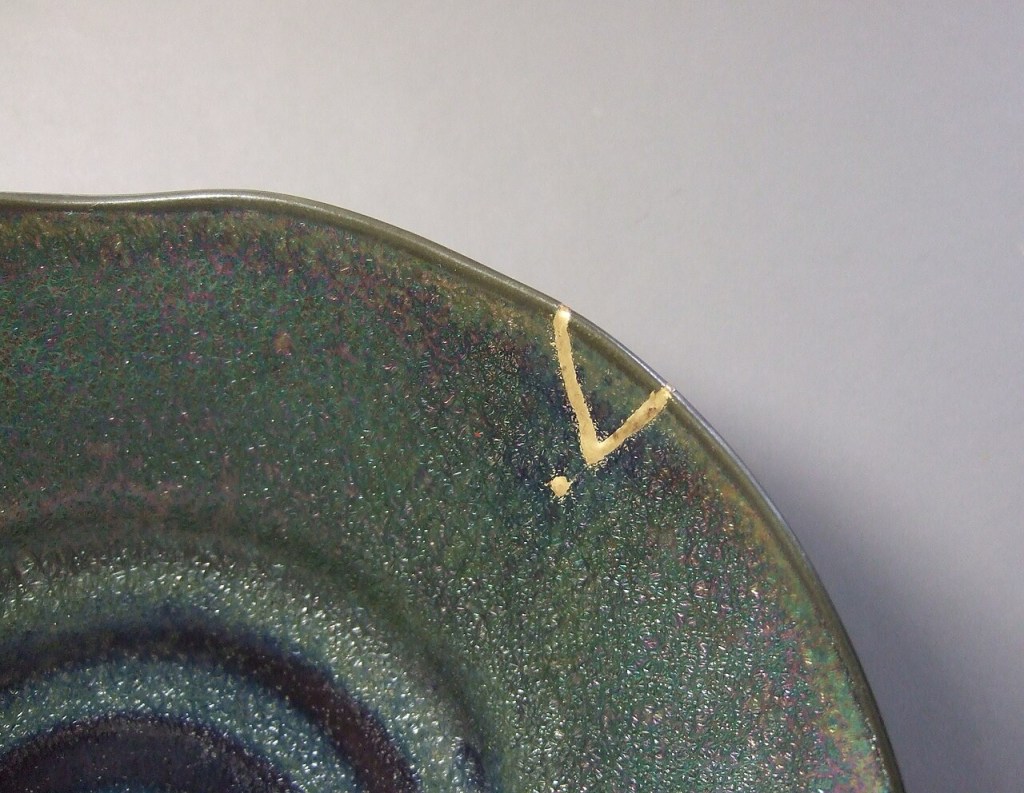
A bowl that has been broken and mended tells a different story than one that has never been touched. In Japan, the art of kintsugi, literally “golden joinery,” is the practice of repairing broken pottery with a lacquer mixed with powdered gold. The repaired item does not hide its crack. It highlights it. The golden line becomes part of the design. The flaw is no longer something to be ashamed of. It becomes the center of the bowl’s new beauty.
This is not just a metaphor. It is a way of being. Each crack tells of a fall, but also of the hands that lifted the pieces. It tells of something fragile that was not discarded. It speaks of attention, of care, of time. In kintsugi, the brokenness is not erased. It is embraced, transformed, made radiant.
So much of modern life urges us to cover our flaws. Social media is curated, skin is filtered, stories are edited. But deep down, we know what really moves us. It is the scar on the wrist, the stutter in the thank-you speech, the line in a face that wasn’t there last year. These are the places where something real has happened. And often, they are the only parts we truly trust.
Theology of Flaw
In Christian faith, there is a mystery at the center of the story: that God, perfect and eternal, took on human form in Jesus. Not as an idea or apparition, but as a person with skin, with breath, with limits. He grew tired. He wept. He suffered. And this was not a compromise of divinity. It was its revelation.
The old term for this is kenosis; the self-emptying of God. Instead of holding tightly to perfection, God entered the world through its weakest points. Not in a palace, but in a manger. Not through domination, but through humility. The divine became vulnerable. And in doing so, became more perfectly present than any abstract idea of perfection ever could.
Jesus did not avoid suffering. He moved through it. The flaw was not the detour. It was the path. This is not an easy truth, but it is a beautiful one. It means that God is not standing far off, waiting for us to become flawless. God is already present, in the crack, in the mess, in the trembling. Perfection did not remain distant. It walked beside us and bled with us.
Mercy in the Flaw
If perfection had been the requirement, none of us would qualify. And yet, that is not the standard. The world is not a test. It is a relationship. And in relationships, flaw is not failure. It is where intimacy begins.
There is a mercy that enters when we stop trying to polish everything. When we speak honestly. When we show the part that doesn’t work, that still hurts, that hasn’t healed. In that space, something extraordinary happens. We are not shunned. We are seen. And often, the person across from us breathes easier too, because now they don’t have to pretend either.
In wabi-sabi, there is no shame in decay or imperfection. In Christian mercy, there is no rejection in weakness. These two paths, though from different cultures, meet in their shared insight: the flaw is not the enemy of love. It is where love finds its opening.
Living Unfinished
We are all works in progress. This sounds cliché, but only because it is so deeply true. Every friendship, every craft, every habit we try to build is always in process. Completion is rare. Perfection, rarer still. But that does not mean the effort is wasted.
When we see ourselves through the eyes of wabi-sabi or grace, something shifts. We stop waiting to become ideal. We begin living honestly. The chipped edges remain, but they are part of our shape now. The places where we once tried to hide become the places where others are welcomed in.
In this light, failure is not final. Regret is not permanent. The unfinished is not unworthy. There is room to grow, and there is time. And in that time, beauty takes root, not clean or sharp or flawless, but deep and warm and real.
The Beauty That Can Only Be Found in Time
We return to the cracked bowl, now traced with gold. Its line is no longer just a break. It is a memory, a repair, a sign of care. It holds the past, but also a kind of future. It says: this was once broken, but it is still here. Still useful. Still beautiful.
We live in a world that tells us to hide our flaws, to fix them quickly, to move on. But sometimes, the crack is the most sacred part. Not because it looks good, but because it holds a story. It holds grace. It holds us.
So let the triangle be slightly off. Let the voice shake. Let the bowl break and be mended. Let the leaves stay on the path a little longer.
Perfection is not what makes us whole.
Love is.
And love, as it turns out, often enters through the place we thought disqualified us.
Image: Wikipedia
 Tom’s Blog