
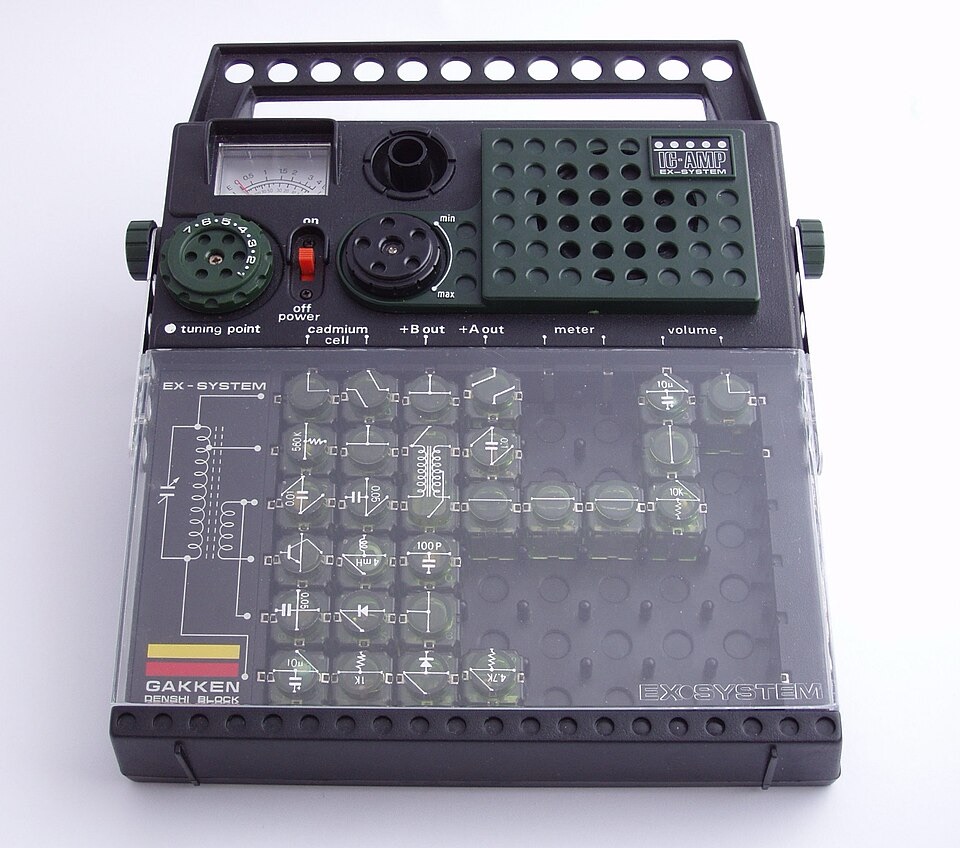
I still remember the first time I placed my fingers on the translucent blocks of the Gakken EX-System. It was a box of curiosities, a hands-on device that invited me to explore the world not through abstract lessons, but through direct experience. There was no screen, no code, just components, circuits, and a gentle hum of possibility.
It was an educational toy, but to me, it was something more: a playground of logic, a sandbox of electricity. Each block carried a secret inside, diodes, resistors, capacitors, and the board itself became a stage where invisible forces performed silent tasks.

Each time I connected a circuit and saw the needle move, or heard a tone from the speaker, I felt like I had unlocked a secret. These weren’t just results; they were rewards for curiosity. In those small signals, I caught a glimpse of something powerful. And though I didn’t yet know the names for it all, I knew I was touching the future.
The Power Inside the Block
Among the components that fascinated me most was the transistor block. It felt almost magical. It wasn’t just a technical curiosity; it was a symbol of transformation. A few decades earlier, electronics had been large, fragile, and hot. Radios and computers used bulky vacuum tubes that glowed like tiny suns. But here was this tiny, silent block that did the same job and more.
We had heard from teachers and books that this tiny component replaced the bulk and fragility of vacuum tubes. It made radios small enough to carry in your pocket. It allowed computing machines to shrink in size while growing in complexity. There was something deeply compelling about that.
It wasn’t just a part; it represented a new way of thinking: smaller, faster, more efficient. It was the kind of power that gave birth to portable transistor radios and inspired pioneers like Akio Morita and Masaru Ibuka to build Sony. As a child playing with blocks, I didn’t just imagine circuits; I imagined the world changing.
Transistors: The Dawn of a New Era
The invention of the transistor at Bell Labs in 1947 was more than a technical achievement; it marked a cultural shift. It wasn’t just that it worked better than vacuum tubes. It redefined what was possible. For the first time, powerful electronic systems could be made small, reliable, and eventually affordable.
In Japan, Morita and Ibuka recognized this and moved quickly. With Sony’s first transistor radio in the 1950s, the dream of personal electronics became real. It wasn’t just a technological breakthrough; it was a social one. Music became mobile. Information became accessible. The world got a little smaller.
And so began a quiet revolution. From radios to televisions to early calculators, transistors allowed technology to escape the lab and enter everyday life. The invisible spark of silicon became the foundation of modern society.
The Rise of Integrated Circuits
Soon came the next leap: integrating multiple transistors into a single chip. Jack Kilby at Texas Instruments and Robert Noyce at Fairchild Semiconductor helped bring the idea of the integrated circuit into reality. This shift wasn’t just practical; it opened the door to exponential growth.
The 1960s and 1970s saw the emergence of large-scale integration (LSI), followed by very-large-scale integration (VLSI). This enabled chips to contain thousands, then millions, of transistors. With it came the rise of companies like Intel, whose microprocessors would define a generation of computing.
Computers that once occupied entire rooms now sat on desks. Later, they would fit in palms. My childhood toy, with its physical blocks and wires, suddenly looked quaint next to sleek laptops and handheld devices. But the logic, the curiosity, was still the same.
Moore’s Law and the Speed of Progress
In 1965, Gordon Moore made an observation that became a prophecy. He noticed that the number of components on a chip was doubling every two years. This became known as Moore’s Law, and for decades, it held true.
It wasn’t just a prediction; it became a goal. Engineers and companies aligned their roadmaps with it. Shrink the transistor. Make it faster. Reduce the cost. Repeat. The industry marched forward in lockstep, compressing decades of progress into years.
From Intel’s 4004 processor to the chips powering today’s AI supercomputers, Moore’s Law shaped the tempo of the digital age. But like all laws of growth, it faced eventual limits, not of ambition, but of physics.
From Silicon to Superposition
As transistors neared the atomic scale, strange behaviors emerged. Electrons no longer obeyed classical logic. Engineers faced a choice: treat quantum effects as problems, or embrace them as possibilities.
Quantum computing was born from this shift. Qubits, which can exist in multiple states at once, offer a fundamentally different form of computation. Companies like IBM, Google, and D-Wave began building machines that harnessed entanglement and superposition.
And while quantum hardware evolved, another frontier opened, one based on language. Large language models like GPT emerged, trained on vast text datasets. Built on transformer architecture, they began to generate human-like responses, simulate reasoning, and even participate in creative work.
The future was no longer just about speed. It was about cognition. Machines weren’t just calculating; they were beginning to seem like they were thinking.
Tomorrow’s Toy Box
Sometimes I wonder: just as my childhood circuits look primitive today, will our most advanced tools one day look equally quaint? Will quantum processors and neural networks be viewed by future generations as charmingly outdated, the way we now view vacuum tubes and punch cards?
It’s a humbling and thrilling thought. That what we now call “cutting-edge” will one day be surpassed not just in speed, but in imagination. Perhaps a child in 2085 will look at today’s AI the way I once looked at a transistor: as the beginning of something vast and still unfolding.
And maybe, just maybe, that child will find wonder in the same way I did, through play, through curiosity, through assembling the future one block at a time.
Reflections on a Personal Timeline
Looking back, it’s clear that this journey, from analog to digital, from silicon to quantum, mirrors my own evolution. What started with a toy on a wooden floor became a lifelong passion for learning how things work, and why they matter.
The progression of technology feels deeply personal. Each innovation felt like a step in a path I somehow understood before I had words for it. The circuits I once built as a child were blueprints for something bigger: a mindset of exploration.
In that sense, the Gakken EX-System didn’t just teach me electronics. It taught me how to think, how to build, how to believe that even the smallest spark could lead to something extraordinary.
Closing the Loop Between Past and Future
There’s something quietly profound about this arc. That a toy from the 1970s could inspire reflections on quantum theory and artificial intelligence. That circuits once held in a child’s hand could mirror systems now distributed across global networks.
It reminds me that the future always begins in simple places, with questions, with tinkering, with joy. Progress doesn’t erase the past. It reveals the continuity of imagination that binds every generation together.
And in that moment, when wonder meets creation, we glimpse the real shape of progress.
Image: Gakken EX-System
 Tom’s Blog