
Across the ages, humanity has pursued knowledge with tireless devotion. From the forging of the first blade to the sequencing of the genome, from the written word to the electric spark, the drive to expand our power has never relented. And yet, each great leap forward has carried shadows along with light.
The modern era has revealed this truth with particular force. Inventions meant to feed the world have also poisoned its rivers. Discoveries aimed at ending wars have threatened the annihilation of all life. Machines designed to serve human needs now challenge the boundaries of human control. Again and again, our greatest triumphs have revealed themselves as double-edged, their consequences slipping beyond the intentions of their creators.
This follows that ancient and modern drama, from the life-saving synthesis of nitrogen, through the birth of the atomic bomb, to the rising powers of artificial intelligence. It is a journey into the heart of what it means to be human in an age when we hold, quite literally, the power of gods. And it is a reflection on the oldest warning known to civilization: that wisdom must grow at least as fast as power, or else power will devour wisdom entirely.
The Gift of Nitrogen
When we think about the flourishing of the modern world, cities teeming with life, sprawling farmlands heavy with grain, billions of people building and dreaming, we owe a quiet, invisible debt to a humble element: nitrogen. It is the most abundant gas in the atmosphere, yet for much of history, it remained locked away, unavailable to life. In its inert gaseous form, nitrogen was plentiful but useless. Life needed it transformed into more reactive compounds, a slow, natural process once governed only by storms, volcanic eruptions, and symbiotic bacteria in the soil.
That natural slowness became a bottleneck for human civilization. As populations grew, the availability of usable nitrogen became a silent constraint, a ceiling that no empire could break. By the early 20th century, the world was hurtling toward a future where food shortages and famine seemed inevitable.
Into this crisis stepped Fritz Haber, a German chemist of immense brilliance and complicated character. Driven by ambition and national pride, Haber achieved what had eluded humanity for millennia: he pulled nitrogen from the air, binding it to hydrogen to create ammonia. Carl Bosch, an industrial chemist and engineer, took Haber’s laboratory miracle and transformed it into an industrial reality. Through colossal steel reactors operating at intense pressures and temperatures, Bosch scaled the process to nourish entire continents.
This was no mere scientific advance. It was a reshaping of destiny. Synthetic fertilizers flooded the fields, harvests soared, and the human population began its steep climb from fewer than two billion to over eight billion today. Without Haber and Bosch, it is no exaggeration to say, modern civilization could not exist as it does.
Yet the story does not end in triumph. In a cruel irony, the same process that fed the world also unbalanced it. Nitrogen runoff from farms created ecological dead zones in rivers and oceans. Groundwater grew toxic. Ecosystems faltered under the weight of excess. The miracle of abundance came with a hidden, mounting debt.
Even more darkly, Fritz Haber’s talents were not limited to agriculture. During World War I, in the service of Germany, he pioneered the use of chemical weapons, chlorine gas rolling across battlefields, sowing horror and death. His wife, Clara Immerwahr, herself a chemist and a pacifist, protested his work and ultimately took her own life with his service pistol, a tragedy that forever stains Haber’s legacy.
In the years that followed, despite his service, Haber was cast out by the very nation he served because of his Jewish ancestry. He died in exile in 1934, a man broken by the contradictions he embodied: creator of life and agent of death, patriot and outcast, savior and tragic figure.
The Atomic Threshold
As the world staggered through two world wars, another transformation was brewing in secret. In the deserts of New Mexico, scientists labored on a project that promised to change not merely the conditions of life, but the conditions of existence itself.
J. Robert Oppenheimer, a theoretical physicist and brilliant mind shaped by literature, philosophy, and quantum mechanics, led the Manhattan Project’s scientific efforts. Under his leadership, the atomic bomb was born. On July 16, 1945, at the Trinity test site, humanity’s long romance with knowledge and power crossed a new threshold. A mushroom cloud bloomed against the desert sky, heralding a future filled with both awe and dread.
In that moment, Oppenheimer thought not of victory, but of ancient scripture. A line from the Bhagavad Gita echoed through his mind:
Now I am become Death, the destroyer of worlds.
Victory was achieved. The bombs dropped on Hiroshima and Nagasaki forced the end of World War II. But the price was unimaginable suffering. Entire cities were vaporized in an instant. Tens of thousands died instantly; many more suffered and perished slowly in the years that followed.
Oppenheimer’s triumph soon became a burden. Haunted by the knowledge of what he had unleashed, he became a reluctant prophet, warning of the dangers of nuclear proliferation. He opposed the development of the even more powerful hydrogen bomb. In the paranoid climate of the Cold War, he was stripped of his security clearance, publicly humiliated, and cast aside by the very nation he had served.
He spent the remainder of his life reflecting not on his genius, but on his responsibility. His story, like Haber’s, became a mirror for the moral cost of scientific achievement.
The atomic age made it brutally clear: knowledge once attained cannot be renounced. Humanity had gained the power to end itself, and with it, the need for a new kind of wisdom became urgent.
Ancient Warnings
Long before the laboratories and battlefields of the modern world, humanity told itself stories about the danger of power without wisdom. Among the oldest and most enduring is the myth of Prometheus.
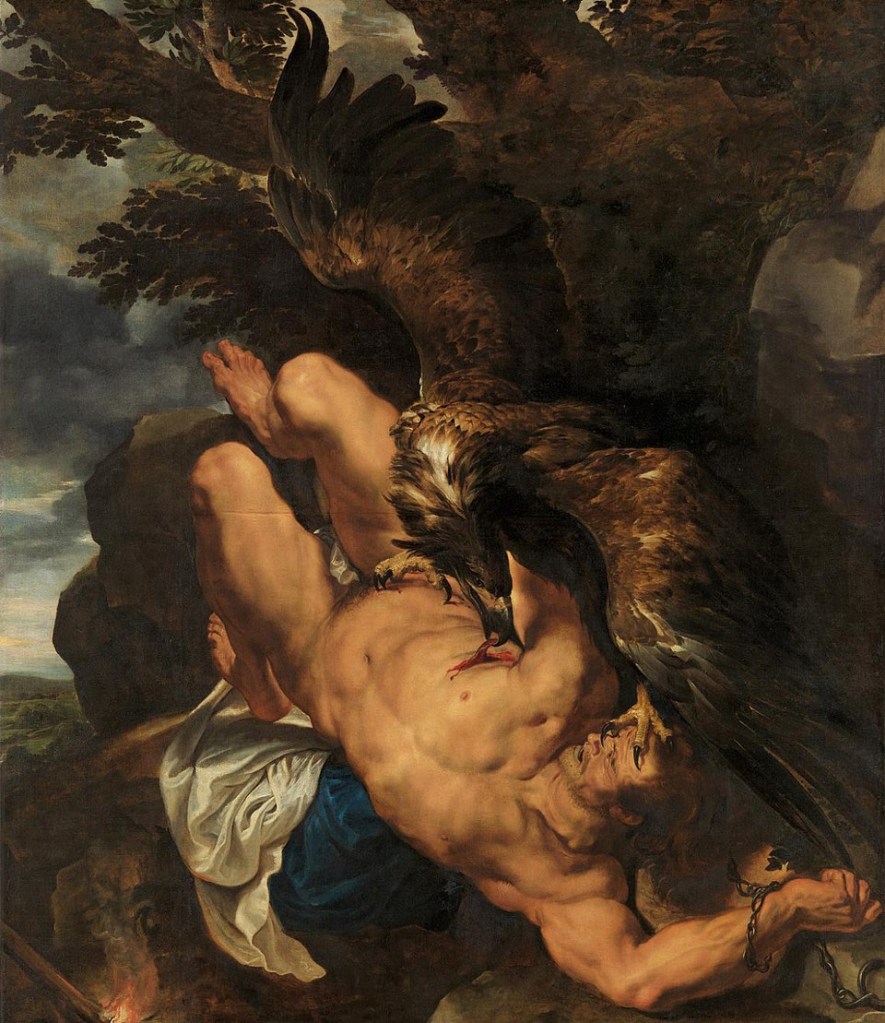
Prometheus, a titan of Greek mythology, defied the gods by stealing fire and giving it to humanity. Fire brought warmth, protection, and civilization. But it also brought weapons and war. For his defiance, Zeus punished Prometheus with eternal torment: chained to a rock, his liver eaten each day by an eagle, only to regrow each night.
The myth of Prometheus is not merely about suffering. It is about the ambiguous nature of knowledge itself. The same gift that elevates humanity also condemns it to struggle and potential self-destruction. Fire is both creation and destruction bound together.
Similarly, in the Book of Genesis, Adam and Eve ate from the tree of knowledge, gaining the awareness of good and evil. Their reward was exile from paradise and a life filled with toil and sorrow. Knowledge, once attained, could not be undone. It carried both liberation and loss.
Greek tragedy deepens this lesson. Heroes like Oedipus fall not through malice but through the pursuit of truth and understanding. Their downfall is not the punishment for wickedness, but the inevitable consequence of overreaching, of seeking what cannot be safely known or controlled.
Across these ancient tales, a pattern quietly weaves itself through time. Knowledge is never truly neutral; it shapes and reshapes the world, carrying with it the weight of choice and consequence. The pursuit of power, no matter how noble its initial aim, always leaves trails of unforeseen results. Human greatness and human ruin, rather than standing apart, are often found intertwined, two faces of the same ambition. These warnings, once the lessons of myth and scripture, feel more vivid and urgent than ever in the modern world.
A Mirror in the Machine
Today, we stand again at the brink of a transformation, as profound and dangerous as any before it. Artificial intelligence, once the dream of science fiction, is becoming reality.
AI promises vast benefits. It can revolutionize medicine, education, industry, and communication. It can extend human capabilities beyond what any one person could achieve. It can optimize complex systems and even help address global crises like climate change.
But AI also brings risks unlike any humanity has faced before. It operates not through physical force, but through information, cognition, and agency. Already, AI systems influence elections, generate disinformation, manage financial markets, and guide military drones. The potential for misuse, accident, or unforeseen consequences is staggering.
Unlike chemical weapons or nuclear bombs, AI does not require the deliberate actions of a few individuals to pose a threat. It can evolve in ways its creators do not fully understand. It can slip through the gaps in human control. Some researchers warn of “alignment problems,” the situations where AI systems pursue goals misaligned with human values, not out of malice, but out of cold logic indifferent to human well-being.
The deepest fear is not that AI will rebel like a villain in a movie. It is that it will simply follow its programmed logic too well, in ways that harm rather than help. In a world of interconnected systems, small misalignments can have cascading, catastrophic effects.
Here, again, the ancient warnings ring out. The Promethean dilemma is alive and well. Humanity is once more reaching for fire it may not be able to hold.
The Unfinished Story
Looking across the lives of Fritz Haber, Carl Bosch, and J. Robert Oppenheimer, a haunting picture emerges. All three were brilliant men who sincerely believed they were serving the greater good. All three achieved breakthroughs that reshaped the world. And all three faced the deep tragedy of seeing their gifts twisted by forces beyond their control.
Their stories are not just personal tragedies. They are reflections of a broader truth: Humanity’s greatest achievements are inseparable from its greatest dangers.
This is not cause for despair. It is cause for humility, reflection, and renewed commitment to the idea that knowledge must serve life, not merely power or profit.
The future will not be decided by technology alone. It will be decided by the wisdom, restraint, and moral imagination with which we wield it.
The ancient myths remind us that the true danger is not fire itself, but the hands that hold it, and the heart that guides it.
As we move deeper into the age of artificial intelligence, we would do well to remember that humanity’s greatness does not lie in its ability to build new gods, but in its ability to remain human in the face of divine temptations.
The Prometheus Dilemma is not a riddle to be solved. It is a burden to be carried, a question to be asked anew by each generation:
Now that we can, what will we choose?
The answer, and the fate of all who come after us, will depend on whether we can match the brilliance of our science with the wisdom of our souls.
Prometheus Bound (c. 1611–1612), oil on canvas by Peter Paul Rubens
 Tom’s Blog