
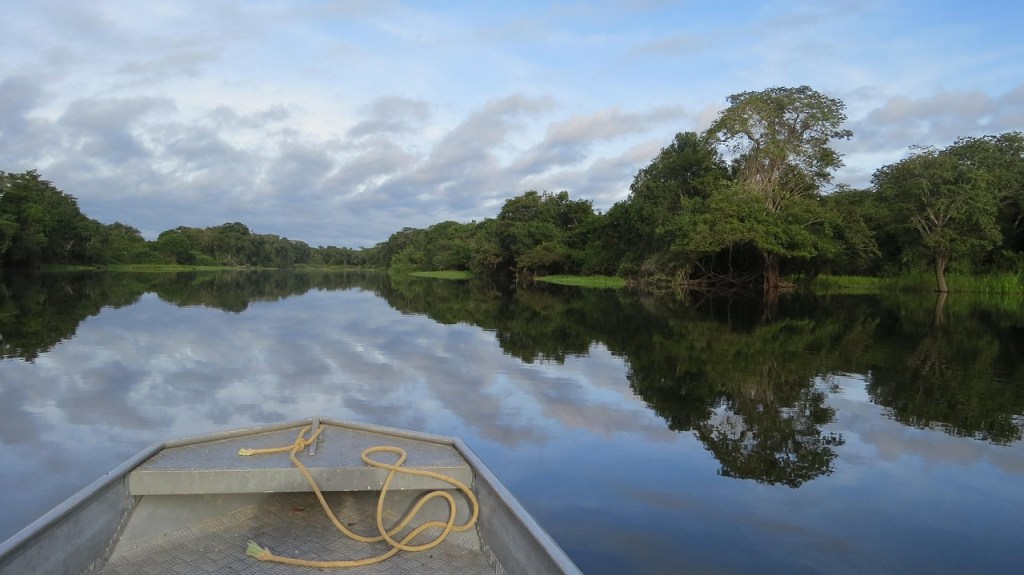
I recently had the opportunity to read about the linguistic discussions surrounding the Pirahã language, spoken by a small tribal community deep in the Amazon rainforest. Due to their limited interaction with outsiders, their language has remained remarkably unique and preserved.
What makes this minor language so famous among linguists is its unusual characteristics—or rather, its lack of certain features that are assumed to be universal in human languages. Pirahã reportedly lacks numbers, color names, verb tense, and, most notably, recursion—a grammatical function that allows for complex sentence structures, such as embedding one clause within another (“A thinks that B believes C”). According to Noam Chomsky, recursion is a fundamental trait of all human languages, forming a key pillar of his theory of universal grammar.
In this context, the linguistic ethnography of Pirahã—especially the work of Daniel Everett—challenged the very foundation of Chomsky’s theory, either questioning the validity of universal grammar itself or the selection of features deemed universal. While I am not an expert in this linguistic debate, I couldn’t help but feel that it reflects a broader, recurring challenge: the difficulty of understanding differences, whether in language, culture, or human experience.
Beyond Linguistics
The debate over Pirahã is not old—it emerged just decades ago and remains a hot topic. However, its structure reminds me of earlier ethnological debates about different cultures. In the 19th century, Western scholars, in their study of “exotic” societies, debated whether people from different cultures and religions were even fully human in the same way they considered themselves to be. Such perspectives contributed to the dehumanization that justified slavery and colonialism. If “others” were perceived as fundamentally different, it became easier to treat them as inferior, even as less than human.
Understanding human rights as we do today requires the recognition that all people, regardless of background, are fundamentally equal. While this seems self-evident now, it remains difficult in practice. Even in an era of diversity and inclusion, many still struggle to fully empathize with those they perceive as “other.” The challenge of understanding others is as difficult as understanding ourselves. This fundamental difficulty is what I sensed in the linguistic discussions over Pirahã—or, more broadly, in any attempt to study another language through the lens of one’s own.
The Fallacy of a Single Norm
The assumption that a language without recursion, numbers, or color names is “primitive” mirrors the way traditional ethnography once viewed non-Western cultures as less advanced. We unconsciously apply a hierarchy, equating linguistic complexity with intellectual or cultural superiority. Yet, the absence of certain features does not imply inferiority—only difference.
Languages evolve in response to the needs of their speakers. Modern languages in technologically advanced societies have developed accordingly, absorbing new concepts and expanding their lexicons. An English dictionary is undoubtedly thicker than any possible Pirahã dictionary. However, this does not mean Pirahã is impoverished as a language. Rather, it likely contains nuances, concepts, and modes of expression that other languages lack. The problem is that we cannot see what we cannot see.
Throughout history, dominant cultures have imposed their linguistic frameworks on others. For centuries, Latin was considered the pinnacle of linguistic sophistication in Europe, and English, at one time, was seen as an incomplete or inferior language in comparison. When English later became dominant, Japanese intellectuals in the early 20th century worried that Japanese was not “rational” enough to support modernization. Some even proposed replacing it with a European language to align with the “civilized world”—a phenomenon that also occurred in many colonized nations. Before that, Japanese intellectuals had looked to China, borrowing its writing system and literary traditions.
This pattern repeats itself: when one language is viewed through the lens of another, it is easy to focus on what it lacks rather than what it uniquely offers. The same issue arises between languages of so-called “civilized” nations and those of small, isolated communities.
The Dilemma of Understanding “Others”
The Pirahã debate reveals an important lesson: the absence of features we consider universal does not make a language incomplete. It simply means we may be blind to what it does possess. What if Pirahã contains structures or modes of thought that other languages lack? We can only compare what we can perceive—but perception is inherently limited by our cognitive and cultural frameworks.
This limitation extends beyond linguistics. It applies to any attempt to understand an unfamiliar perspective. Consider the relationship between neurotypical individuals and neurodiverse individuals. Neurodiverse people experience the world in ways that neurotypical people may struggle to comprehend. While efforts can be made to bridge the gap, a neurotypical person cannot truly see the world through a neurodiverse lens, just as an English-speaking anthropologist will never fully grasp the worldview encoded in Pirahã.
We cannot escape our own perspectives, yet we are always trying to understand others. This is the fundamental dilemma.
The Limits of Perspective
Ultimately, every person experiences the world through their own unique lens. I can only see the world through my own eyes, just as you can only see it through yours. The moment I leave this world, my experience ends. No one else can truly know what it was like to be me.
The challenge of understanding others—whether another person, another culture, or another language—is not just an intellectual exercise. It is a fundamental human struggle. The Pirahã debate is not just about recursion or universal grammar. It is about the difficulty of recognizing that different ways of thinking, speaking, and perceiving the world are not deficiencies but alternative expressions of human experience.
The real question is not whether we can fully understand “others”—but whether we can accept that some things may always remain beyond our comprehension.
Image by luis deltreehd
 Tom’s Blog
Wonderful post 🎸🎸
LikeLiked by 1 person
Thank you for your comments! 🤗
LikeLike