
Participatory observation is one of the key methodologies used mostly in the social sciences such as anthropology and sociology and the like. It started from the criticism against what is called armchair researchers.
When those researchers in social sciences tried to understand and describe specific communities like tribes, cultures, societies, ethnicities, or any type of group, the approach that those “traditional researchers” used was just reading books and documents mainly written by those who visited the communities they wanted to study. The approach was, in short, more like reading what those who visited the field wrote instead of visiting and living in the targeted communities themselves.
In nineteenth-century ethnology, this was, in a way, inevitable because traveling to those remote areas itself was a challenging task. As such, in most cases, they had no choice but to rely on books and documents written by travelers, explorers, and the like. In this way, their approach was quite similar to that of historians. For historians, of course, it is impossible for them to go back to the past, to a certain historical era they want to study, by using a time machine. All they can do is read books and documents preserved from the past and reconstruct historical reality based on these available materials.
The Myth of Historical Progress
That is why, for those historians and researchers who believe in the progress or evolution of humankind, the present era is, in a way, the most advanced time as the result of all the progress and development that has taken place throughout history. In the nineteenth century and even in the twentieth century, people saw themselves as the most advanced as a result of all the past efforts, trials, and errors. In a way, this is true. The sophisticated definition of human rights is just one of the latest achievements, overcoming various brutalities and ignorances.
Especially in the modern period in the Western world, they believed they were the most advanced—the first group to have achieved the highest level of possible human achievement at that moment. It was no wonder that one of the most influential theories at that time, first by Hegel and then by Marx and Engels, was the historical worldview of dialectical idealism by Hegel, followed by dialectical materialism by Marx and Engels. The latter especially made tremendous impacts on the other half of the world among all those socialist and communist countries. They all believed in the social process leading toward the utopian omega point called a communist society, where we would no longer be burdened by labor but would “work” as we “like,” making us most productive without any harmful “exploitations” at all.
Being freed from labor (given by God as a consequence of humans leaving the Garden of Eden) leading us to a utopian state seems quite similar to the Christian worldview and, more broadly, to Abrahamic religious perspectives. Furthermore, aspiring to a utopian state appears to be an archetypal desire of humankind, even in Eastern religions like Buddhism. In this sense, even though Marx said religion was an opium and claimed that we should be non- or anti-religious in the process of human development, his ideology itself looked quite religious. In reality, the ideological pursuits of all socialist and communist movements did not seem so different from religious fanaticism, where, in the worst-case scenarios, they induced cruel genocides, as we all know from human history in both religions and ideologies.
The Legacy of Armchair Researchers
Going back to the armchair researchers, all those nineteenth- and early twentieth-century thinkers were more or less such armchair ones. It’s well known that Marx wrote his book The Capital, spending a long period of time in the British Library. His worldview and ideology of dialectical materialism were reinforced by the books and documents he read and studied, much like historians. And most ethnologists at that time were also the same. They studied “remote” cultures and regions based on the available books and documents in libraries, as if they were studying the “distant past”—just as historians studied history.
In this regard, it was perhaps inevitable that, even unintentionally, they felt that their hometowns in Europe represented the present, the latest stage of human development, while the “remote” areas they studied could appear more like the past. When they read about exotic cultures in the Orient or Eastern regions, or the strange habits of tribal communities—all described in books and documents written by travelers, explorers, and colonizers—what they “felt” was their own “distant past,” a stage of civilization they had supposedly moved beyond.
It’s interesting to note that even modern cosmology, while based more on scientific rationalism, presents a similar phenomenon. Due to the time it takes for light to travel, what we see in the far reaches of the universe is actually the distant past. Even the sunlight we see is from about eight minutes ago, as it takes that much time for light to travel from the Sun to our eyes.
The Shift Toward Empirical Evidence
Probably influenced by Darwin’s travels around the globe, which led him to write the epoch-making book On the Origin of Species, the importance of empirical evidence became more and more emphasized. As experimental science and scientific observation drove the progress of science and technology in the twentieth century, acting like bookish armchair researchers meant they lacked the ability to observe factual evidence. It implied inefficiency in research capabilities, even in the social sciences.
The so-called “fieldwork” approach was no longer limited to natural science researchers but became a necessary method even for social science researchers as well. So, we saw cultural anthropologists like Malinowski and their followers. Their approach was called, as I mentioned above, “participatory observation.”
The Contradiction of “Participatory” Observation
Why “participatory”? While those social science researchers were influenced by the experimental, observant, and inductive approach of natural sciences, the big difference is that what they observe is not a hard object. To truly understand the communities they study, the best possible approach is to participate in the target community.
For example, for anthropologists, it is not enough at all to simply read and study books and documents written about the target communities—especially when such materials are written by “unprofessional” travelers and the like. How do they know if those materials are free from fallacies and biases? That’s impossible to determine just by reading them. So, the best possible approach is to participate in the target community, to directly experience the community itself, and to interact with its members more intimately.
Thus, staying in the community for a long period as a participant observer and eventually writing ethnography are the necessary and indispensable approaches for all “modern” anthropologists. Even for other social scientists, and even journalists, such a participatory approach has become the most recommended way to deeply understand a target community. While it is also important to read books and documents about the target community, especially statistical information and historical records, if this approach can be called a quantitative approach, then such a participatory, experiential, and deeply descriptive approach can be called a qualitative one. As Geertz called it, “thick description”, where one can understand the richness of meanings and contexts—something that can only be grasped through deep participatory commitment as an observer.
Rethinking Historical Progress: Cultural Relativism and Diversity
In a way, the late twentieth century was a period when researchers made numerous attempts and errors in seeking the ideal approach to participatory observation, as various “cultural studies” and “area studies” became the mainstream of social sciences. We no longer see the world through a simplistic, naïve lens that views the Western world as the latest and most advanced while regarding remote, non-literate tribal communities as the most primitive and backward. Geographical gradations can never equate to historical progress.
In a way, as long as we live in the present moment, all communities are the “latest” regardless of their differences. There is no such distinction as advanced vs. backward. If anything, as Lévi-Strauss mentioned, we can differentiate societies as “cold” or “hot.” In the former, historical changes may not seem as significant compared to the hot ones, yet both are sophisticated in their own way. This perspective laid the foundation for cultural relativism and eventually contributed to the current worldview of diversity and inclusion.
The Paradox of Observation and Participation
Through all these efforts in seeking the best approach to “participation,” however, it is not that we have truly found the ultimate approach for participatory observation. In a sense, across all fields—including natural sciences, especially quantum physics—we have been facing the dilemma of the act of observation in the effort of participation.
One well-known dilemma is quantum superposition, illustrated by the double-slit experiment in observing electrons. Is light a particle or a wave? The answer is both, as we cannot avoid the intervention of the observer.
In Newtonian physics and traditional scientific conditions, an experiment is ideally conducted under the assumption that any observer’s intervention can be eliminated. That is possible; however, on the quantum scale, the act of observation itself influences the movement of quantum particles, making it virtually impossible to eliminate the observer’s intervention.
The Unavoidable Influence of the Participant Observer
Actually, this impossibility is also inevitable in participatory observation in the field of social sciences. For example, if you interview people in the target community you are supposed to participate in, can you totally eliminate your intervention as a “participant observer”? You cannot ignore the fact that they see you as an interviewer. You believe you can become their participant observer and obtain good, “thick” qualitative answers in your interviews. But how sure can you be? How do you know you have truly become a participant observer in the community?
Perhaps they simply see you as a special guest who asks many questions about them, while they have no real understanding of why you are asking so many questions or what your motivations are. Probably, for Malinowski, his effort at that time was outstanding, but how do we know that, for the people in the Trobriand Islands, he was not just another Westerner—like missionaries, colonizers, explorers, and the like?
The Contradiction of “Participatory Observation”
Even now, we see countless publications of so-called ethnographies, nonfiction documentaries, and so on. But how much were these researchers truly able to participate in the target communities? They tried their best to become another member of the community, but it is barely possible for them to become 100% part of the community. If they did, they would have to stop their observation. The community would no longer be their “target” community to “observe”—it would simply be their own community, the one they live in.
As such, the term “participant observation” is inherently contradictory. As long as you observe, you can never fully participate. If you participate completely, you can no longer observe. And this dilemma is actually everywhere—it is a common experience when we try to join a community in an effort to be accepted.
When the Observer Becomes the Observed
Consider an anthropologist who stays in a target community for research. He does his best to immerse himself in the community. He feels he has almost completely become a participant in their world. After his best efforts, he finally completes his dissertation and publishes a book based on his research.
Meanwhile, one day, he comes across another book in a bookstore. The title is “An Anthropologist in the Community.” The book is written by a member of the very community where this anthropologist conducted his participatory observation. It describes the culture and customs that the anthropologist himself belongs to and unknowingly exhibits in his behaviors. It is, in a way, another “ethnography”—but this time, about the “tribal community“ called the department of anthropology and the university.
Reading this book, the anthropologist suddenly realizes that he, too, was merely an informant, observed by someone in the very community he thought he was studying.
The Reflexivity of Ethnography
This is just an allegorical scenario I made up, but my point is the vague distinction between observer and observed, the impossibility of complete participation, and the truth that anyone’s life is part of the communities that ethnographic writings describe.
Clifford Geertz “mystified” cockfighting in Bali. In the same way, anyone can “mystify” the academic fights within a university. Both can be “thick descriptions” within their rich contexts and implications. You may find one “remote” culture exotic. But your own culture is just as exotic to those whom you consider “remote.”
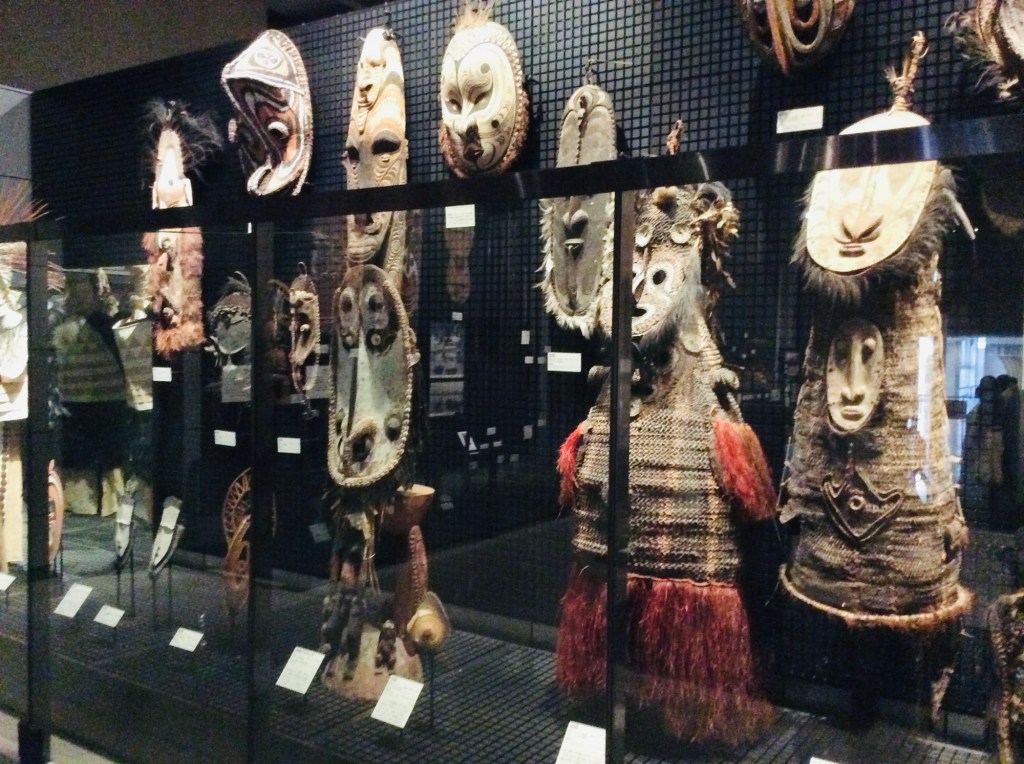
Image: A photo captured by the author.
 Tom’s Blog