
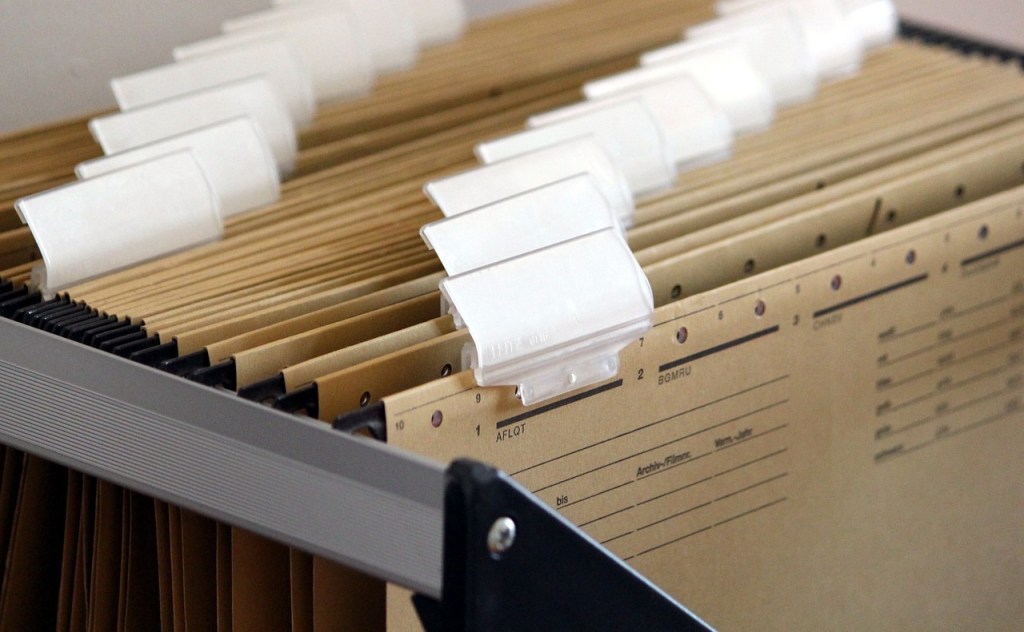
Decades ago, one of the symbols of a paper-based office was the filing cabinet. These steel boxes were placed in the corners of offices, and if you needed to check documents, you would open one of them. Inside, you would find many folders placed vertically, each with its own name tag to indicate its contents. Within each folder were the necessary documents, neatly organized.
This system, known as a filing system, was the pinnacle of knowledge organization in the 20th century.
The same principle was applied to archives. In the warehouses of organizations, large boxes (the equivalent of steel cabinets) were stored on massive shelves. Inside these boxes were folders placed vertically, each tagged for identification. The documents were preserved in layers: documents within folders, folders within cabinets or boxes.
This method ensured accessibility and represented the best possible solution for knowledge management in the 20th century.
***
Then came digitalization. While some sectors—such as finance, government, and libraries—still rely on paper-based systems to some extent, the push for digital transformation has been increasingly evident in the 21st century.
However, there’s an issue that needs addressing: although filing systems have been digitized, the principles underlying them remain rooted in the legacy of paper-based systems.
Consider our computers: as the number of documents increases, we create folders to organize and categorize them. But as the number of folders grows, we inevitably create more folders to organize the folders. In a physical system, there were natural limits. A physical folder could only hold documents, and cabinets could only fit folders. This physical limitation also kept the system cognitively manageable, with only three layers: documents, folders, and cabinets.
In the digital world, however, there are no such limits. We can create an infinite number of nested folders. This creates a paradox: while folders are meant to ease cognitive overload, they often become the primary source of frustration. Searching through countless nested folders to locate a single document becomes a maze-like experience, defeating the purpose of the system.
***
The irony is that the flexibility of digital filing, intended to simplify organization, often overwhelms us. Managing folders becomes an end in itself, detracting from the real goal: accessing the relevant documents. To address this, we should discipline ourselves to limit folders to three layers.
But is replicating the limitations of physical filing systems the best approach in a digital environment? Should we simply “duplicate” the old system, or can we leverage the unique advantages of digital technology?
Digital systems offer significant benefits beyond saving physical space. Among these are searchability and linking. These advantages pave the way for a new paradigm: folderless knowledge management.
***
When Gmail was introduced in the mid-2000s, one of its catchphrases was:
Search, don’t sort.
This philosophy challenged the traditional practice of creating folders for emails. Instead of sorting incoming emails into categories, Gmail encouraged users to rely on its robust search functionality. The principle can be extended to all aspects of digital knowledge management.
Sorting emails—or documents—into folders is a manual, time-consuming process. Even with AI assistance, this approach is inherently flawed. Instead, AI should enhance search and linking capabilities, freeing us from the task of folder management.
***
Creating folders is an act of categorization. Inevitably, this leads to category errors. For example, where does an “apple” belong? It could fit into categories like “fruit,” “food,” “symbolism,” “agriculture,” “nutrition,” or even “business.” Similarly, some folders might logically belong to multiple parent folders, creating confusion.
A more flexible alternative is tagging. By assigning multiple hashtags to a document (e.g., #fruit, #food, #symbolism), we can eliminate rigid hierarchies. However, this too has its challenges. Tagging requires manual effort and can lead to inconsistencies (e.g., #food vs. #foodproducts). The sheer diversity of possible tags makes this approach impractical at scale.
***
The ultimate solution is to stop categorizing altogether.
Let the documents grow organically, even if it feels chaotic. Just as Gmail transformed email management, AI can revolutionize knowledge management. By reading and analyzing all your documents, AI can identify connections, curate clusters of related documents, and present them in a meaningful way.
Think of this as a neural network for knowledge. The human brain stores information in a dynamic, non-hierarchical manner, forming connections as needed. Similarly, AI can curate dynamic, contextual clusters of documents without relying on predefined folders, hashtags, or hyperlinks.
This approach is not only efficient but mirrors the structure of a flat organization, where individuals collaborate dynamically rather than being siloed into rigid teams. Just as traditional hierarchies have given way to flat organizations in the workplace, folder-based systems can be replaced by AI-curated networks.
***
Adopting this new paradigm doesn’t mean eliminating folders, hashtags, or hyperlinks overnight. A gradual transition is more realistic.
For example, you could maintain an “inbox” folder as a temporary workspace for active documents. Once completed, these documents can be moved to an “archive,” where AI takes over. This hybrid approach allows you to experiment with AI-curated knowledge management while maintaining a level of order.
The future of knowledge management lies in embracing the chaos of unstructured data. By relinquishing control to AI, we can free ourselves from the constraints of manual categorization and focus on what truly matters: the knowledge itself. The mantra for this new era is simple:
Don’t sort. Ask AI.
Image by Ulrike Mai
 Tom’s Blog