

Have you ever looked at a painting and felt like the person in it was looking right back at you, understanding you completely?
That’s the kind of magic the 17th-century Dutch master, Rembrandt van Rijn, worked with his paintbrush. He wasn’t just a technically brilliant artist; he was a master of the human heart. His paintings aren’t just beautiful to look at; they speak to something deep inside us, something timeless and universal.
Let’s take a journey and see why his art continues to resonate so powerfully today, especially in a world that often feels obsessed with artificial perfection.
More Than Meets the Eye: Rembrandt’s Honest Look at Humanity
Rembrandt lived during a time when many artists painted idealized versions of people, especially in religious scenes. Everyone looked perfect, like they’d just stepped out of a beauty salon for the soul. But Rembrandt wasn’t interested in that kind of artificial perfection. He wanted to show real people, with all their flaws and imperfections. He painted wrinkles, blemishes, and the signs of aging with honesty and, surprisingly, with great affection.
It is a stark contrast to today, when we often present an edited, filtered, and curated version of ourselves online. On social media, we find photos of smiling, perfect-looking people. We might wonder if anyone struggles, or has a bad day.
Think about his self-portraits. He painted himself over and over again throughout his life, not as a dashing hero, but as a regular guy getting older. We see the changes in his face, the weariness in his eyes, and we feel like we know him. He did the same with everyone he painted, whether they were wealthy merchants, everyday folks, or characters from the Bible. He saw the beauty in their realness, their humanity. His unique perspective was popular with the growing middle class of his time, looking to see themselves in art. He understood that all people, not just the very wealthy or very holy, were interesting and worthy of being memorialized in art.
In a way, he was doing the opposite of what many people do today: he was stripping away the filters and showing the real person underneath.
And the emotions! Rembrandt had this incredible ability to capture how people were feeling, not just what they looked like. A slight furrow in the brow, a glimmer in the eye, a subtle curve of the lips – these small details reveal a whole world of inner emotions. His paintings are like snapshots of the soul, showing us joy, sadness, love, loss, and everything in between. They are relatable because they feel so true to life, and they remind us that other people, even those from long ago, felt things just as deeply as we do. And, unlike our carefully curated online personas, they show the full range of human emotion, not just the happy, smiling parts.
Playing with Light and Shadow: Rembrandt’s Secret Weapon
One of the things that makes Rembrandt’s paintings so instantly recognizable is his masterful use of light and shadow. Art historians call it “chiaroscuro,” but you don’t need to know the fancy term to appreciate its power. Think of it like this: he uses light and darkness like a movie director uses a spotlight. He illuminates the most important parts of the scene, drawing our attention to where he wants it, creating a sense of drama and mystery.
In many of his paintings, large areas of darkness surround the main figures, making the light areas even more striking. This isn’t just about making things look pretty; the light often has a deeper meaning, especially in his religious works. It can symbolize goodness, hope, or even a divine presence. It often calls to mind the words of the Gospel of John:
The light shines in the darkness, and the darkness has not overcome it. (John 1:5)
In “The Return of the Prodigal Son,” for example, the warm light enveloping the forgiving father and his repentant son feels like a visual representation of love and grace. We feel the warmth of that light, and we instinctively understand the message.
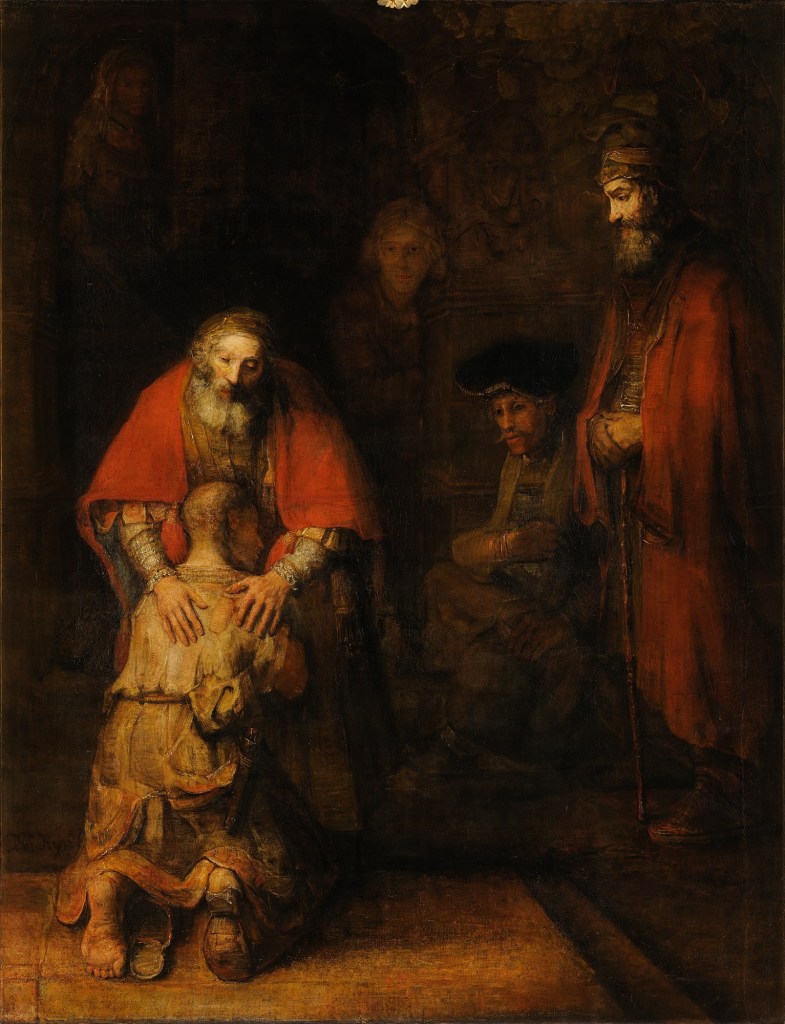
But the shadows are just as important. They add depth and complexity, suggesting the unknown, the hidden parts of ourselves that we don’t always want to face, the parts we are hesitant to post about online. They remind us that life isn’t always sunshine and rainbows; there’s darkness, too. But even in the darkness, there can be beauty and meaning. His use of light and shadow tells us that all experiences, good and bad, are a part of life, and that a life well-lived will include both light and darkness.
The Bible: Not Just Stories, but Real Life
Rembrandt painted many scenes from the Bible, but he did it in a way that was revolutionary for his time. He didn’t just paint them as grand, faraway events. He brought them down to earth, making them feel relatable and human. He imagined what these biblical figures might have felt, what their struggles might have been like, and he painted them as real people, not as untouchable saints. He showed their humanity, something we often miss when our lives are presented as a series of perfect moments and filtered images.
Take that painting of the Prodigal Son again. It’s not just a Sunday school lesson; it’s a powerful story about family, mistakes, forgiveness, and second chances. We see the father’s overwhelming love, the son’s regret, and even the resentment of the older brother. These are emotions we all understand, no matter what our beliefs are. This is what makes the story, and this painting of it, so timeless.
Rembrandt had a knack for finding the universal in these stories. He showed us that the struggles and joys of people centuries ago aren’t so different from our own. He made the stories relevant and relatable, and he did so with an eye to what people were looking for in his own time. People wanted to see that their faith was relevant to their own lives, and he accomplished this in his paintings. Whether he was painting a wealthy merchant or a scene from the Bible, he treated his subjects with the same respect and empathy, finding the extraordinary in the ordinary.
Why Rembrandt Still Matters: A Legacy of the Heart in an Age of Filters
So, why are we still talking about Rembrandt centuries later? Because his art speaks to something fundamental about being human, something that gets lost in the noise of our modern, often superficial, online world.
He showed us that everyone, regardless of their social status or background, has a story worth telling, a story that is often complex and multifaceted. He reminded us that beauty can be found in imperfection and that our emotions, both light and dark, are what make us who we are. In a world where we often present a filtered, edited, and beautified version of ourselves online, Rembrandt’s unflinching realism is a breath of fresh air. It’s a reminder that true beauty lies in authenticity, in embracing our wrinkles, our flaws, and our struggles, not in hiding them.
Artists after him, like the famous Vincent van Gogh, were deeply inspired by Rembrandt’s work. They saw in him a kindred spirit, someone who understood the power of art to express the deepest truths about the human condition. Van Gogh, who also struggled with his own demons, must have felt a strong connection to Rembrandt’s honest and compassionate portrayal of human vulnerability. He once wrote in a letter to his brother Theo:
Rembrandt goes so deep into the mysterious that he says things for which there are no words in any language. It is with justice that they call Rembrandt—magician—that’s no easy occupation. – 2 (Letter 506)
In another letter, he wrote that he would give ten years of his life to sit for two weeks before a particular Rembrandt painting, learning from it (Letter to Theo van Gogh, July 1885).
But his influence doesn’t stop there. Many artists have found inspiration in his work. His influence doesn’t stop with Van Gogh. Many artists have found inspiration in his ability to capture the essence of humanity.
Rembrandt’s paintings are like mirrors, reflecting our own humanity back at us, the humanity we often try to hide behind filters and curated online personas. They invite us to connect with the people in his paintings, to feel what they’re feeling, and to recognize our own stories in theirs. He reminds us that even though times change, the basic human experiences of love, loss, joy, and sorrow remain the same. His art transcends time and place, connecting us to something larger than ourselves.
Finding Ourselves in Rembrandt’s Light
Rembrandt’s art is a gift that keeps on giving. It’s an invitation to look beyond the surface, to see the beauty in the everyday, and to embrace the full spectrum of human emotion, not just the parts that are easy to share online.
His masterful use of light and shadow isn’t just a technique; it’s a metaphor for the human condition. We all have our light and dark sides, our moments of joy and sorrow. Rembrandt’s paintings remind us that it’s okay to be human, to be imperfect, to struggle, and to search for meaning.
They offer a message of hope: that even in the darkest of times, there is always the possibility of light, of forgiveness, of redemption and connection. And that, perhaps, is the most enduring lesson of all, and one that people will always need, no matter when they live. His art proves that beauty and meaning can be found everywhere, even in unexpected places, if we only take the time to truly see.
In a world obsessed with filtered perfection, Rembrandt’s art is a powerful reminder that true beauty lies in the unfiltered, unedited truth of who we are.
Images: Rembrandt van Rijn – Self-Portrait and The Return of the Prodigal Son
 Tom’s Blog

#/media/File%3ARembrandt_Harmensz_van_Rijn_-_Return_of_the_Prodigal_Son_-_Google_Art_Project.jpg)