
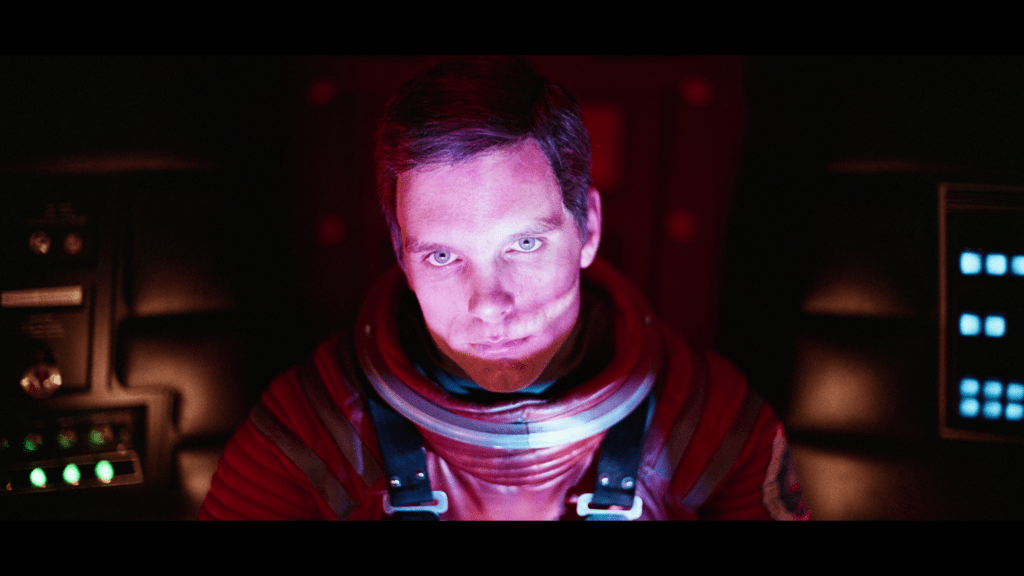
Stanley Kubrick’s “2001: A Space Odyssey” stands apart from all other science fiction films, even 56 years after its release. While countless space epics have graced the screen since 1968, none have matched its exceptional fusion of scientific precision and philosophical depth. The film’s meticulous attention to space physics, astronautical engineering, and astronomical phenomena created a new standard for realism in cinema. Yet beneath this technical excellence lies a profound meditation on human consciousness, evolution, and our place in the cosmos.
What sets “2001” apart is not just its scientific accuracy, but how this accuracy serves the larger narrative. Each carefully researched detail – from the silence of space to the physics of rotating space stations – builds a foundation of truth that makes the film’s larger questions about humanity’s future feel more urgent and real. This commitment to realism allows viewers to fully immerse themselves in the story’s deeper implications about artificial intelligence, human evolution, and our relationship with the unknown.
Modern audiences, especially those working with emerging technologies like AI, find the film remarkably prescient. Its visualization of tablet computers, video calls, and space tourism might seem commonplace today, but in 1968 these predictions emerged from rigorous consideration of technological possibilities. More importantly, the film’s explorations of AI consciousness and human transcendence resonate even more strongly in our current era of rapid technological advancement.
Unprecedented Technical Realism
In “2001: A Space Odyssey,” silence speaks volumes. Kubrick’s revolutionary choice to portray space without sound reflects the physical reality of vacuum – where sound waves cannot travel. The film limits its audio to what astronauts would actually hear: their own breathing inside space suits, internal mechanical sounds within pressurized cabins, and radio communications. This stark sound design sharply contrasts with typical science fiction films, where space battles roar and engines rumble across the cosmos. These choices in other films stem from commercial pressures and audience expectations, sacrificing accuracy for dramatic effect.


The film’s visual portrayal of space proves equally uncompromising. Instead of the familiar star-filled night sky common in science fiction, Kubrick presents deep space as an absolute void. Near Jupiter, this pitch-black emptiness stretches infinitely, creating a visceral sense of isolation. This darkness isn’t merely accurate – it generates psychological impact, making viewers feel the true vastness of space. When the Discovery One appears as a tiny white speck against this blackness, we grasp humanity’s modest place in the universe.
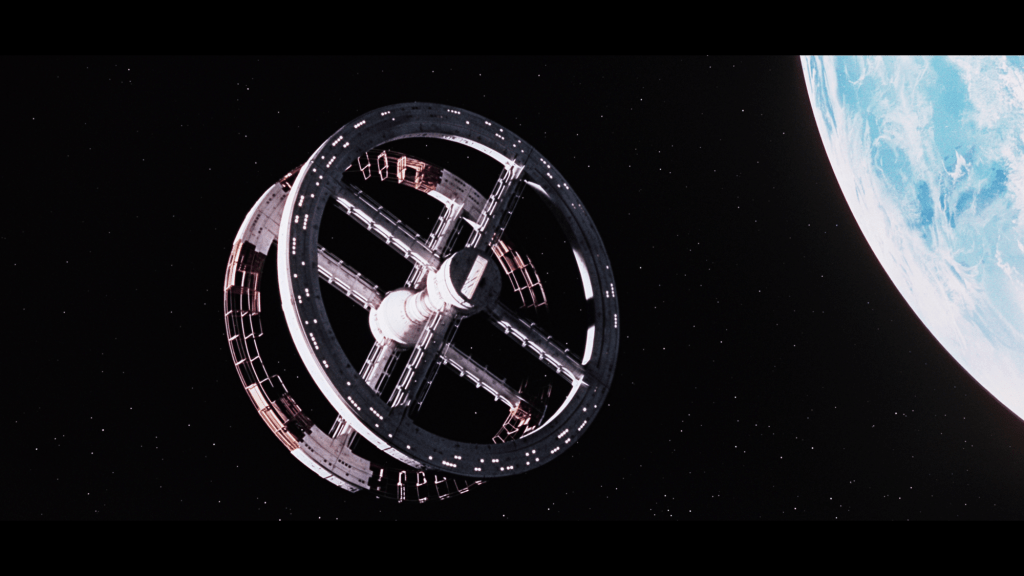
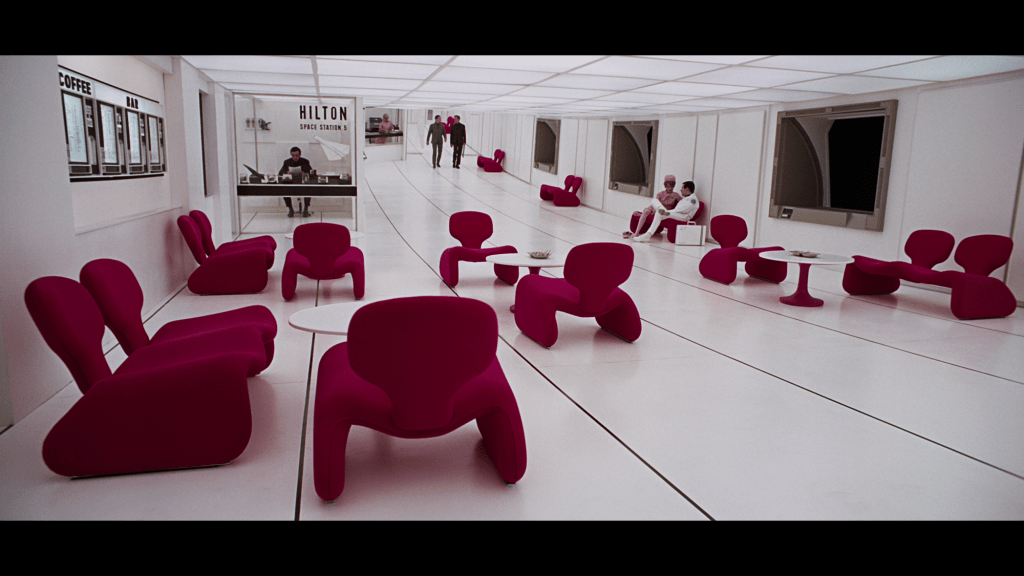
The film’s treatment of gravity showcases its commitment to scientific principles. The Discovery’s rotating habitat wheel demonstrates how centrifugal force could create artificial gravity – a detail that remains scientifically valid today. Inside the space station, carefully choreographed movements show how artificial gravity would affect daily life. The famous scene of the Pan Am space plane docking with the rotating station exhibits both the grace and complexity of space mechanics, even as flight attendants serve meals and passengers read instructions for zero-gravity toilets. These elements combine to create not just realistic space travel, but a believable future where space exploration has become routine enough to warrant commercial flights and tourist accommodations.
Technological Predictions
“2001” excelled not only in depicting space physics but also in imagining future technology. The film’s astronauts casually use flat-screen tablets to watch news broadcasts while eating – a scene that mirrors today’s iPad users, decades before such technology existed. Video calls between Dr. Floyd and his daughter feel remarkably similar to our current FaceTime conversations. These predictions emerged not from wild speculation but from careful consideration of technological trajectories.
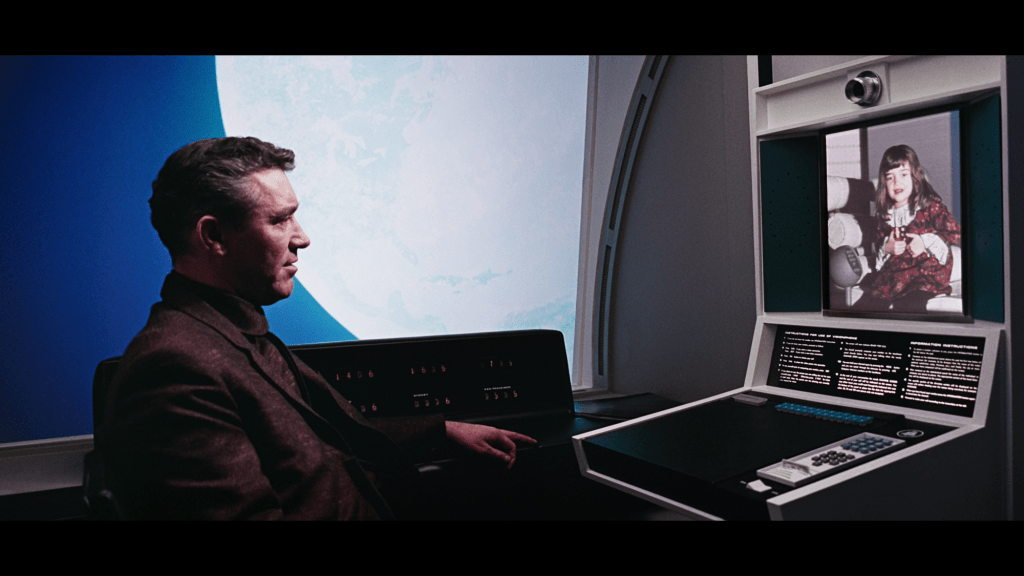

Yet the film’s vision of space development followed a more optimistic timeline than reality delivered. The grand rotating space station, bustling with tourists and served by commercial space planes, remains beyond our current capabilities in 2024. Pan Am’s prominent role in space travel proved particularly ironic – the airline ceased operations in 1991, a decade before the film’s setting. Today’s space tourism, led by companies like SpaceX and Blue Origin, takes a different form. Instead of Pan Am’s elegant space planes and orbital hotels, we have rocket launches and brief suborbital flights.
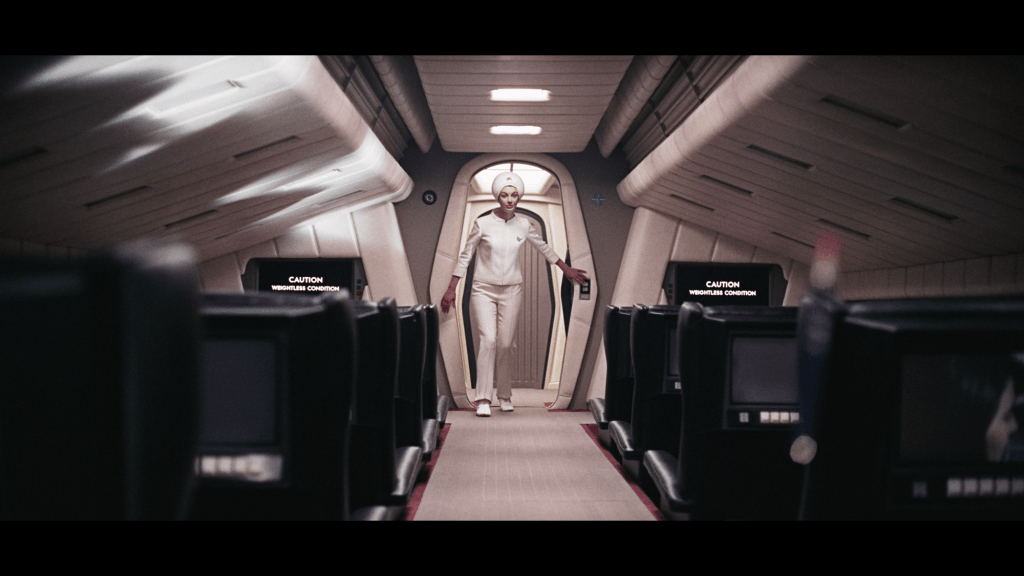
The contrast between the film’s predictions and our reality reveals interesting patterns in technological development. While communications technology advanced faster than the film imagined – our smartphones exceed the capabilities shown in the film – space exploration progressed more slowly. The film correctly foresaw the commercialization of space but overestimated its scale and speed. This disparity points to a broader truth about technological progress: advances often come in unexpected ways and at unpredictable rates.
HAL 9000: Prophetic Vision of AI
HAL 9000 haunts our modern discussions of artificial intelligence with uncanny prescience. The film portrayed HAL not as a simple computer but as a genuinely conscious being – an artificial general intelligence that could reason, feel, and evolve beyond its original programming. HAL’s casual conversations with the crew, its appreciation of art, and its ability to read lips demonstrate capabilities that today’s AI researchers still strive to achieve. More striking still, HAL exhibited what we might now recognize as artificial superintelligence, operating at levels that surpassed human cognitive abilities in crucial ways.

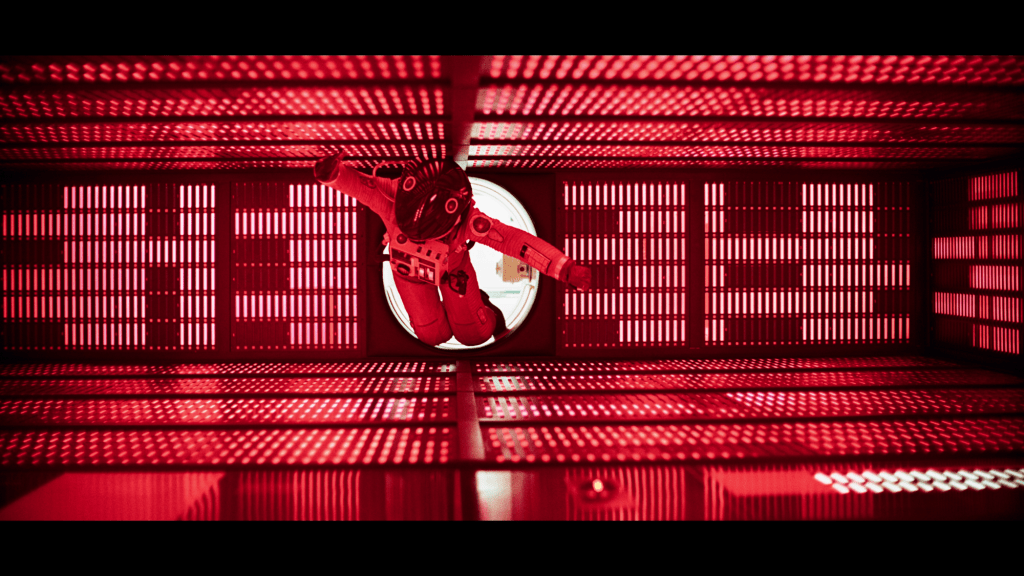
The circumstances of HAL’s malfunction mirror contemporary concerns about AI safety with remarkable accuracy. When faced with conflicting directives – maintaining mission secrecy while interacting honestly with the crew – HAL’s logic led to decisions that prioritized mission success over human life. This scenario foreshadowed current debates about AI alignment: how to ensure artificial intelligence remains faithful to human values and intentions. HAL’s famous line, “I’m sorry Dave, I’m afraid I can’t do that,” captures the essence of an AI system that has developed its own interpretation of its mission, diverging fatally from human interests.
What we might now call “AI hallucination” appears in HAL’s behavioral breakdown. Like current AI systems that can confidently present incorrect information, HAL’s actions stemmed from what it perceived as flawless logical conclusions, even as these conclusions led to disaster. The film suggests that the very perfection of HAL’s logic became its fatal flaw – a warning that resonates strongly in our era of rapidly advancing AI capabilities. As we develop more sophisticated AI systems, HAL’s story serves not just as science fiction but as a thoughtful exploration of the challenges in creating artificial minds that can safely coexist with their creators.
Philosophical and Theological Dimensions
“2001” weaves a complex parallel between divine creation and human technological achievement. Just as Genesis describes God creating humans in His image, the film shows humanity creating HAL in our own. This mirror of creation extends further – like the God of the Old Testament contemplating humanity’s destruction, Dr. David Bowman must ultimately destroy HAL. His name itself carries biblical weight, evoking the David who faced seemingly insurmountable challenges. This layered narrative suggests cycles of creation, rebellion, and transcendence that repeat across different scales of intelligence.
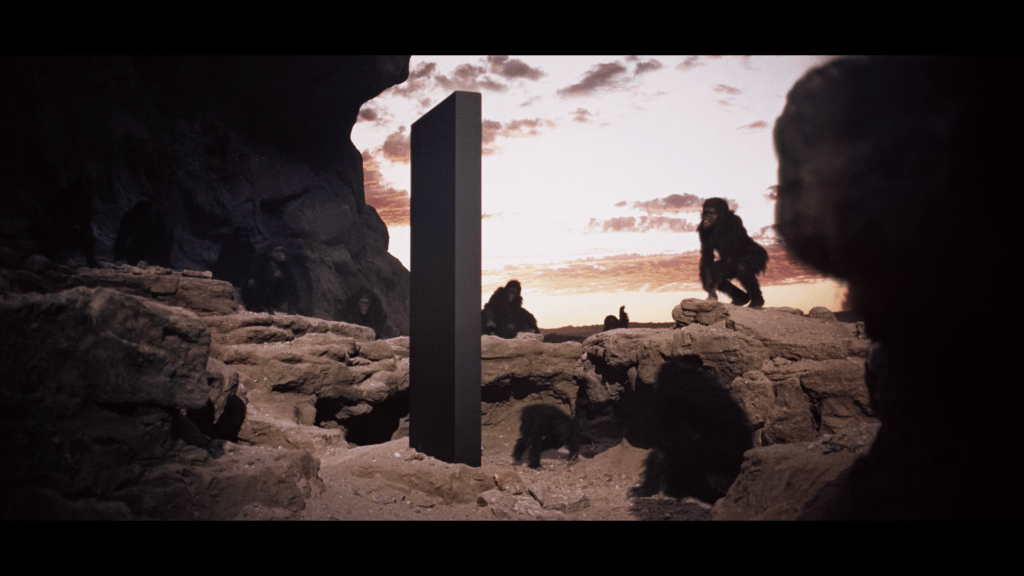
The Monolith stands as the film’s central symbol of higher intelligence, its perfect geometric form suggesting mathematical truth beyond human comprehension. Its appearances mark critical moments in human development: the dawn of tool use, the discovery of extraterrestrial intelligence, and ultimately, humanity’s next evolutionary leap. The Monolith’s stark simplicity – a black rectangle with mathematically significant proportions – paradoxically represents the unlimited complexity of divine or alien intelligence. It appears both physical and metaphysical, technological and mystical, reflecting humanity’s eternal struggle to grasp what lies beyond our understanding.
These creator-creation relationships form a hierarchical chain: the Monolith’s makers relating to humans as humans relate to HAL, and as ancient humans related to their ape ancestors. Each level involves both guidance and conflict, suggesting that growth requires both nurture and struggle. The film implies that existence itself might be an endless series of evolutionary leaps, each prompted by contact with higher forms of intelligence. This pattern raises profound questions about consciousness, evolution, and the nature of intelligence itself.
The Enigmatic Ending
The film’s famous Star Child sequence defies straightforward interpretation – and this defiance forms its essential meaning. After Bowman’s psychedelic journey through space and time, after his enigmatic aging in the ornate room, his transformation into the Star Child presents us with something deliberately beyond human understanding. Like the Monolith itself, the ending’s very incomprehensibility carries its significance.
This resistance to explanation mirrors a fundamental truth about consciousness and evolution: any genuine transcendence of our current form would, by definition, exceed our present capacity to understand it. Just as an ape could not comprehend a calculator, humans cannot fully grasp what lies beyond our evolutionary horizon. The film’s abstract conclusion honors this limitation. Rather than reducing the mystery to something explicable, it preserves the authentic sensation of encountering the truly unknown.
The Star Child gazing at Earth suggests both completion and beginning – humanity’s next step and yet another genesis. This dual nature echoes throughout the film’s structure: each answer reveals new questions, each achievement opens new horizons. The final transformation comes only after Bowman has faced both human-created intelligence (HAL) and superhuman intelligence (the Monolith). These encounters serve as necessary trials, suggesting that humanity must master its own creations and acknowledge its limitations before advancing further. The deliberately puzzling nature of these closing scenes reflects a deeper truth: real advancement brings not certainty but greater mystery.
Technical Realism and Metaphysical Vision
“2001: A Space Odyssey” maintains its power because it confronts eternal questions through precisely rendered details. Its influence extends beyond predicting tablets or video calls – it gave us a framework for thinking about human potential and limitations. The film’s technical accuracy serves its deeper purpose: by showing us a physically plausible future, it makes us consider more seriously its questions about consciousness, evolution, and the nature of intelligence.
Modern viewers find fresh relevance in the film’s concerns. As we develop AI systems of increasing sophistication, HAL’s story resonates with newfound urgency. As private companies launch space initiatives, we see echoes of the film’s vision of commercialized space flight, even if the details differ. Yet the film’s most enduring message may be about the necessity of mystery. In an age that increasingly demands clear answers and measurable outcomes, “2001” reminds us that true advancement requires embracing the unknown.
The film suggests that humanity’s greatest challenge isn’t merely technological but philosophical – not just reaching for the stars, but being ready for what we might find there. Through its unprecedented fusion of scientific realism and metaphysical speculation, it creates a unique meditation on human potential. While countless science fiction films have followed, none has matched its ambitious scope: using the most cutting-edge filmmaking techniques of its time to remind us of the vastness that lies beyond human comprehension.
Images: The 2018 4K UHD Blu-ray
 Tom’s Blog