
In his seminal work “The Birth of Tragedy,” Friedrich Nietzsche explored the tension between two fundamental creative principles in Greek culture: the Apollonian and the Dionysian. Apollo, the god of light, reason, and order, represented the measured, rational aspects of art and life. In contrast, Dionysus, the god of wine, ecstasy, and revelry, embodied the chaotic, passionate, and transformative elements of existence. This dichotomy, Nietzsche argued, was not just a matter of artistic preference but a fundamental tension in human nature and culture.
As we reflect on the controversy surrounding the opening ceremony of the Paris 2024 Olympic Games, Nietzsche’s insights provide a compelling framework for understanding the clash between artistic vision and public reception. The choice to feature Dionysus, rather than the more traditionally Olympic-associated Apollo, set the stage for a modern reenactment of this ancient cultural tension.
The decision to center the ceremony around Dionysus was bold and provocative, echoing the god’s own nature. It challenged viewers to embrace the chaotic, transformative spirit that Dionysus represents – a spirit of breaking boundaries, challenging norms, and celebrating the full spectrum of human experience. Yet, as we will explore, this choice also invited misunderstanding and controversy, demonstrating the enduring power of mythological symbols to stir deep-seated cultural and religious sensitivities.
The Vision Behind the Vines
The artistic team behind the Paris 2024 opening ceremony, led by director Thomas Jolly, envisioned a spectacle that would blend ancient mythology with contemporary French values. Their choice of Dionysus was far from arbitrary. As the mythological father of Sequana, the goddess of the River Seine, Dionysus provided a unique connection between Greek mythology and the Parisian landscape where the ceremony would unfold.
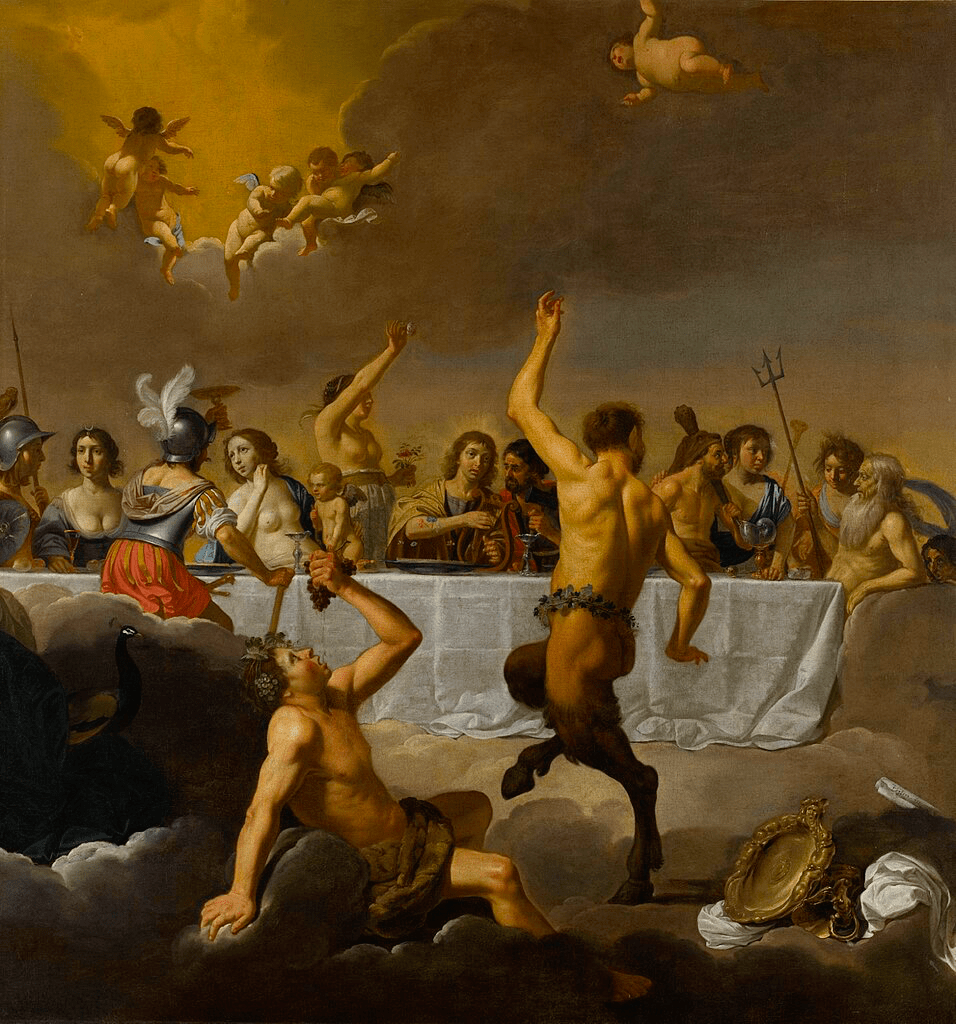
Moreover, the organizers saw in Dionysus a symbol of diversity, inclusivity, and the joie de vivre that Paris is famous for. They aimed to create what Jolly described as “a big pagan party in link with the God of Mount Olympus,” drawing inspiration from classical artworks like Jan van Bijlert’s “The Feast of the Gods.” This approach sought to celebrate not just athletic achievement, but the full range of human expression and identity.
The performance featured a diverse cast, including drag queens and transgender models, embodying the organizers’ commitment to representing modern French society in all its variety. As Jolly explained, “In France, we’re allowed to love who we want, how we want. In France, we can believe or not believe. In France, we have a lot of rights, and I wanted to convey those values throughout the ceremony.” This vision of Dionysus as a patron of freedom and diversity aligned with the Olympic ideals of international cooperation and understanding, while also making a bold statement about contemporary French values.
The Road Not Taken: Imagining Apollo’s Reign
In light of the controversy that erupted, it’s worth considering how the ceremony might have unfolded had Apollo been chosen as the central figure instead. Apollo, with his associations with athleticism, music, and enlightenment, seems at first glance a more natural fit for the Olympic Games. His imagery is deeply woven into Olympic tradition, from the laurel wreaths of victory to the ideal of physical and mental perfection that athletes strive for.
An Apollo-centered ceremony might have emphasized themes of harmony, reason, and the pursuit of excellence. It could have drawn on a rich tradition of artistic depictions that are less likely to intersect with religious sensitivities. The god of light and knowledge could have served as a powerful symbol for the enlightening power of international sporting events, fostering understanding between nations through friendly competition.
However, choosing Apollo might have also limited the organizers’ ability to present their intended message of diversity and modern French values. Apollo’s ordered, rational nature doesn’t lend itself as readily to challenging societal norms or celebrating the full spectrum of human identity. The Dionysian approach, for all its controversy, allowed for a more diverse and inclusive representation that aligned with the organizers’ vision of showcasing contemporary French society in all its complexity.
The Last Supper Controversy
The most heated controversy surrounding the ceremony stemmed from a scene that many viewers interpreted as a mockery of Leonardo da Vinci’s “The Last Supper.” This perception led to accusations of anti-Christian sentiment and disrespect for religious symbols. The French Bishops’ Conference condemned the ceremony for including “scenes of mockery and derision of Christianity,” while political figures and religious leaders worldwide expressed their disapproval.
However, the organizers maintained that the scene was inspired by pagan celebrations and Greek mythology, particularly the feasts of Dionysus, rather than Christian imagery. The similarity to “The Last Supper” was, they argued, coincidental – an unintended resonance between different cultural depictions of communal meals. This explanation, however, did little to quell the outrage of those who saw deliberate mockery in the performance.
The intensity of the reaction highlights the enduring power of religious symbolism in our global culture. It also demonstrates the challenges of reinterpreting ancient myths and symbols in a modern context, where multiple cultural and religious traditions intersect and sometimes clash. The controversy serves as a reminder of the need for sensitivity and clear communication when dealing with imagery that might be interpreted through different cultural lenses.
Commercialization of the Olympics
The controversy surrounding the opening ceremony also brings into focus the broader issue of the commercialization of the Olympic Games. On one hand, the massive scale and global reach of the modern Olympics require substantial financial resources, which commercialization helps to provide. Corporate sponsorships and media rights deals fund not only the spectacular ceremonies but also the infrastructure and organization necessary to host thousands of athletes from around the world.
However, this commercialization also brings pressures that can conflict with the original spirit of the Games. The need to appeal to a global audience and satisfy corporate sponsors can lead to a homogenization of cultural expression, potentially diluting the unique character of each host nation’s contribution. It can also create tension between artistic expression and the need to avoid controversy that might alienate viewers or sponsors.
In the case of the Paris 2024 opening ceremony, we saw this tension play out in real-time. The backlash led to some businesses, such as C Spire in Mississippi, withdrawing their advertisements from Olympic broadcasts. This response highlights the delicate balance that organizers must strike between creative vision and commercial viability. It also raises questions about the role of corporate influence in shaping cultural expressions on a global stage.
Lessons from Dionysus’s Dance
The controversy surrounding the Paris 2024 Olympic opening ceremony offers valuable lessons for future organizers of global events. It demonstrates the power of mythological symbols to evoke strong reactions and the need for careful consideration of how these symbols might be interpreted across different cultural contexts. At the same time, it highlights the importance of artistic courage in addressing contemporary issues and representing diverse perspectives.
Perhaps the most significant lesson is the need for balance – between tradition and innovation, between artistic vision and public sensibility, between celebration of host culture and respect for global diversity. The Olympic Games, at their best, serve as a forum for cultural exchange and mutual understanding. Achieving this ideal requires not just athletic excellence, but also artistic and organizational wisdom.
As we move forward, the challenge will be to create ceremonies that can inspire, unite, and provoke thought without alienating significant portions of the global audience. This may require new approaches to communication and community engagement, ensuring that artistic choices are explained and contextualized effectively. It may also call for a reimagining of how we use ancient symbols and myths to speak to contemporary realities.
The dance of Dionysus at the Paris 2024 Olympics, with all its controversy and complexity, may serve as a catalyst for important conversations about art, culture, religion, and the evolving meaning of the Olympic Games in our globalized world. Like Dionysus himself, it has the power to transform – not through uniform agreement, but through the creative tension of diverse perspectives coming together on a global stage.
Image: Le Festin des Dieux (“The Feast of the Gods”) by Jan van Bijlert around 1635–1640.
 Tom’s Blog